
Insights
Multilingual Safety Meetings: How On-Site Interpreters Reduce Workplace Injuries in Indiana Factories
Published May 4, 2026 · By Stephen Gardner
Quick Summary
• Indiana manufacturing facilities with diverse workforces face elevated injury risk when safety training isn't fully understood.
• Certified on-site interpreters bridge the communication gap during OSHA safety meetings, equipment orientations, and emergency drills.
• Federal law (OSHA's General Duty Clause) requires employers to communicate hazard information in a language workers understand.
• Heartland Interpretation & Translation Services provides vetted, industry-trained interpreters across Evansville, Henderson KY, and the entire Tri-State region.
• This post explains how multilingual safety meetings work — and why on-site interpreters outperform apps, bilingual supervisors, and machine translation.
Every year, thousands of American workers are injured or killed in manufacturing accidents. A significant number of those injuries share a preventable root cause: the worker didn't fully understand the safety instructions they were given.
In the Tri-State region — spanning southwest Indiana, northwest Kentucky, and southeast Illinois — manufacturing is the economic backbone. Automotive assembly, food processing, aluminum production, plastics fabrication, and distribution operations employ tens of thousands of workers. Many of those workers speak Spanish, Marshallese, Haitian Creole, Burmese, or other languages as their primary tongue.
When safety training happens only in English, the consequences are predictable: confusion during emergency drills, misunderstood lockout/tagout procedures, incorrect use of PPE, and preventable injuries. OSHA knows this. Federal courts know this. And increasingly, Indiana manufacturers are beginning to understand it too.
The solution isn't an app. It isn't a bilingual coworker pulled off the line to translate. It's a certified, industry-trained interpreter — present in person, at your facility, for your safety meeting.
This guide explains exactly how multilingual safety meetings work, why they matter legally and morally, and how Heartland Interpretation & Translation Services (/industries) helps Tri-State manufacturers build safer, more compliant workplaces.
## The Legal Foundation: OSHA's Language Access Requirements
Let's start with the law — because this isn't just a best practice. It's a compliance obligation.
OSHA's General Duty Clause (Section 5(a)(1) of the OSH Act) requires employers to provide a workplace "free from recognized hazards." Courts and OSHA enforcement guidance have consistently interpreted this to mean that safety instructions, warnings, and hazard communications must be provided in a language workers understand — or the employer has failed to provide a hazard-free workplace.
Beyond the General Duty Clause, OSHA's Hazard Communication Standard (HazCom / 29 CFR 1910.1200) requires that workers be trained to understand safety data sheets (SDS) and chemical labeling. The standard explicitly anticipates multilingual training scenarios. Similarly, OSHA's PPE standards, lockout/tagout rules, and confined space entry regulations all require effective training — which regulators interpret as training in a language the worker actually comprehends.
OSHA has cited employers for inadequate safety training specifically because it was conducted only in English when workers spoke other languages. Fines can reach $15,625 per willful violation. More importantly, a worker who dies or is seriously injured because safety training was inaccessible to them creates catastrophic liability exposure for the employer.
The takeaway is clear: if your safety meetings aren't reaching every worker in a language they understand, you are not in compliance — and you are at risk.
## Why Bilingual Supervisors and Apps Fall Short
Many Tri-State manufacturers attempt to solve the multilingual safety challenge with two workarounds: pulling a bilingual employee to translate, or relying on machine translation apps. Both approaches are inadequate — and can actually create additional liability.
### The Bilingual Supervisor Problem
Using a bilingual supervisor or coworker as an interpreter seems logical and cost-effective. In practice, it creates several serious problems:
• No professional training: Being bilingual doesn't mean being an interpreter. Professional interpretation requires simultaneous or consecutive rendering of technical content with precision. A bilingual supervisor may understand general conversation but struggle with OSHA terminology, chemical safety terms, or equipment-specific procedures.
• Role conflict: A supervisor asked to interpret while also managing their own responsibilities will make compromises. Accuracy suffers.
• Liability transfer: If the interpretation is inaccurate and a worker is injured, the employer cannot claim the training was adequate simply because a bilingual employee was present.
• Worker reluctance: Employees may not ask clarifying questions or report concerns when the interpreter is also their supervisor or a coworker they interact with daily.
### Why Machine Translation Apps Don't Work on the Factory Floor
Apps like Google Translate have improved dramatically — but they remain fundamentally unsuited for high-stakes industrial settings:
• Technical vocabulary (OSHA terms, equipment-specific language, SDS chemistry) is mistranslated more often than general conversation.
• Factory floors are noisy. Voice-based translation tools fail completely.
• Apps cannot handle the back-and-forth of a live safety meeting — questions, clarifications, demonstrations.
• Machine translation is not acceptable evidence of compliant safety training under OSHA enforcement standards.
The only reliable solution for consequential safety training is a certified professional interpreter — someone whose entire focus is accurate, real-time language access for your workers.
## What Certified On-Site Interpreters Do in a Manufacturing Safety Meeting
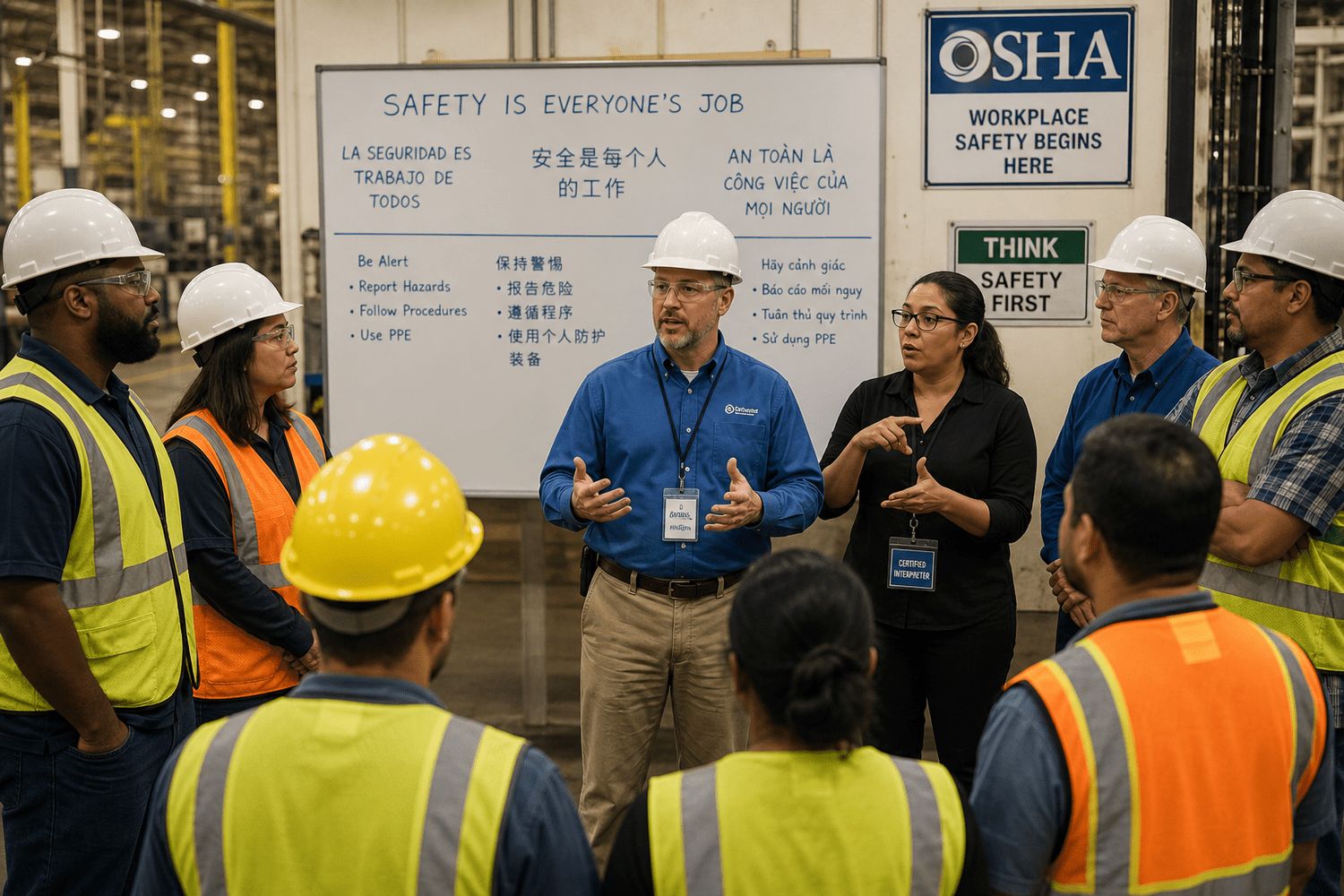
When Heartland sends a certified interpreter to your facility for a safety meeting, here's what actually happens:
### Pre-Meeting Preparation
A good interpreter doesn't walk in cold. Heartland's manufacturing interpreters receive materials in advance when possible — the safety agenda, any new SDS sheets, equipment manuals, or policy updates being covered. This preparation ensures terminology is accurate and the interpreter is ready to handle technical content without hesitation.
### Consecutive Interpretation During the Meeting
In most manufacturing safety meeting formats, consecutive interpretation works best: the safety trainer speaks a few sentences, then pauses while the interpreter delivers the same content in the workers' language. The interpreter maintains eye contact with the workers, monitors comprehension, and flags confusion to the trainer.
For larger facilities with multiple language groups, Heartland can coordinate multiple interpreters to run concurrent language tracks in separate rooms or sections, with training materials synchronized across all groups.
### Live Q&A Facilitation
One of the most valuable functions of an on-site interpreter is enabling genuine two-way communication. Workers who didn't understand a procedure, who have a safety concern, or who want to report a near-miss can communicate directly through the interpreter — in real time, without the filter of a bilingual supervisor who may discourage difficult questions.
This is not a minor detail. OSHA's enforcement philosophy specifically values worker participation in safety programs. Interpreters make that participation possible across language barriers.
### Emergency Drill Interpretation
Emergency evacuation drills, shelter-in-place procedures, and emergency shutdown sequences must be understood by every worker on the floor. An interpreter during a drill doesn't just translate the announcement — they help workers understand exactly what to do, where to go, and what each alarm means. That institutional knowledge can save lives in an actual emergency.
## Key Scenarios Where On-Site Interpreters Are Critical
Not every manufacturing communication challenge requires an interpreter. But certain scenarios carry enough consequence that professional interpretation is non-negotiable:
### New Employee Onboarding
The first days on a factory floor are statistically the most dangerous. New workers who don't fully understand machine guarding rules, PPE requirements, or emergency procedures are at the highest risk. An interpreter at onboarding ensures nothing is lost in translation during the moment it matters most.
### Equipment Introduction and Operator Training
When new machinery is installed or existing equipment is reconfigured, training for operators and adjacent workers must be thorough. A certified interpreter working alongside your equipment trainer ensures that lockout/tagout procedures, pinch point warnings, and operational sequences are fully understood before production begins.
### Injury and Near-Miss Investigations
When an injury occurs, OSHA may investigate. Your internal investigation will require witness statements and a clear account of what happened. If the workers involved are non-English speakers, a certified interpreter is essential — both for accuracy and to ensure workers feel comfortable sharing what they observed without fear of miscommunication.
### Policy and Handbook Updates
Changes to attendance policies, safety protocols, or employee rights must be communicated clearly to all workers. Heartland also provides certified document translation services (/services) to convert employee handbooks, safety manuals, and SOP documents into the languages your workforce speaks.
### Union Meetings and Worker Advocacy
In unionized manufacturing environments, workers have the right to participate in union meetings and understand collective bargaining agreements. Interpreters ensure those rights aren't diminished by language barriers.
## Languages Heartland Supports for Manufacturing Clients
Heartland serves manufacturing clients across the Tri-State region with interpreters in over 350 languages. The most commonly requested languages in Indiana and Kentucky manufacturing settings include:
• Spanish — the most widely requested language across virtually all manufacturing sectors in the Tri-State region
• Marshallese — a significant community in southwest Indiana, particularly in food processing and distribution
• Haitian Creole — growing presence in Evansville and Henderson manufacturing facilities
• Burmese and Karen — including Sgaw Karen and Pwo Karen dialects, increasingly present in Indiana manufacturing
• Portuguese (Brazilian) — present in automotive manufacturing and metalworking facilities
• Arabic — various dialects, present in plastics and logistics operations
• Somali — food processing and warehouse distribution environments
If your facility has workers who speak a language not listed here, contact Heartland. With 350+ language coverage, the answer is almost certainly yes — we can help.
## The ROI of Multilingual Safety Training
Some manufacturers hesitate when they see the cost of professional interpretation services. That hesitation disappears quickly when measured against the actual cost of workplace injuries and OSHA violations.
According to the National Safety Council, the average cost of a medically consulted workplace injury in 2024 was over $40,000 — including medical costs, lost productivity, and administrative burden. A single serious injury or fatality can cost a facility millions of dollars in workers' compensation claims, legal fees, OSHA fines, and reputation damage.
The cost of a certified interpreter for a four-hour safety training session is a fraction of the cost of a single preventable injury. For most manufacturers, the calculation isn't difficult.
Beyond the financial case, there's a workforce retention argument. Workers who feel valued, understood, and safe are more productive and more loyal. Multilingual safety meetings signal to your workforce that you take their wellbeing seriously — regardless of what language they speak. That signal matters in a tight labor market where experienced manufacturing workers are difficult to replace.
## Heartland's Manufacturing Interpretation Services: What's Available
Heartland offers industry-specific interpretation (/aluminum-manufacturing) tailored to the specific needs of Tri-State manufacturers:
• On-site interpretation: Certified interpreters dispatched to your facility in Evansville, Henderson, Louisville, Jasper, Owensboro, or anywhere in the Tri-State region
• Video Remote Interpretation (VRI): For spontaneous interpretation needs on the factory floor — injury consultations, HR conversations, equipment questions — using secure, HIPAA-standard video platforms
• Over-the-Phone Interpretation (OPI): 24/7 emergency language access for urgent situations
• Document translation: Certified translation of safety manuals, OSHA 300 logs, employee handbooks, SDS sheets, SOPs, and more into the languages your workers read
• Scheduled safety meeting support: Recurring interpretation coverage for weekly toolbox talks, monthly safety reviews, and annual OSHA-required training programs
All Heartland interpreters working in manufacturing environments are vetted, background-checked, and trained in industrial vocabulary and OSHA terminology. They arrive prepared, professional, and ready to integrate seamlessly into your safety culture.
## Frequently Asked Questions
### How far in advance do I need to schedule an on-site interpreter for a safety meeting?
For planned events like quarterly safety training or new equipment orientations, Heartland recommends scheduling at least 5–7 business days in advance to ensure the right interpreter with manufacturing experience is assigned. For urgent needs, Heartland offers same-day and next-day service in most Tri-State locations.
### Can one interpreter handle multiple languages in the same safety meeting?
No — an interpreter is certified in a specific language pair. If your workforce speaks Spanish and Marshallese, you need two separate interpreters. Heartland can coordinate multiple interpreters for a single training event and manage logistics across language groups.
### Does OSHA require that safety training be documented in multiple languages?
OSHA requires that training be documented and that it was conducted in a manner workers understood. Best practice — and increasingly the legal standard — is to document what language each worker was trained in and confirm comprehension was verified. Heartland can provide certificates of interpretation service to support your compliance documentation.
### Is VRI (video remote interpretation) acceptable for factory floor safety meetings?
VRI can work for small group or one-on-one conversations in a relatively quiet setting. For full safety meetings with multiple workers, live demonstrations, or noisy environments, on-site interpretation is strongly preferred. Heartland will help you choose the right modality for each scenario.
### What languages are available for document translation of safety manuals?
Heartland provides certified document translation in 350+ languages. Safety manuals, SDS sheets, employee handbooks, lockout/tagout procedures, and emergency response plans are all common translation requests. Translated documents are certified accurate by a credentialed linguist.
### Can Heartland provide interpretation for OSHA inspections or investigations?
Yes. Heartland provides certified interpretation for OSHA walkthroughs, worker interviews, and incident investigations. Having a neutral, certified interpreter — rather than a company employee — is strongly recommended when OSHA investigators are present and speaking with workers.
## Building a Safer, More Inclusive Manufacturing Floor
Multilingual safety meetings are not an accommodation for the few — they are a foundational element of responsible manufacturing operations in a diverse workforce environment. The Tri-State region's manufacturing sector is built on workers from dozens of countries and language backgrounds. Those workers deserve the same access to safety information, the same ability to ask questions, and the same protection from preventable harm as any English-speaking colleague.
Heartland Interpretation & Translation Services exists to make that equity real — not in a compliance checkbox sense, but in the practical, floor-level reality of whether every worker on your team understands what to do in an emergency, how to operate their equipment safely, and how to report a hazard without fear of miscommunication.
If you're ready to make your safety meetings truly multilingual, we're ready to help. Serving Evansville, Henderson, Louisville, Jasper, Owensboro, and the entire Tri-State region — Heartland is your local partner for professional manufacturing interpretation.
Contact Heartland Language Services today — call (812) 499-1696 or get a free quote online (/quote) to schedule your first multilingual safety meeting.
About the author
Stephen Gardner
Stephen Gardner shares practical guidance from Heartland Language Services on clear, reliable communication for multilingual workplaces.
Keep reading
Related articles
January 2, 2026
Multilingual Safety: Reducing Workplace Injuries in Southwest Indiana Factories
Read article →July 6, 2026
Manufacturing Interpreter Indiana: Protecting Workers Through Language Access
Manufacturing interpreter services help Indiana employers reduce safety risk, improve HR communication, and support multilingual teams across Evansville, Henderson, Louisville, Jasper, and Southeast Illinois.
Read article →July 27, 2026
Multilingual Incident Reporting Indiana: A Manufacturing Guide
When a safety concern, injury, near miss, or equipment issue must be reported, every employee needs a practical way to speak up and be understood. This guide helps Tri-State manufacturers plan language support before an incident occurs.
Read article →