
Insights
Safety Data Sheet Translation for Indiana Manufacturers: OSHA HazCom Compliance and the Multilingual Workforce
Indiana manufacturers with multilingual workforces must provide OSHA HazCom-compliant Safety Data Sheets in every language their employees speak. Learn how certified SDS translation keeps your facility compliant with 29 CFR 1910.1200, GHS standards, and OSHA penalty thresholds — and how Heartland serves the Tri-State region.
Published June 26, 2026 · By Jacob Brown

Quick Summary
OSHA's Hazard Communication Standard (29 CFR 1910.1200) requires that Safety Data Sheets be provided in a language workers can understand.
Indiana manufacturers with Spanish, Burmese, Karen, Somali, Arabic, and other language speakers face significant compliance risk when SDS documents are English-only.
Certified translation of all 16 GHS sections — including H-statements and P-statements — requires trained chemical translators, not general interpreters or machine translation tools.
OSHA penalties for HazCom violations range from $16,550 (per serious violation) to $165,514 (per willful or repeat violation).
Heartland Interpretation & Translation Services provides certified SDS and chemical documentation translation for manufacturers across Southwest Indiana and the Tri-State region.
Every morning, workers on Indiana manufacturing floors handle hazardous chemicals — solvents, acids, coatings, lubricants, and cleaning agents. Their safety depends on one thing: being able to read and understand the Safety Data Sheet (SDS) for every substance they touch.
For facilities with a multilingual workforce, that understanding breaks down the moment an SDS is only available in English. A worker who speaks Spanish, Burmese, or Somali as their primary language cannot be expected to navigate a 16-section technical document in a language they don't fully read. And under federal law, your facility is responsible for ensuring they can.
This post walks through exactly what OSHA requires for SDS translation, what makes SDS translation uniquely difficult, and how Indiana manufacturers can stay compliant while protecting their workers.
What OSHA's Hazard Communication Standard Requires
OSHA's Hazard Communication Standard — commonly called HazCom 2012, codified at 29 CFR 1910.1200 — is the federal rule that governs how employers must communicate chemical hazards to workers. It was updated in 2012 to align with the Globally Harmonized System of Classification and Labelling of Chemicals (GHS), and it applies to virtually every manufacturing facility in the United States.
Under HazCom, employers must:
Maintain an SDS for every hazardous chemical in the workplace
Ensure SDSs are accessible to employees during their shifts
Train workers on how to read and use SDSs
Communicate hazard information in a language that employees understand
That last point is the critical one. OSHA's General Duty Clause (Section 5(a)(1) of the OSH Act) also requires that employers provide a workplace free from recognized hazards, and language barriers during chemical safety training are a recognized hazard.
OSHA has repeatedly cited employers for failing to communicate hazard information to non-English-speaking workers. The penalties are substantial: $16,550 per serious violation, and up to $165,514 per willful or repeat violation.
Indiana's Multilingual Manufacturing Workforce
Southwest Indiana and the broader Tri-State region — including Evansville, Henderson, KY, and Owensboro — have seen significant growth in multilingual manufacturing workers over the past two decades. The languages most commonly spoken in Indiana manufacturing settings include:
Spanish — the largest non-English manufacturing workforce in the state
Burmese and Karen — significant refugee communities in Indianapolis, Fort Wayne, and Evansville
Somali — large communities in Indianapolis and the surrounding areas
Haitian Creole — growing presence in manufacturing corridors
Arabic — across multiple dialect groups
Hindi, Punjabi, and Gujarati — particularly in pharmaceutical and precision manufacturing
For a facility in Vanderburgh County running three shifts with workers from four different language backgrounds, a single English-only SDS library represents a real and ongoing compliance exposure — as well as a genuine safety risk for your workers.
Why SDS Translation Is Different From General Translation

Safety Data Sheets are not general business documents. They are technical chemical documents with a precise 16-section structure mandated by GHS. Each section has specific formatting requirements, and many sections contain regulatory terminology that must be translated with exact fidelity.
The 16 GHS sections are:
Identification
Hazard(s) identification
Composition/information on ingredients
First-aid measures
Fire-fighting measures
Accidental release measures
Handling and storage
Exposure controls / personal protection
Physical and chemical properties
Stability and reactivity
Toxicological information
Ecological information
Disposal considerations
Transport information
Regulatory information
Other information
Two sections are especially critical from a compliance and safety standpoint: Section 2 (Hazard Identification) and Section 4 (First-Aid Measures). These sections contain H-statements (hazard statements) and P-statements (precautionary statements) — standardized GHS phrases with specific numeric codes.
For example, H314 means "Causes severe skin burns and eye damage." P260 means "Do not breathe dust/fume/gas/mist/vapors/spray." These statements have officially standardized translations in every GHS-aligned language, and a certified translator must use the correct official phrase — not a paraphrase or approximation.
This is why machine translation tools and general translators are not appropriate for SDS work. An error in Section 4 (first aid) or Section 8 (PPE requirements) could result in a worker mishandling a chemical exposure, with serious consequences for both the worker and the facility's liability.
Heartland's 7-Step SDS Translation Process
Document intake and assessment — We review the full SDS, identify the chemical family, and assign a translator with relevant subject matter expertise.
Terminology extraction — H-statements, P-statements, and regulated chemical names are flagged for controlled vocabulary matching against official GHS translation tables.
Translation by certified specialist — A professional translator with a chemistry or industrial safety background completes the initial translation, maintaining the full 16-section structure.
H/P-statement verification — All hazard and precautionary statements are cross-referenced against the official GHS Annex 3 tables for the target language.
Technical review — A second reviewer with manufacturing safety knowledge checks for accuracy, especially in Sections 2, 4, 7, 8, and 11.
Formatting and layout — The translated SDS is formatted to match the original document's structure, with all section headers, tables, and labeling preserved.
Certificate of translation — We provide a signed certificate of translation with each completed SDS for your compliance file.
Common SDS Translation Mistakes to Avoid
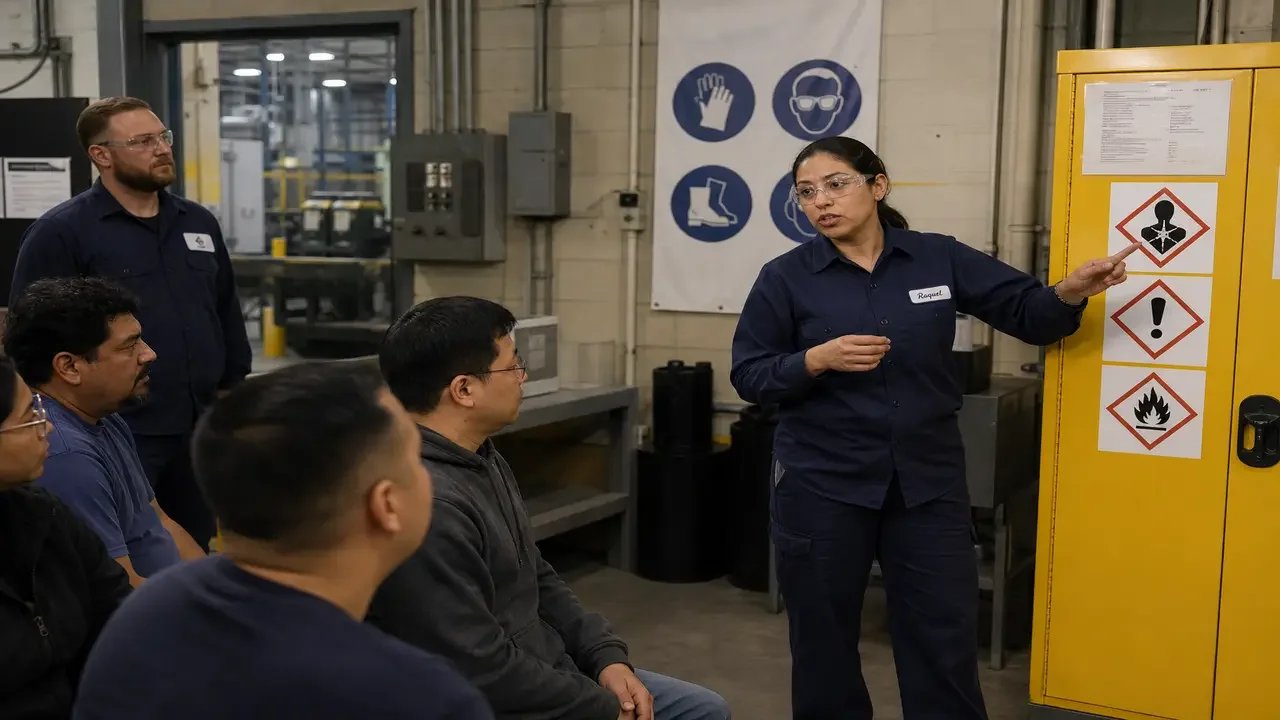
Based on our work with Indiana manufacturers, here are the most common mistakes facilities make when approaching SDS translation:
Using bilingual employees as translators. A bilingual employee may speak Spanish fluently but have no background in chemical safety terminology. Using them to translate SDSs exposes your facility to significant liability if a translation error contributes to an incident.
Relying on machine translation. Tools like Google Translate cannot match H-statements and P-statements to their official standardized translations, and they regularly mistranslate technical chemical terminology. OSHA does not consider machine-translated SDSs as compliant documentation.
Only translating Sections 1 and 2. Some facilities attempt a partial translation, assuming workers only need the identity and hazard sections. But emergency response, first aid, PPE requirements, and handling procedures are equally critical — and equally required to be understandable.
Not updating translated SDSs when the original changes. When a chemical supplier updates an SDS — which happens regularly due to formulation changes or new regulatory data — your translated versions must be updated as well.
Which Manufacturers Need SDS Translation?
If your Indiana facility meets any of the following criteria, SDS translation is not optional — it's a compliance requirement:
Any worker who performs hands-on tasks with or near hazardous chemicals speaks a language other than English as their primary language
Your facility has received OSHA HazCom citations in the past
You use staffing agencies that place non-English-speaking workers in chemical-adjacent roles
Your facility is subject to Process Safety Management (PSM) requirements under 29 CFR 1910.119
You manufacture or distribute products that require SDSs under REACH, GHS, or WHMIS standards
Industries in the Tri-State region where we most commonly see SDS translation needs include automotive parts manufacturing, food processing and packaging, plastics and injection molding, metal fabrication, agricultural chemical handling, and industrial cleaning products.
Frequently Asked Questions
Does OSHA specifically require translated SDSs, or just translated training?
OSHA's HazCom standard requires that employees be able to understand the hazard information on SDSs and labels. While the standard does not mandate a specific translated document format, OSHA inspectors look at whether non-English-speaking workers can actually access and understand SDS content. In practice, maintaining translated SDSs is the clearest way to demonstrate compliance.
Can we use one Spanish SDS for all our Spanish-speaking workers?
Generally, yes, for most manufacturing SDSs, standard Spanish (neutral/formal) is understood by workers from Mexico, Central America, and South America alike in a professional context. For some highly dialect-specific situations, we may recommend regionally adapted terminology, but this is rarely necessary for industrial SDS documents.
How long does it take to translate an SDS?
A standard single-product SDS (typically 10–15 pages) takes 2–3 business days for translation and review. Rush turnaround (24 hours) is available for urgent compliance situations. Larger batches of SDSs can be managed on a rolling project basis with agreed turnaround schedules.
What languages can Heartland translate SDSs into?
We provide certified SDS translation into Spanish, Burmese, Karen, Somali, Haitian Creole, Arabic, Hindi, Punjabi, Gujarati, and many other languages. Contact us to confirm availability for less common languages.
Do we need a certificate of translation for compliance purposes?
OSHA does not mandate a specific certification format, but maintaining a certificate of translation in your compliance file is a best practice that demonstrates good-faith compliance efforts. Heartland includes a signed certificate with every completed SDS translation project.
What if we have hundreds of SDSs that need translation?
We handle large-volume SDS translation projects regularly. We'll audit your current SDS library, prioritize by hazard severity and worker exposure frequency, and develop a phased translation schedule that fits your compliance timeline and budget.
Get a Quote for Your SDS Translation Project
Heartland Interpretation & Translation Services works with manufacturers across Evansville, Henderson, KY, Owensboro, and the broader Tri-State region. Whether you need one SDS translated or a complete library overhaul, we provide certified translations with full GHS H/P-statement compliance.
Our manufacturing translation team understands OSHA HazCom requirements, GHS formatting standards, and the multilingual workforce reality of Indiana's industrial sector. We don't just translate words — we deliver compliance-ready documents that protect your workers and your facility.
Ready to get started? Request a quote or learn more about our manufacturing language services. We also support food manufacturing and plastics manufacturing facilities throughout the region.

About the author
Jacob Brown
Jacob Brown shares practical guidance from Heartland Language Services on clear, reliable communication for multilingual workplaces.
Keep reading
Related articles
July 27, 2026
Multilingual Incident Reporting Indiana: A Manufacturing Guide
When a safety concern, injury, near miss, or equipment issue must be reported, every employee needs a practical way to speak up and be understood. This guide helps Tri-State manufacturers plan language support before an incident occurs.
Read article →June 12, 2026
On-Site Interpreters vs. Translation Apps: Why Indiana Manufacturers Can't Afford to Get This Wrong
Should Indiana hospitals use VRI or on-site interpreters? Learn when each modality meets Section 1557, HIPAA, and Joint Commission requirements — and how Heartland's hybrid model serves the Tri-State.
Read article →May 18, 2026
FSMA, OSHA, and Language Access: Why Indiana Food Manufacturers Can’t Afford Language Gaps
Indiana food manufacturers face FSMA and OSHA language access requirements. Learn why certified interpreters are essential for food safety compliance and worker protection.Indiana food manufacturers face FSMA and OSHA language access requirements. Learn why certified interpreters are essential for food safety compliance and worker protection.
Read article →