
Insights
Why Indiana Courts Require Certified Interpreters — And What Law Firms Need to Know
Published May 7, 2026 · By Jacob Brown
By The Heartland Team
Quick Summary
Indiana law requires certified interpreters for court proceedings involving limited English proficient (LEP) parties. For law firms in Evansville IN, Henderson KY, and Louisville KY, using uncertified or ad-hoc interpreters in legal settings can jeopardize case outcomes, expose your firm to liability, and violate federal Title VI obligations. This guide covers what legal professionals need to know — and how Heartland Interpretation & Translation Services supports the Tri-State legal community.
Language barriers in legal settings are not just an inconvenience — they are a fundamental barrier to justice. For the thousands of limited English proficient (LEP) residents living across Southwest Indiana, Northwest Kentucky, and Southeast Illinois, access to qualified legal interpretation is often the difference between a fair proceeding and a miscarriage of justice.
In recent years, Indiana courts, federal agencies, and state bar associations have tightened expectations around interpreter qualifications. Yet many law firms — particularly small and mid-size practices in the Tri-State region — still rely on bilingual staff, family members, or unvetted freelancers to bridge language gaps in depositions, client consultations, and courtroom proceedings.
That approach carries serious risk. Here's what every attorney, paralegal, and court administrator in Indiana needs to know about certified legal interpretation requirements.
What Indiana Law Says About Court Interpreters
Indiana has formalized its commitment to language access in judicial proceedings. Under Indiana Code § 34-45-1, courts are required to provide competent interpreters for parties and witnesses who are unable to adequately communicate in English. The Indiana Supreme Court also provides certification for court interpreters through its Indiana Court Interpreter Certification Program, which evaluates interpreters across oral and written proficiency standards.
Federally, Title VI of the Civil Rights Act of 1964 prohibits discrimination on the basis of national origin in any program receiving federal funds — which includes courts and most legal aid organizations. The Department of Justice has consistently interpreted Title VI to require meaningful language access for LEP individuals, and failure to provide qualified interpreters can trigger civil rights complaints or the loss of federal funding.
For law firms and attorneys representing LEP clients, these obligations extend beyond the courtroom itself. Depositions, client intake meetings, written pleadings, and evidence review all fall within the scope of language access responsibilities.
The Difference Between "Bilingual" and "Certified"
One of the most persistent myths in the legal community is that a bilingual colleague or staff member can adequately serve as an interpreter in legal proceedings. The reality is far more complex.
Bilingual fluency is not legal interpretation. A certified legal interpreter must:
Possess advanced proficiency in both languages in a legal context
Understand procedural terminology: hearsay, subrogation, mens rea, voir dire, chain of custody
Interpret simultaneously or consecutively with precision — not summarizing, not paraphrasing
Maintain professional impartiality, avoiding any advocacy for either party
Adhere to strict codes of ethics, including confidentiality and conflict-of-interest disclosure
Document their qualifications and be subject to cross-examination on their credentials
An employee who grew up speaking Spanish at home — but has no formal interpreter training — may inadvertently omit key phrases, inject personal interpretation, or simply lack the legal vocabulary necessary for accurate interpretation. In a deposition or trial, that gap can sink a case.
Heartland's legal interpretation team consists of vetted, trained linguists who understand Indiana court standards and the specialized demands of legal proceedings. Our interpreters support over 350 languages and serve law firms throughout Evansville, Henderson, Louisville, and surrounding communities.
Key Areas Where Certified Interpreters Are Required (or Strongly Advised)
1. Court Hearings and Trials
Indiana courts require interpreters for any defendant, witness, or party who cannot adequately communicate in English. This applies to criminal proceedings, civil litigation, family court, immigration hearings, and small claims court. An unqualified interpreter in these settings can result in reversed verdicts, mistrial motions, or federal civil rights violations.
2. Depositions
Depositions are discovery proceedings that create a sworn record. Every question, answer, and nuance must be accurately captured. A mistranslated deposition can undermine trial strategy, enable impeachment, or create irreconcilable inconsistencies. Certified interpreters ensure the record reflects precisely what was said.
3. Client Intake and Attorney-Client Consultations
Attorney-client privilege hinges on confidential, accurate communication. When an LEP client cannot fully communicate with their attorney — or when they misunderstand their rights, options, or legal exposure — informed consent breaks down. Using a certified, confidentiality-bound interpreter protects both the client and the attorney.
4. Contract Review and Document Signing
Having a client sign a contract, plea agreement, consent order, or settlement without fully understanding its terms is an ethical and legal liability. Certified interpreters facilitate informed consent for legally binding documents. Heartland also offers certified document translation for contracts, court filings, pleadings, and discovery materials.
5. Immigration Proceedings
Immigration courts are governed by federal standards requiring competent interpretation for all hearings. Errors in immigration interpretation have been directly linked to wrongful deportations and denied asylum claims. Immigration attorneys in the Tri-State region increasingly rely on professional interpretation services to ensure compliance and protect clients.
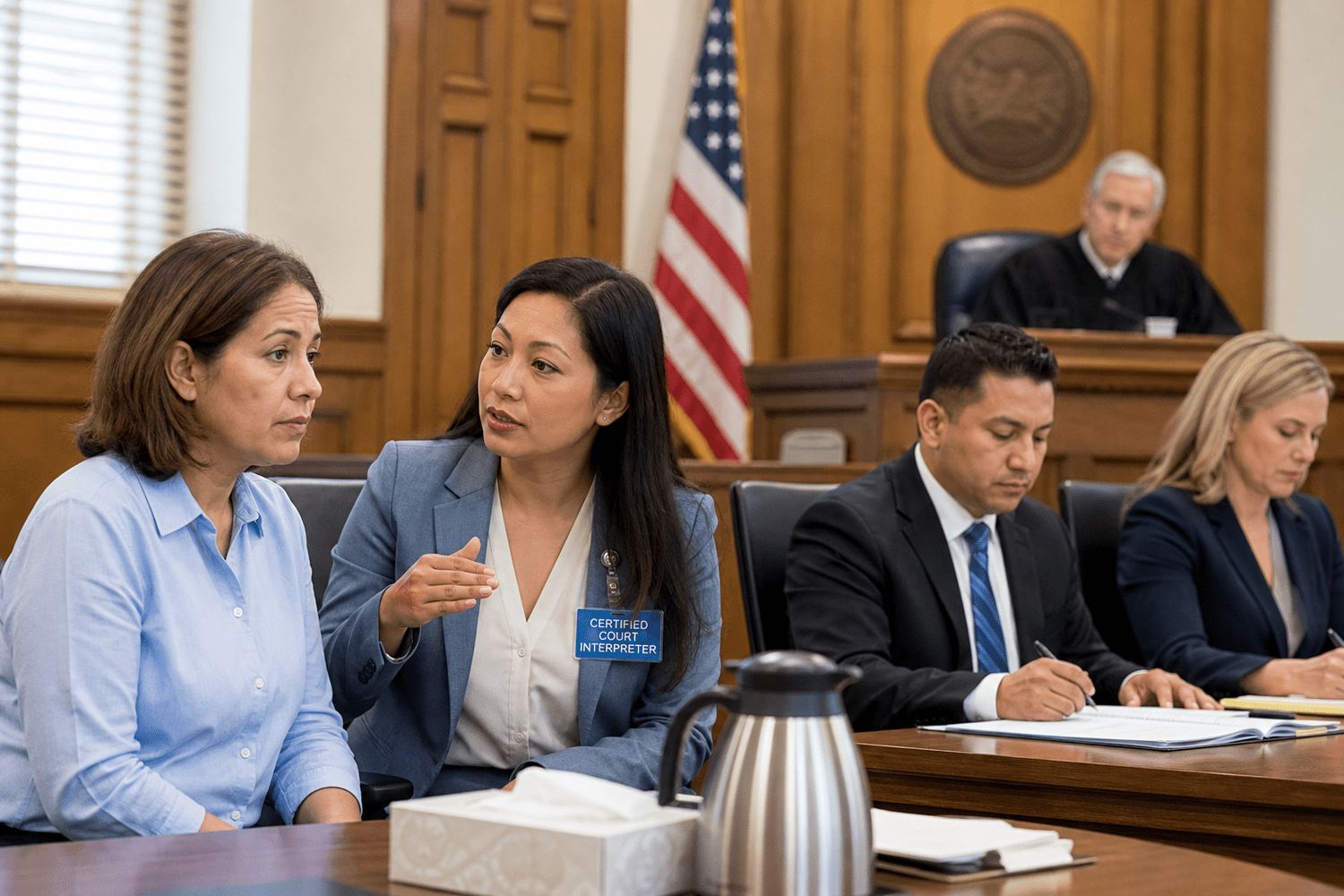
A certified legal interpreter facilitates attorney-client communication in an Evansville, Indiana law firm.
Title VI Compliance: What Law Firms Must Understand
Title VI applies not only to courts and government agencies but to any entity receiving federal financial assistance — which can include legal aid organizations, public defender offices, and law firms that accept certain federally funded legal work.
Beyond formal compliance obligations, the ethical dimension is significant. Rule 1.1 of the Indiana Rules of Professional Conduct (Competence) requires attorneys to provide competent representation, which includes understanding your client's situation — a standard that cannot be met when communication is compromised by language barriers.
The ABA Model Rules also address interpreter use, and state bar ethics opinions across the country have emphasized that using unqualified interpreters in client communications may violate duties of competence and communication.
Practical steps for Tri-State law firms:
Establish a written language access policy for your firm
Pre-screen clients at intake for language needs
Never use opposing parties' staff, family members, or minors as interpreters
Document all interpreter engagements with credentials on file
Partner with a vetted language services provider — like Heartland — for consistent access to qualified linguists
Languages Most Commonly Needed in Indiana Legal Settings
Based on community demographics across Southwest Indiana and the broader region, the most frequently requested languages in legal settings include:
Spanish — The most common language by far, with large Spanish-speaking communities in Evansville, Fort Wayne, Indianapolis, and across agricultural SE Illinois
Haitian Creole — A growing community in Evansville and nearby communities; Heartland provides specialized Haitian Creole interpreters with legal training
Marshallese — A significant population in the Midwest, particularly in Arkansas and surrounding states; increasingly seen in Tri-State legal proceedings
Burmese / Karen — Refugee communities settled in Indiana with language needs across healthcare and legal sectors
Arabic — Present in urban areas including Louisville and Indianapolis
Somali — East African immigrant communities with legal service needs
Portuguese (Brazilian) — Growing population in manufacturing-adjacent communities
Heartland supports over 350 languages, with specialized linguists for rare languages available for emergency or scheduled engagements throughout Indiana, Kentucky, and Illinois. Learn more about our full range of language services.
The Risk of Machine Translation and AI Interpretation in Legal Settings
As AI tools become more sophisticated, some firms are experimenting with machine translation — using apps like Google Translate or AI voice translation tools for client meetings or document review. This approach is particularly dangerous in legal contexts.
Why AI interpretation fails in legal settings:
AI tools routinely mistranslate idiomatic expressions, legal terminology, and context-dependent phrasing
Machine-translated documents are not legally certified and are inadmissible in many proceedings
AI cannot maintain the professional neutrality and ethical obligations of a certified interpreter
Privacy protections for attorney-client communications may be violated when conversations are processed through third-party AI platforms
No AI tool can take the witness stand, verify credentials, or be held accountable for errors
The legal profession's ethical obligations — competence, confidentiality, communication — require human, certified interpreters. The stakes are too high for anything less.
Heartland's certified translators handle court filings, contracts, and legal evidence with precision and confidentiality.
How Heartland Serves the Tri-State Legal Community
Heartland Interpretation & Translation Services is based in Evansville, Indiana and serves law firms, public defenders, courts, and legal aid organizations throughout the Tri-State region. Our legal interpretation services include:
On-site interpretation for court proceedings, depositions, client meetings, and hearings
Video Remote Interpreting (VRI) for urgent or remote legal consultations
Over-the-phone interpretation (OPI) for 24/7 emergency access
Certified document translation for pleadings, contracts, immigration forms, evidence, and court filings
Deposition support with certified simultaneous and consecutive interpreters
Title VI compliance consultation to help firms establish language access policies
We serve the full Tri-State region: Evansville IN, Henderson KY, Louisville KY, Owensboro KY, Jasper IN, Vincennes IN, Carmi IL, and communities throughout SE Illinois.
Frequently Asked Questions
Q: Does my law firm legally need to provide an interpreter for LEP clients?
A: It depends on your funding sources and the nature of the proceeding. Courts are legally required to provide interpreters. Law firms receiving federal funds have Title VI obligations. Even absent a legal mandate, ethics rules on competence and communication create a strong professional obligation to ensure accurate client communication.
Q: Can a bilingual paralegal interpret for our clients?
A: While not strictly prohibited in all contexts, using untrained bilingual staff carries significant risk. They may lack legal terminology proficiency, may not maintain proper interpreter neutrality, and their use could compromise attorney-client privilege if they are also involved in the matter. Certified interpreters are always the recommended approach.
Q: What languages does Heartland provide for legal interpretation?
A: Heartland supports over 350 languages, including Spanish, Haitian Creole, Marshallese, Burmese, Karen, Arabic, Somali, Portuguese, and many more. Contact us to confirm availability for a specific language.
Q: How quickly can Heartland provide an interpreter for a deposition or court date?
A: For scheduled proceedings, we recommend at least 48–72 hours advance notice. For urgent matters, our team works to accommodate same-day or next-day requests. Emergency OPI interpretation is available 24/7.
Q: Are Heartland's interpreters qualified to interpret in Indiana courts?
A: Yes. Our legal interpreters are vetted, trained linguists with experience in legal settings. We maintain documentation of interpreter qualifications and can provide credentials upon request.
Q: Does Heartland provide certified document translation for court filings?
A: Yes. Heartland offers certified translation services for legal documents, court filings, immigration forms, contracts, and evidence. Our certified translations meet Indiana court and USCIS standards.
The Bottom Line
Indiana's legal system — and the Tri-State communities it serves — depends on accurate, professional interpretation to function fairly. When law firms cut corners on language access, the consequences extend far beyond individual cases: they undermine trust in the legal system, expose firms to liability, and fail clients who came seeking justice.
Certified legal interpretation is not optional — it is a professional and ethical obligation.
Need professional legal interpretation or certified document translation in Indiana, Kentucky, or Illinois? Contact Heartland Language Services in Evansville — call (812) 499-1696 or get a free quote online.
Our team is ready to support your law firm, court, or legal aid organization with experienced, certified linguists across 350+ languages. Visit our about page to learn more about what makes Heartland different.

About the author
Jacob Brown
Jacob Brown shares practical guidance from Heartland Language Services on clear, reliable communication for multilingual workplaces.
Keep reading
Related articles
June 1, 2026
Certified Legal Translation Services for Indiana Law Firms: What You Need to Know
Read article →June 22, 2026
Behavioral Health Interpretation in Indiana: Why Certified Interpreters Are Essential for Mental Health Care
Language barriers in behavioral health settings can delay diagnosis, erode trust, and put patients at risk. Here's what Indiana mental health providers need to know about certified interpreter access.
Read article →May 22, 2026
Behavioral Health Interpretation in Indiana: Why Mental Health Providers Need Certified Interpreters
Mental health care relies on exact words, emotional nuance, and cultural trust. Discover why Indiana's behavioral health providers need certified interpreters—and what's at stake when language access fails.
Read article →