
Insights
Why Indiana Hospitals Need 24/7 Interpreter Access — And How to Get It
Indiana hospitals serve patients who speak 50+ languages. Learn why around-the-clock interpreter access is a legal requirement, a patient safety imperative, and a practical necessity for Tri-State healthcare providers.
Published May 10, 2026 · By Jacob Brown
By The Heartland Team | Heartland Interpretation & Translation Services, Evansville, IN
Quick Summary
• Indiana's diverse patient population speaks 50+ languages — and the number is growing.
• Section 1557 of the ACA and HIPAA require covered healthcare entities to provide timely, qualified interpreter services at no cost to patients — 24 hours a day.
• After-hours language gaps lead to adverse events, extended stays, and costly readmissions.
• On-demand phone, video, and on-site interpreting can be layered to cover every shift.
• Heartland provides 24/7 emergency language access across Southwest Indiana, Northwest Kentucky, and Southeast Illinois.
It is 2:47 a.m. on a Tuesday. The emergency department at a mid-sized Indiana hospital is busy — a multi-vehicle accident on I-64, a pediatric asthma case from the Henderson side of the river, and now a Spanish-speaking patient who arrived alone, clutching her chest, unable to tell the triage nurse what medications she takes or whether she has a history of cardiac events.
The on-call physician needs answers now. But the hospital's staff interpreter went home at 5 p.m., and the bilingual nurse on the floor is already managing two other critical patients. Someone pulls out a phone and starts typing into a translation app.
This scene plays out in Indiana emergency departments every week. It is dangerous, it is preventable, and in most cases, it is illegal. Around-the-clock interpreter access is not a luxury — it is a federal compliance requirement, a patient-safety imperative, and a practical reality of serving one of the fastest-growing multilingual populations in the Midwest.
Indiana's Language Landscape: The Numbers That Demand Action
According to U.S. Census Bureau data, more than 100,000 Hoosiers speak English "less than very well" — the federal threshold that triggers language-access protections. In Vanderburgh County alone, the foreign-born population has grown more than 40 percent over the past decade, with Spanish, Burmese, Haitian Creole, Arabic, and Marshallese among the most common non-English languages near major medical centers.
The challenge is not just volume. It is timing. Strokes, cardiac events, obstetric complications, and traumatic injuries happen around the clock — and patients who need interpreter support need it at the moment of presentation, not six hours later when a day-shift staff interpreter arrives.
The Legal Framework: What "Timely" Really Means
Section 1557 of the Affordable Care Act prohibits language discrimination by any health program receiving federal financial assistance — which includes virtually every hospital in Indiana. The Office for Civil Rights (OCR) has consistently interpreted "meaningful access" to include timely availability. "Timely" means without undue delay — not at the next available staff appointment.
HIPAA's Privacy Rule adds a second layer: communications with patients must be effective. A bilingual family member whispering translations in a crowded trauma bay does not satisfy the requirement. Untrained ad-hoc interpreters routinely omit, soften, or mistranslate clinical information, creating HIPAA exposure when those "translations" become part of the medical record.
The risk of non-compliance is real. OCR investigations, civil rights complaints, and malpractice claims have all stemmed from documented language-access failures. Indiana hospitals are not immune from this exposure.
What After-Hours Gaps Actually Cost
Research in the Journal of General Internal Medicine found that LEP patients with inadequate interpreter access experience 2× higher adverse event rates, longer lengths of stay, higher 30-day readmission rates, and lower HCAHPS scores. For Indiana hospitals under value-based care contracts, every readmission has a direct financial consequence. The cost of a 24/7 interpreter services contract is a fraction of a single preventable readmission — let alone an OCR investigation.
The Three-Layer Model for 24/7 Language Access
No single interpreting modality covers every scenario. The most effective hospital programs use a layered approach:
Layer 1: Over-the-Phone Interpretation (OPI). OPI connects healthcare providers with a qualified interpreter in seconds, 24/7/365, for 200+ languages. Every nurse station, exam room, and ER bay should have a posted OPI number and a clearly documented activation protocol.
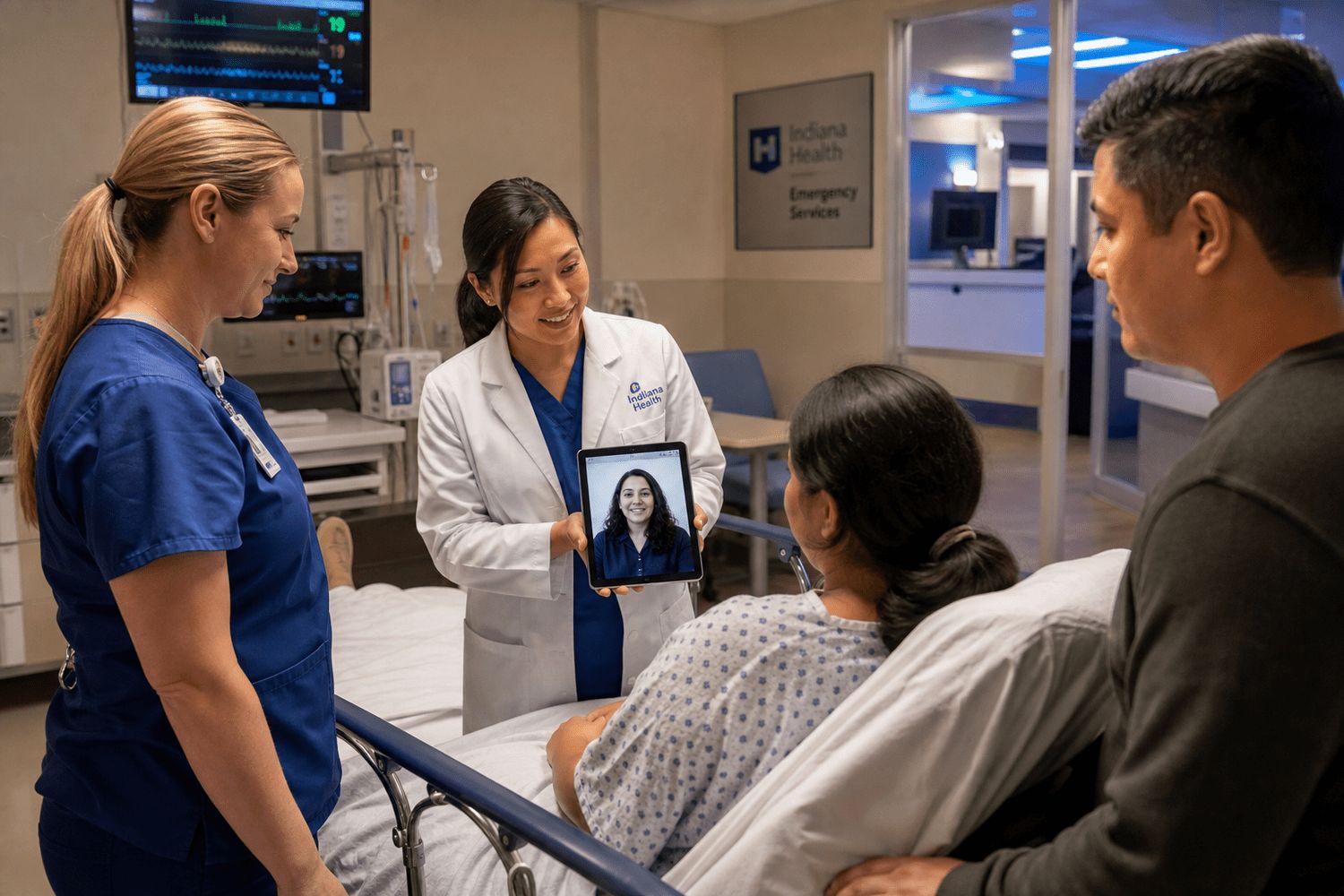
Layer 2: Video Remote Interpretation (VRI). VRI delivers the facial expressions and non-verbal cues that phone-only interpretation cannot — critical for mental health assessments, informed consent conversations, pediatric cases, and ASL interpretation. For Evansville hospitals and clinics, Heartland's healthcare interpreting services integrate with existing workflows and require no specialized hardware.
Layer 3: On-Site Interpreters. Certain encounters require a physically present interpreter: complex informed-consent discussions for surgery, end-of-life conversations, and situations where cultural brokerage is part of the clinical need. Heartland maintains a credentialed interpreter network across Southwest Indiana, Northwest Kentucky, and Southeast Illinois. Our on-call interpreters hold CMI or CCHI certifications and have cleared HIPAA training. Learn about our full language services.
Building a Compliant 24/7 Language Access Program
Step 1: Conduct a Language-Need Assessment. Analyze 12–24 months of patient records to identify the top languages in your population. This data drives OPI vendor selection, VRI coverage, and staffing decisions.
Step 2: Establish a Written Language Access Plan (LAP). OCR expects a documented LAP covering which languages trigger immediate interpreter activation, which modality to use first, how consent is documented, and how staff are trained. A written LAP is your first line of defense in an investigation.
Step 3: Contract with a Qualified Provider. A qualified hospital language services provider should offer certified medical interpreters, HIPAA BAA execution, sub-60-second OPI/VRI connections, and 24/7/365 availability — especially for less-common languages.
Step 4: Train Every Patient-Facing Staff Member. Compliance gaps often live in frontline behavior — nurses who skip the interpreter because it takes too long, technicians who use Google Translate, registration staff who let family members translate. Regular LAP training is essential.
Step 5: Audit Continuously. Review interpreter utilization by language and shift, patient satisfaction by language-access status, and any incidents involving language barriers — at minimum annually.
Why Tri-State Geography Demands a Local Partner
Indiana hospitals near the Kentucky and Illinois borders face a complication national vendors cannot solve: patients who cross state lines. A patient transported from Henderson County, Kentucky, to Deaconess in Evansville has the same language-access rights as any Indiana resident.
Heartland is embedded in the Tri-State region. We know the dialects spoken by Marshallese communities in Evansville, Haitian Creole speakers in Henderson, and Spanish-speaking agricultural workers in Southeast Illinois. A national call center is unlikely to have a Mayan-language interpreter on call at 3 a.m. Heartland does.
Frequently Asked Questions
Does our hospital legally need interpreters around the clock?
Yes. Federal law requires timely interpreter access whenever an LEP patient seeks care — including nights, weekends, and holidays. Emergency departments must have an after-hours plan. Relying on family members or untrained staff does not satisfy the legal requirement.
Can we use a free translation app to communicate with LEP patients overnight?
No. Machine translation tools do not meet the standard for meaningful language access under Section 1557. They are not HIPAA-compliant and lack the medical vocabulary required for clinical interpretation.
What is the difference between a medical interpreter and a bilingual staff member?
A bilingual staff member has not been trained in medical interpreter ethics, sight translation, or clinical vocabulary. They also create role conflicts — a bilingual nurse interpreting cannot simultaneously focus on patient care. Certified medical interpreters (CMI or CCHI) are trained to interpret accurately and impartially.
How quickly can Heartland connect us with an interpreter after hours?
OPI and VRI connections are available within seconds to minutes, 24/7. For on-site requests in the Tri-State region, we typically place a certified interpreter on-site within one to two hours. For scheduled high-stakes encounters, we recommend 24-hour advance booking.
We already have a language line — do we need Heartland too?
Heartland fills three gaps: on-site interpreters for high-stakes encounters, community-language expertise for less-common languages (Marshallese, Haitian Creole, Burmese), and a HIPAA BAA-backed local partner who knows the Evansville patient population.
The Bottom Line: 24/7 Language Access Is Non-Negotiable
The question for Indiana hospitals is not whether to provide round-the-clock interpreter access — federal law answers that. The question is how to build a layered system covering every shift, every language, and every modality.
Heartland Interpretation & Translation Services exists to answer that question for Tri-State healthcare providers. Our healthcare interpreting services page outlines our full range of offerings, and our team is ready to conduct a no-obligation language-access gap analysis for your facility.
Don't wait for a compliance complaint or an adverse event to close the gap. Request a free quote or call us at (812) 499-1696 — available, appropriately enough, at any hour.

About the author
Jacob Brown
Jacob Brown shares practical guidance from Heartland Language Services on clear, reliable communication for multilingual workplaces.
Keep reading
Related articles
July 14, 2026
Certified Medical Interpreter Evansville, IN: HIPAA, Section 1557 & Patient Safety
Clear communication is a patient-safety requirement. Learn how qualified medical interpreters help Evansville-area healthcare providers protect privacy, support Section 1557 language access, and reduce preventable communication errors.
Read article →May 28, 2026
Top Languages Spoken in Indiana Healthcare Settings — And How Hospitals Can Serve Every Patient
Which languages do Indiana hospitals encounter most? Learn how Evansville-area healthcare facilities meet Section 1557 language access requirements with certified interpreters.
Read article →July 10, 2026
Spanish Interpretation Services in Evansville, Indiana
Businesses across Evansville and the Tri-State area rely on professional Spanish interpretation to communicate clearly, protect compliance, and serve multilingual communities. Learn how Heartland Language supports healthcare, legal, manufacturing, and business teams.
Read article →