
Insights
Workers' Compensation Interpreters in Indiana: A Guide for Law Firms
Indiana and Kentucky law firms rely on qualified workers’ compensation interpreters to protect injured workers, preserve accurate records, and support depositions, IMEs, and hearings. Heartland Language serves Evansville, Henderson, Louisville, and the Tri-State region.
Published July 13, 2026 · By Jacob Brown

Quick Summary
Workers' compensation interpreters in Indiana help Spanish and Haitian Creole-speaking injured workers communicate with attorneys, doctors, and hearing officers.
Federal law — Title VI, the ADA, and OSHA regulations — requires language access in many workers' comp proceedings.
Heartland Language provides certified legal and medical interpreters for law firms in Evansville, IN, Henderson, KY, and Louisville, KY.
Depositions, independent medical exams (IMEs), and Workers' Compensation Board hearings all require qualified interpreters to protect your client and your record.
When a factory worker in Evansville sustains a back injury on the line, or a food-processing employee in Henderson, KY, is exposed to a chemical spill, the legal process that follows can be extraordinarily difficult — even before you factor in a language barrier. Workers' compensation interpreters in Indiana play a critical role in helping law firms protect the rights of Spanish-speaking, Haitian Creole-speaking, and other limited English proficient (LEP) injured workers throughout the Tri-State region.
If you represent injured workers — or if you're a defense attorney for a carrier or self-insured employer — having a certified interpreter present at every stage is not just a best practice. In many situations, it's a legal requirement. This guide explains what Indiana, Kentucky, and Illinois law firms need to know about language access in workers' compensation proceedings.
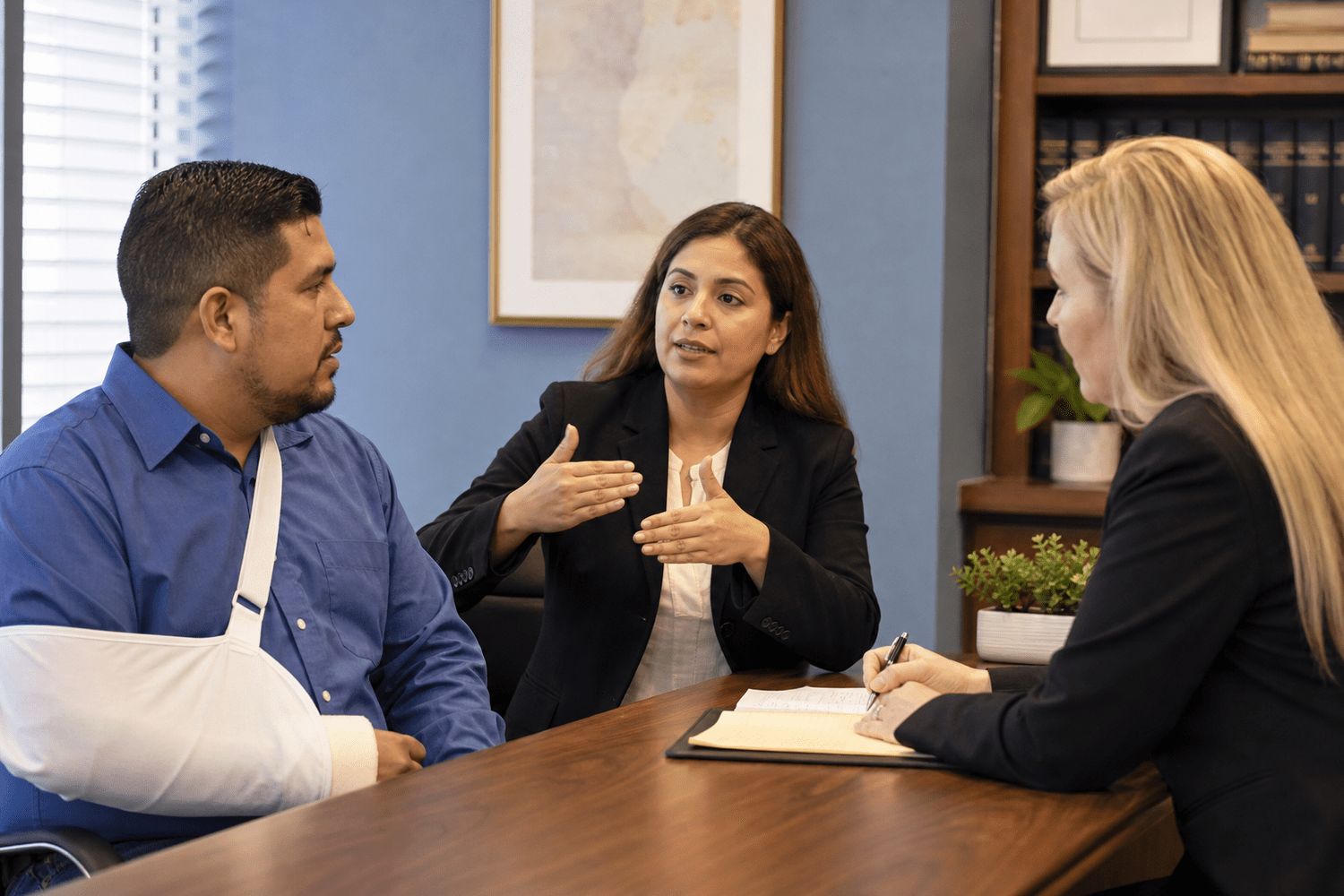
Heartland Language provides certified interpreters for workers' compensation law firms across Evansville, IN, and the Tri-State region.
Why Language Access Matters in Workers' Comp Cases
Workers' compensation cases involve complex medical terminology, legal procedures, and critical deadlines. For a client who speaks limited English, each of these stages presents a risk of miscommunication that could jeopardize their claim — or expose your firm to liability.
Consider the stakes:
Initial intake and investigation: An attorney who cannot accurately capture how an accident happened — because the client speaks only Spanish or Haitian Creole — may miss facts that later undermine the claim.
Medical evaluations: If an IME physician cannot communicate effectively with the claimant, the resulting report may misrepresent the severity or nature of the injury.
Depositions: A poorly interpreted deposition creates a written record full of errors that opposing counsel can exploit at every subsequent stage.
Indiana Workers' Compensation Board hearings: Administrative law judges rely on accurate testimony to make decisions. Without a qualified interpreter, a favorable case can fall apart.
The Tri-State region — encompassing Evansville, IN, Henderson, KY, Louisville, KY, Jasper, IN, and southeastern Illinois — has a substantial and growing Spanish-speaking workforce in manufacturing, food processing, construction, and agriculture. Haitian Creole-speaking workers are also a significant community in the region, particularly in healthcare, elder care, and service industries. These workers are injured at work at the same rates as English speakers, but they face compounded challenges when seeking justice.
The Legal Framework: Title VI, ADA, and OSHA
Multiple federal statutes create obligations for language access that affect workers' compensation proceedings in Indiana and Kentucky.
Title VI of the Civil Rights Act
Title VI prohibits discrimination on the basis of national origin by any entity receiving federal financial assistance. Because many workers' comp cases intersect with federally funded healthcare systems, vocational rehabilitation programs, and state agencies, Title VI often applies. Failure to provide a qualified interpreter to an LEP patient or claimant can constitute a Title VI violation — regardless of who pays for the interpretation.
The Americans with Disabilities Act (ADA)
When a workers' comp claimant has a disability that affects communication (in addition to limited English proficiency), Title II and Title III of the ADA may require effective communication accommodations. While language barriers themselves are not covered by the ADA, attorneys should be aware that their LEP clients may also have disability-related communication needs that require additional support.
OSHA and Language Access on the Job
The Occupational Safety and Health Administration (OSHA) requires that safety information, training, and hazard communication be provided in a language and at a literacy level that workers can understand. When an injury occurs, the OSHA investigation may turn on whether the employer provided adequate bilingual training. A legal interpreter can help your client accurately describe what safety communication they did — or did not — receive before the accident.
For workers in industries Heartland Language serves, law firms, including manufacturing, food processing, and healthcare, OSHA compliance issues, and workers' comp claims frequently overlap. Understanding both dimensions is essential for effective representation.

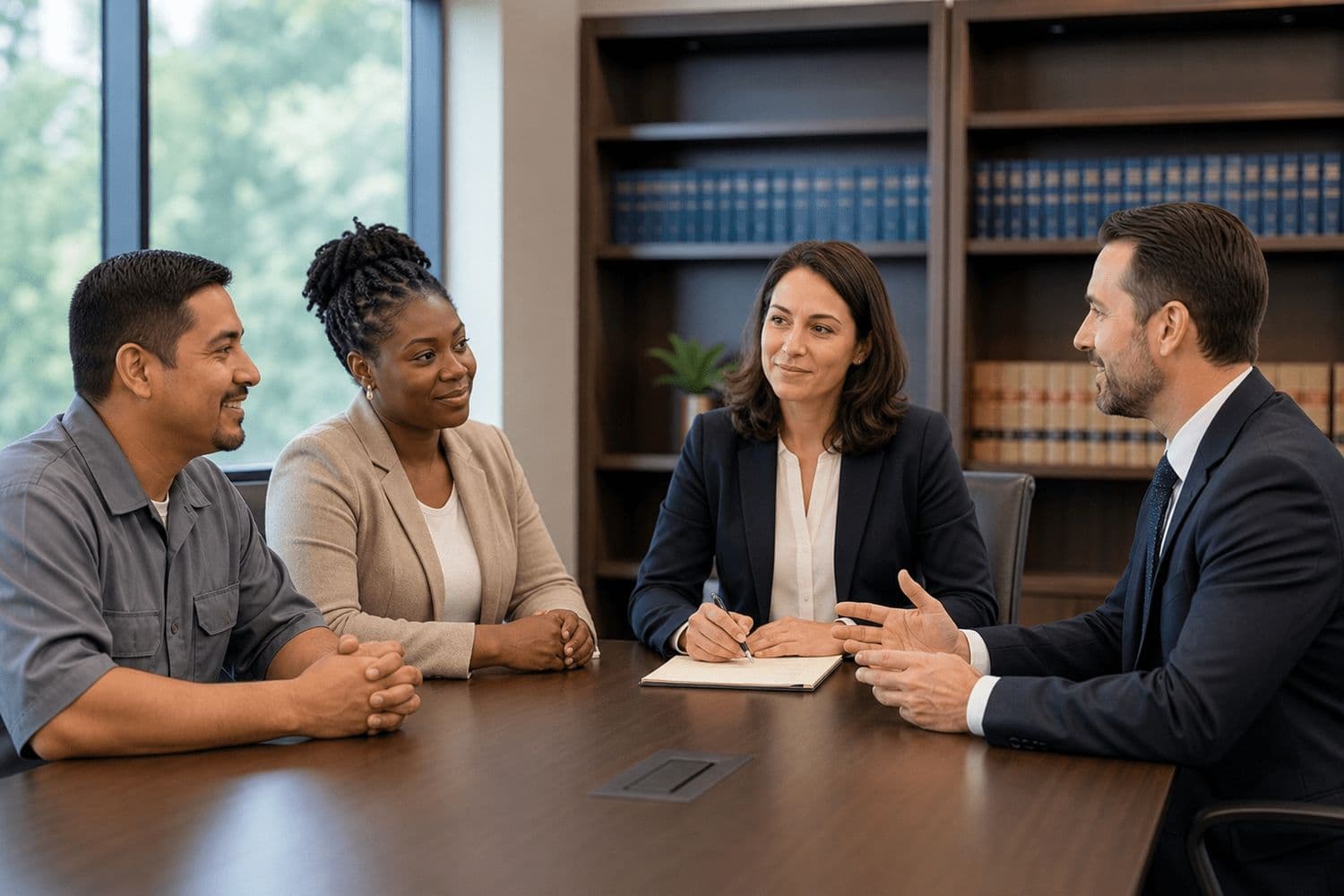
Certified interpreters at depositions and administrative hearings protect the evidentiary record for law firms throughout Indiana and Kentucky.
Types of Interpretation Your Clients Need
Not all interpretation assignments in a workers' comp case look the same. Here are the most common settings where law firms in the Tri-State region request interpreters from Heartland Language:
Attorney-Client Meetings
From the initial intake through settlement discussions, your client must be able to communicate freely with you. Telephone or video interpretation can work for routine updates, but in-person interpretation is strongly recommended for case strategy conversations, document reviews, and sensitive discussions about case value or risks.
Independent Medical Examinations (IMEs)
Defense-requested IMEs are notoriously adversarial. When the examining physician cannot communicate directly with your client, the results can be distorted. Having a qualified interpreter present at the IME — not just the physician's office nurse — protects your client's ability to accurately describe symptoms, limitations, and history. Make sure your interpreter is certified and neutral, not a family member or co-worker.
Depositions
Deposition interpretation is a specialized skill. The interpreter must work in consecutive mode, rendering testimony faithfully and completely, without paraphrasing or summarizing. At Heartland Language, our legal interpreters are trained in consecutive interpretation protocol and understand the critical difference between advocate interpretation and neutral interpretation. Our professional interpretation services for depositions are available throughout Evansville, IN, Henderson, KY, and Louisville, KY.
Indiana Workers' Compensation Board Hearings
Administrative hearings before the Indiana Workers' Compensation Board require simultaneous or consecutive interpretation, depending on the hearing format. The interpreter must be present in the hearing room, understand legal and medical terminology, and be able to maintain neutrality under cross-examination. Our interpreters are familiar with the Board's procedures and can appear on short notice for hearings in Evansville and across southwest Indiana.
Vocational Rehabilitation and Medical Management
When a claim includes vocational rehabilitation, your client may need interpretation at meetings with vocational counselors, medical case managers, and treating physicians throughout their recovery. Heartland Language can coordinate ongoing interpretation support across the full continuum of a workers' comp case.
Common Languages in Tri-State Workers' Comp Cases
The two most common non-English languages among injured workers in the Evansville, IN–Henderson, KY–Louisville, KY corridor are:
Spanish: The dominant non-English language across all three states in the Tri-State area. Spanish-speaking workers are heavily represented in manufacturing (including food manufacturing), construction, agriculture, and service industries. Regional dialects include Mexican Spanish (most common), Central American Spanish, and Caribbean variants.
Haitian Creole: Haitian Creole speakers are a significant and growing community in the Evansville and Henderson areas, working in healthcare, elder care, meatpacking, and logistics. Haitian Creole is a distinct language from French — do not substitute a French interpreter for a Haitian Creole speaker.
Other languages commonly encountered include Burmese, Somali, Kinyarwanda, and Arabic, particularly in Louisville, KY, where the refugee resettlement community is well-established. Heartland Language maintains a network of qualified interpreters across all of these languages for the industries we serve throughout the Tri-State region.
Serving Evansville, IN, Henderson, KY, and Louisville, KY
Law firms throughout southwest Indiana and the Tri-State region trust Heartland Language for workers' compensation interpretation because we understand the regional context:
Evansville, IN: Home to major manufacturing employers, including Toyota suppliers, food processing operations, and healthcare systems that generate a significant volume of workers' comp claims involving LEP workers.
Henderson, KY: The manufacturing corridor along the Ohio River employs a large Spanish-speaking and Haitian Creole-speaking workforce. Henderson attorneys frequently need interpreters for claims originating in local plants and distribution centers.
Louisville, KY: The largest city in Kentucky, Louisville has a well-established refugee and immigrant community. Workers' comp claims from logistics, healthcare, and food processing employers regularly require Spanish, Haitian Creole, Somali, Burmese, and other language support.
Jasper, IN and SE Illinois: The broader Tri-State region includes clients from Jasper and Dubois County in Indiana, as well as Mt. Vernon, Carmi, and other southeastern Illinois communities where agricultural and manufacturing employers operate.
We provide both in-person and remote interpretation (phone and video) for law firms throughout the region. For depositions and Board hearings, we strongly recommend in-person interpretation. For attorney-client updates and document reviews, remote options can be scheduled quickly — sometimes within hours.
How to Request Workers' Compensation Interpreters in Indiana
Booking an interpreter through Heartland Language is straightforward:
Contact us with the assignment details: Date, time, location, language pair, assignment type (deposition, IME, hearing, client meeting), and any specialized terminology your interpreter should review in advance.
We confirm the right interpreter: For legal assignments, we match you with an interpreter who has experience in workers' compensation and legal terminology, not just general fluency.
Pre-assignment preparation: For complex depositions, we recommend providing our interpreter with case documents, medical records, or prior testimony to review. This reduces interpretation errors and speeds up the proceedings.
Day-of support: Our interpreters arrive early, introduce themselves to all parties, and explain their role on the record if needed.
Post-assignment follow-up: If you have questions about terminology or interpretation choices, we're available to discuss.
Request a quote for workers' compensation interpretation services — we typically respond within two hours during business hours, with same-day emergency scheduling available for urgent needs.
Frequently Asked Questions
Does Indiana law require an interpreter for workers' compensation hearings?
Indiana law does not have an explicit statute requiring interpreters at workers' compensation hearings. However, the Indiana Workers' Compensation Board has procedures for accommodating LEP claimants, and federal Title VI requirements may apply in certain contexts. More practically, any attorney representing an LEP claimant has an ethical obligation to ensure effective communication, which requires a qualified interpreter. Failing to provide one can result in malpractice exposure and a compromised evidentiary record.
Who pays for the interpreter in a workers' comp case in Indiana?
In Indiana, the cost of interpretation is typically borne by the party requesting the interpreter. For plaintiff's attorneys working on contingency, interpretation costs are usually advanced as a case expense and recovered at settlement. Defense attorneys and insurance carriers are expected to provide interpreters at depositions and IMEs they schedule. In federal-benefit contexts (e.g., cases involving federally funded programs), interpretation may be required at no cost to the LEP individual under Title VI.
Can a family member interpret for my client?
This is strongly discouraged in legal settings. Family members lack legal interpretation training, may have emotional stakes in the outcome, and can inadvertently omit, summarize, or alter testimony. Opposing counsel can challenge the reliability of a family member's interpretation, and the evidentiary record may be tainted. For formal proceedings — depositions, IMEs, Board hearings — always use a certified professional interpreter.
How quickly can Heartland Language schedule a workers' comp interpreter in Evansville, IN?
For standard assignments in Evansville, IN, Henderson, KY, and Louisville, KY, we can typically confirm an interpreter within 24–48 hours. For emergency assignments (same-day depositions, urgent client meetings), we maintain on-call availability. Contact us as early as possible, particularly for less common languages or specialized legal assignments.
Does Heartland Language provide phone or video interpretation for workers' comp?
Yes. We offer over-the-phone interpretation (OPI) and video remote interpretation (VRI) for attorney-client calls, case updates, document reviews, and some medical appointments. For depositions, IMEs, and Board hearings, we strongly recommend in-person interpretation to protect the evidentiary record and ensure the interpreter can observe all non-verbal communication.
Ready to Schedule a Workers' Comp Interpreter?
Heartland Language provides certified legal interpreters for law firms throughout Evansville, IN, Henderson, KY, Louisville, KY, and the broader Tri-State region. Whether you need an interpreter for a deposition tomorrow or ongoing support throughout a complex case, we're here.
Get a quote for workers' compensation interpretation →
Questions? Review our interpreter FAQ or learn more about our team and our credentials.

About the author
Jacob Brown
Jacob Brown shares practical guidance from Heartland Language Services on clear, reliable communication for multilingual workplaces.
Keep reading
Related articles
June 16, 2026
Immigration Court Interpretation in Indiana: Why Getting It Right Is a Matter of Freedom
Immigration court proceedings in Indiana require qualified, certified interpreters — not bilingual staff. Heartland provides vetted immigration interpreters in 350+ languages across Evansville, Henderson KY, and the Tri-State region. Excerpt: Immigration proceedings require certified interpreters fluent in legal terminology and immigration procedure. A single mistranslated phrase can mean denial of asylum or wrongful deportation. Heartland provides qualified immigration interpreters in 350+ languages across Southwest Indiana and the Tri-State region.
Read article →July 10, 2026
Spanish Interpretation Services in Evansville, Indiana
Businesses across Evansville and the Tri-State area rely on professional Spanish interpretation to communicate clearly, protect compliance, and serve multilingual communities. Learn how Heartland Language supports healthcare, legal, manufacturing, and business teams.
Read article →July 6, 2026
Manufacturing Interpreter Indiana: Protecting Workers Through Language Access
Manufacturing interpreter services help Indiana employers reduce safety risk, improve HR communication, and support multilingual teams across Evansville, Henderson, Louisville, Jasper, and Southeast Illinois.
Read article →