
Insights
Does AI Interpreting Really Matter in 2026? Here's the Truth for Healthcare Providers
Published January 27, 2026 · By Jacob Brown
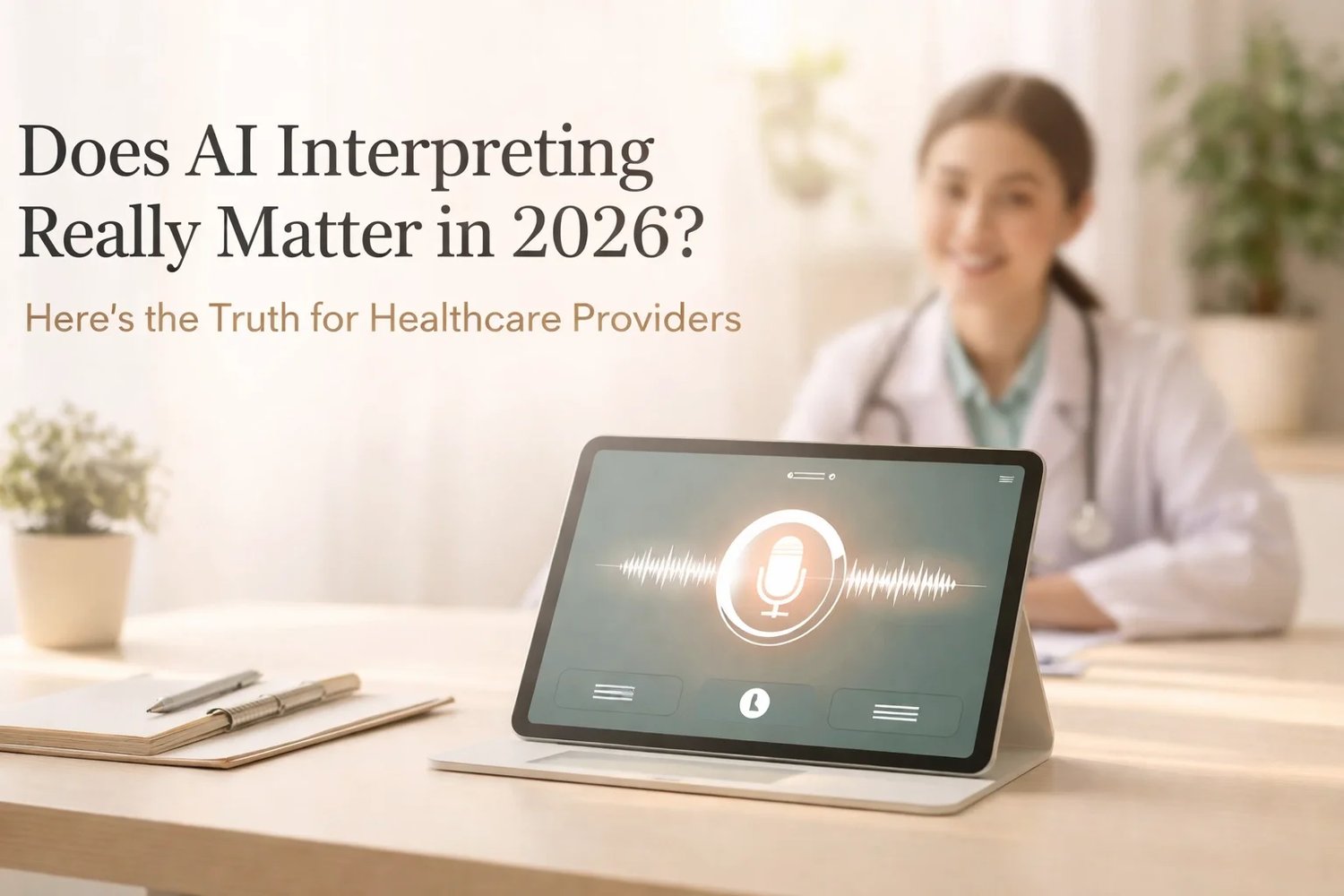
If you work in healthcare, you've probably heard the buzz. AI interpreting tools are everywhere in 2026, promising instant translation, lower costs, and seamless multilingual communication. Tech companies are marketing these solutions hard, and it's tempting to believe they could solve all your language access challenges overnight.
But here's the question that keeps coming up in hospitals, clinics, and medical practices across Southwest Indiana, Northwest Kentucky, and Southeast Illinois: Can AI really replace human interpreters in healthcare settings?
The short answer? Not quite. Let's break down what AI interpreting can and can't do, and why the stakes are too high to get this wrong.
The Rise of AI Interpreting: What's Actually Happening
There's no denying that AI language technology has made impressive strides. Tools powered by machine learning can now handle basic conversational translation, adapt content for different cultural contexts, and support patients who struggle with English-only resources.
For healthcare providers, this sounds promising. Multilingual AI can help with patient engagement, appointment reminders, and general information sharing. Some platforms even claim to offer realtime interpretation during clinical encounters.
But here's where we need to pump the brakes.

What AI Interpreting Does Well
Let's give credit where it's due. AI interpreting tools have genuine strengths:
Speed. : AI can provide instant translations for written materials and basic spoken phrases.
Availability : Unlike human interpreters, AI doesn't need scheduling. It's available 24/7.
Cost: : For high-volume, low-stakes communication, AI can reduce expenses.
Scalability : AI can handle multiple languages simultaneously without additional staffing.
For tasks like translating patient education brochures, sending appointment reminders in multiple languages, or providing basic wayfinding information, AI tools can be genuinely helpful. They're especially useful for administrative tasks that don't involve clinical decision-making.
The Problem: Healthcare Isn't "Basic"
Here's where things get complicated. Medical interpreting isn't just about converting words from one language to another. It's about meaning, context, nuance, and trust.
Consider these scenarios that happen every day in healthcare settings:
A patient describes chest pain as "tightness" in their native language, but the cultural context suggests something entirely different than what a direct translation would convey.
An elderly patient nods along during a discharge conversation, but their body language signals confusion that only a human would catch.
A mother hesitates before answering a question about her child's symptoms: a pause that carries critical diagnostic information.
AI misses these cues. Every. Single. Time.
When it comes to professional interpreting services, the difference between adequate and excellent can literally be life or death.

HIPAA Compliance: The Elephant in the Room
Let's talk about something that doesn't get enough attention in the AI interpreting conversation: data security and HIPAA compliance.
When you use an AI interpreting tool, where does that patient data go? How is it stored? Who has access to it? Is the platform truly HIPAA-compliant, or is it operating in a regulatory gray area?
Many AI tools process data through cloud servers, sometimes overseas. This creates potential vulnerabilities that could expose your practice to significant liability. A data breach involving protected health information (PHI) isn't just a PR nightmare: it's a federal compliance issue with serious financial penalties.
Human interpreters who work with healthcare providers understand HIPAA requirements. Certified linguists receive specific training on patient confidentiality, proper documentation, and the ethical obligations that come with handling sensitive medical information.
Can your AI tool say the same?
Why Human Linguists Are Essential for High-Stakes Situations
Medical interpreting requires more than language fluency. It demands:
Clinical Accuracy
Medical terminology is complex and constantly evolving. A certified medical interpreter understands the difference between similar-sounding conditions, can clarify ambiguous statements, and ensures that critical information isn't lost in translation.
Consider the difference between "I feel dizzy" and "I feel lightheaded." In English, patients often use these interchangeably. But clinically, they can point to very different conditions. A skilled human interpreter knows how to probe for clarification without leading the patient.
Cultural Competence
Healthcare beliefs and practices vary dramatically across cultures. What's considered normal in one community might be a red flag in another. Human interpreters bring cultural knowledge that helps bridge these gaps, ensuring providers understand not just what patients are saying, but what they mean.
Emotional Intelligence
Delivering a cancer diagnosis. Discussing end-of-life care. Explaining a difficult prognosis to a family. These conversations require empathy, sensitivity, and the ability to read the room.
AI doesn't have emotional intelligence. It can't pause when a patient needs a moment. It can't softenits tone when delivering hard news. It can't recognize when someone is too overwhelmed to process information.
For healthcare providers in our tri-state service area, these moments happen daily. Your patients deserve better than a machine in those situations.

Finding the Right Balance
This isn't an either/or situation. The smartest healthcare providers in 2026 are taking a hybrid approach:
Use AI for:
Administrative communications
Appointment scheduling and reminders
General patient education materials
Initial triage for non-urgent inquiries
Use human interpreters for:
Clinical encounters and examinations
Informed consent discussions
Mental health appointments
Diagnosis and treatment planning conversations
Any situation involving sensitive or complex information
This approach gives you the efficiency benefits of AI while protecting patients (and your practice) when the stakes are highest.
What This Means for Healthcare Providers in SW Indiana, NW Kentucky, and SE Illinois
Our region is becoming increasingly diverse. Hospitals in Evansville, clinics in Henderson, and medical practices throughout Southeast Illinois are serving patients who speak Spanish, Burmese, French, Mandarin, and dozens of other languages.
Meeting these patients' needs isn't just good medicine: it's required by federal law. Section 1557 of the Affordable Care Act mandates meaningful language access for patients with limited English proficiency.
The question isn't whether you need language services. The question is whether your current approach actually serves your patients well.
If you're relying solely on AI tools, you might be exposing your practice to compliance risks, missing critical clinical information, and ultimately providing a lower standard of care to your LEP patients.
The Bottom Line
AI interpreting tools have a place in healthcare: but that place isn't at the bedside during critical conversations.
For routine administrative tasks? Sure, AI can help. But for the moments that matter most: the diagnosis, the treatment discussion, the informed consent: you need certified medical interpreters who understand both the language and the weight of what's being communicated.
At Heartland Language Services, we've seen firsthand how professional interpretation improves patient outcomes, reduces liability, and builds trust in diverse communities. We work with healthcare providers throughout Southwest Indiana, Northwest Kentucky, and Southeast Illinois to ensure every patient receives care they can understand.
Ready to evaluate your language access strategy? Contact us to learn how our certified linguists can support your practice: because some things are too important to leave to a machine.

About the author
Jacob Brown
Jacob Brown shares practical guidance from Heartland Language Services on clear, reliable communication for multilingual workplaces.
Keep reading
Related articles
May 1, 2026
How Medical Interpreting Prevents Misdiagnosis: A Guide for Evansville Healthcare Providers
Read article →March 11, 2026
Do You Really Need a Certified Linguist? Here’s the Truth for Legal Firms and Corporations Man- aging High-Risk Files
Read article →July 14, 2026
Certified Medical Interpreter Evansville, IN: HIPAA, Section 1557 & Patient Safety
Clear communication is a patient-safety requirement. Learn how qualified medical interpreters help Evansville-area healthcare providers protect privacy, support Section 1557 language access, and reduce preventable communication errors.
Read article →