
Insights
FSMA, OSHA, and Language Access: Why Indiana Food Manufacturers Can’t Afford Language Gaps
Indiana food manufacturers face FSMA and OSHA language access requirements. Learn why certified interpreters are essential for food safety compliance and worker protection.Indiana food manufacturers face FSMA and OSHA language access requirements. Learn why certified interpreters are essential for food safety compliance and worker protection.
Published May 18, 2026 · By Jacob Brown
Quick Summary: Indiana's food manufacturing sector employs thousands of workers who speak Spanish, Burmese, Somali, and dozens of other languages. Federal FSMA and OSHA regulations require that every worker — regardless of language — understands safety protocols, hazard communications, and food hygiene standards. Certified interpreters don't just help with communication; they're a legal safeguard, a liability shield, and a quality assurance tool rolled into one.
---
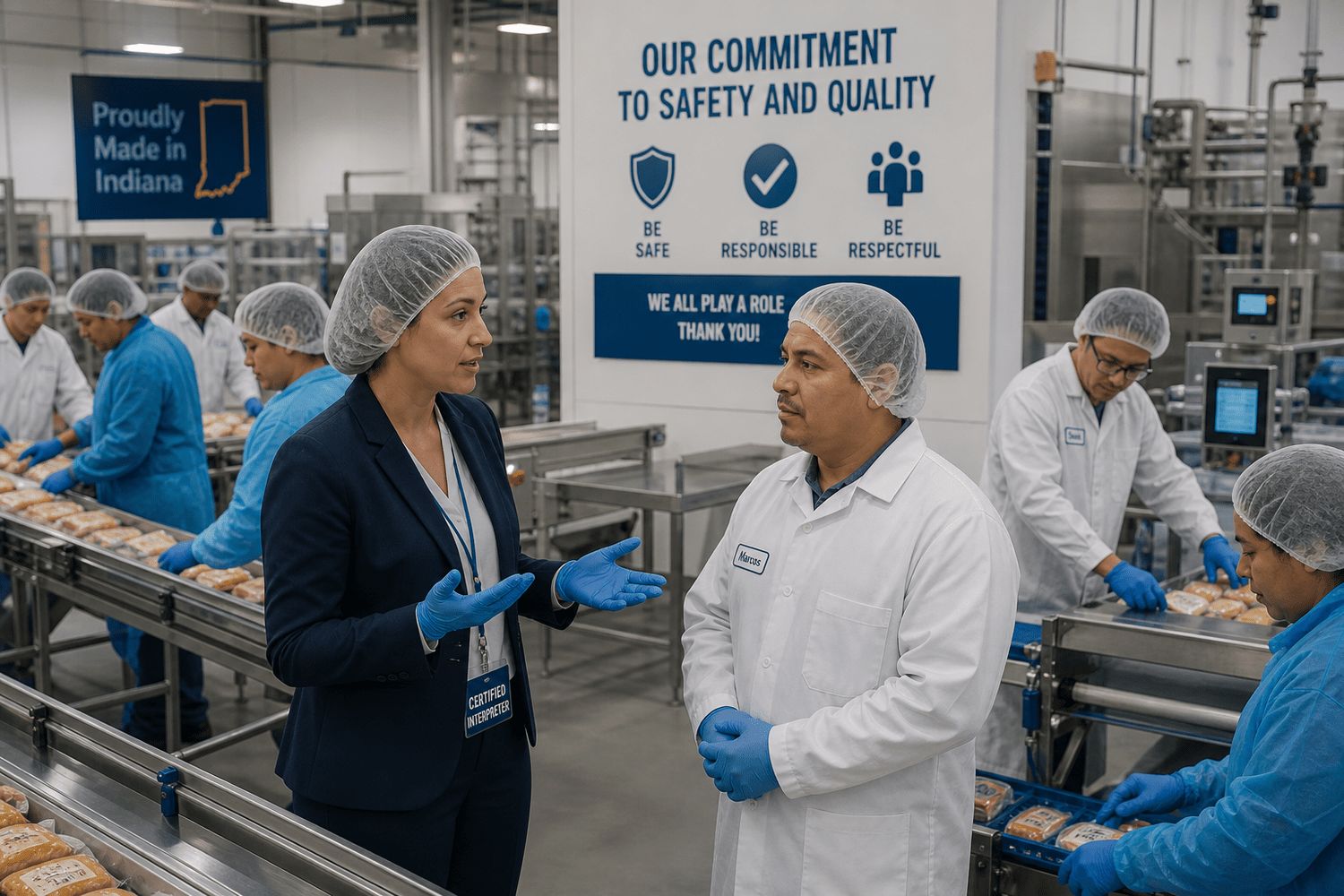
Walk the production floor of nearly any food processing plant in Southwest Indiana, Henderson, or the greater Evansville Tri-State area today, and you'll notice something that's been true for decades but is only becoming more urgent: your workforce speaks many languages.
From Spanish-speaking workers at poultry processors and pork facilities to Burmese and Karen communities in grain handling and food packaging, multilingual employees are essential to Indiana's food manufacturing sector. According to the U.S. Bureau of Labor Statistics, the food processing and manufacturing industry employs a disproportionately high share of workers with limited English proficiency (LEP) — often upward of 40–60% at individual facilities in agricultural regions like Southwest Indiana.
This is not a problem. It's a workforce reality. But it does create a compliance obligation — one that many facilities underestimate until an OSHA citation, an FDA audit, or a preventable workplace injury brings it into sharp focus.
At Heartland Interpretation & Translation Services, we work with food manufacturing facilities across Evansville, Henderson, Jasper, and the broader Tri-State region. What we've seen firsthand is this: language gaps in food manufacturing aren't just a communication inconvenience. They're a regulatory exposure, a food safety risk, and a worker safety liability.
What FSMA Requires — and What It Means for Language Access
The Food Safety Modernization Act (FSMA) fundamentally changed the compliance landscape for food manufacturers when it was signed into law in 2011 and fully phased in over the following decade. Where previous food safety law was largely reactive (responding to outbreaks), FSMA is preventive — requiring facilities to identify, analyze, and control hazards before they cause harm.
Under FSMA's Preventive Controls for Human Food (21 CFR Part 117), food manufacturers must:
• Conduct a written Hazard Analysis and implement a Food Safety Plan
• Train all food handlers and supervisors on the requirements of the Food Safety Plan
• Document that training has occurred and that workers understand their role in hazard control
• Ensure that all personnel working in food production are educated on food hygiene and personal hygiene standards
The critical phrase there is "understand their role." Under FDA enforcement guidance, training that is delivered in a language workers do not comprehend does not satisfy this requirement. Documentation showing that a worker attended a training in English — when that worker speaks primarily Spanish or Burmese — is not evidence of compliant training. It is evidence of a paper trail that will look very bad during an FDA inspection or post-incident investigation.
Facilities that have experienced FDA 483 observations related to training adequacy frequently cite the same underlying cause: content that was technically delivered but not meaningfully understood. Certified interpreters close that gap — both in live training and in translated written materials like SOPs and HACCP documentation.
OSHA's Hazard Communication Standard: The Language Requirement Most Facilities Miss
Alongside FSMA, OSHA's Hazard Communication Standard (HCS, 29 CFR 1910.1200) — commonly called "HazCom" — requires that workers who are exposed to hazardous chemicals receive training in a language and vocabulary they understand.
In food manufacturing, hazardous chemicals are everywhere: chlorine-based sanitizers, ammonia refrigerants, CO2 in enclosed spaces, caustic cleaning agents. Safety Data Sheets (SDS) must be accessible and comprehensible. Chemical safety training must be understood. Lockout/tagout procedures must be followed correctly — the first time, every time.
The OSHA standard doesn't say training must be "offered" in a worker's language. It says the worker must understand the training. That distinction has cost facilities significant fines and — far more importantly — has cost workers serious injuries and lives.
OSHA citation data consistently show that Hispanic and immigrant workers in food processing are injured and killed at rates disproportionate to their workforce share. The National Institute for Occupational Safety and Health (NIOSH) has identified language barriers as a contributing factor in this disparity. Providing certified interpreter support for safety training, toolbox talks, and incident reporting is one of the most direct interventions a facility can make.
The Three Points Where Language Gaps Create Food Manufacturing Risk
1. Safety Training and Toolbox Talks
Recurring safety training — whether it's lockout/tagout, PPE usage, allergen handling, or emergency evacuation — is only effective if every worker in the room understands it. Running bilingual safety meetings with a certified on-site interpreter ensures compliance documentation reflects genuine comprehension, not just attendance.
At Heartland, we regularly support food manufacturing clients with on-site interpreters for scheduled and unscheduled safety meetings — including OSHA 10/30 training sessions delivered through certified bilingual instruction. Our interpreters are trained in industrial and food safety vocabulary, not just general-purpose language services.
2. Food Safety and Hygiene Procedures
Personal hygiene requirements under FSMA — handwashing, illness reporting, PPE use, allergen awareness — must be understood, not just posted. If your Spanish-speaking workers are reading a hygiene policy that was machine-translated, they may be reading a version full of errors that create confusion about critical procedures.
Certified document translation of your Food Safety Plan, SOPs, HACCP records, and allergen control procedures is not a "nice to have." It is the difference between a documented compliance program and a paper trail that exposes you in an audit. Our translation team provides certified translations that are accurate, contextually correct, and formatted to match your original documents.
3. Incident Reporting and Investigation
When an incident happens — a near-miss, an injury, a food safety deviation — accurate reporting depends on every worker being able to describe what they witnessed in their own language. Relying on a bilingual coworker to interpret a post-incident account introduces error, potential bias, and liability risk. A professional interpreter ensures the record reflects exactly what happened.
This matters for OSHA 300 logs, FDA recall investigations, and workers' compensation claims. Certified interpretation of incident reports isn't just good practice; it's protection for the facility and for the worker.
What Indiana Food Manufacturers Should Know About Their Workforce Languages
In the Evansville and Southwest Indiana region, the most commonly spoken languages among LEP food manufacturing workers include:
• Spanish — the most prevalent, spanning workers from Mexico, Guatemala, El Salvador, and Puerto Rico, each with regional vocabulary variations that matter for technical communications
• Burmese / Karen / Karenni — significant communities in Southwest Indiana tied to resettlement programs, heavily represented in food packing and distribution
• Somali — present in several food processing facilities across Indiana
• Haitian Creole — growing in the Tri-State region, particularly in food service and production
• Arabic — present across multiple food manufacturing segments
Heartland supports over 350 languages, including all of the above — with on-site interpreters, phone/video remote (OPI/VRI), and certified document translation. Our interpreters are vetted, trained in food industry contexts, and available on a scheduled or on-demand basis. Learn more about our food manufacturing interpretation services.
Certified Interpreters vs. Bilingual Supervisors: Why the Distinction Matters
Most food manufacturing facilities have at least a few bilingual supervisors or coworkers who informally interpret during training, meetings, and incident response. This is understandable — and common — but it creates several risks that are worth taking seriously.
Quality accuracy: Bilingual doesn't mean a trained interpreter. Even highly proficient bilinguals make interpretation errors in high-stakes technical contexts — especially when interpreting FSMA Preventive Controls language, OSHA 29 CFR citations, or HACCP process requirements.
Conflict of interest: A supervisor who doubles as interpreter may (consciously or not) filter, soften, or omit information — particularly in disciplinary contexts, incident investigations, or complaint reporting.
Liability exposure: Using a bilingual employee instead of a certified interpreter may be viewed unfavorably by regulators in a post-incident review, particularly when the interpreted communication is documented.
Worker burden: Asking a bilingual production worker to interpret during their shift adds workload, creates stress, and pulls them away from their primary role.
Certified interpreters — whether on-site or via video/phone remote — operate under a professional code of ethics, maintain interpreter impartiality, and produce interpretation that meets legal and regulatory standards. For Heartland's full range of language services, our interpreters are evaluated and matched to your industry context before every engagement.
Tri-State Food Manufacturing: Our Service Area
Heartland serves food manufacturing facilities across the Evansville, Indiana metro area, Henderson and Owensboro, Kentucky, and Southeast Illinois — including Carmi and Mount Carmel. We understand the specific workforce demographics of this region, including the Karen and Burmese resettlement communities that have significantly expanded the language access needs of local processors.
We provide:
• On-site interpretation for safety training, OSHA inspections, HR meetings, and daily floor communications
• Video Remote Interpreting (VRI) for unscheduled or urgent communications
• Certified document translation of SOPs, HACCP plans, employee handbooks, allergen warnings, and regulatory filings
• Multilingual safety signage translation for OSHA Hazard Communication compliance
• Language training programs for supervisors who want to build basic communication skills in the languages spoken on their floor
Frequently Asked Questions
Does FSMA actually require interpretation services?
FSMA requires that training be understood — not just delivered. If a significant portion of your workforce has limited English proficiency, providing training only in English does not meet the "understood" standard. The FDA has cited inadequate training programs during inspections, and language access is increasingly part of that evaluation. Certified interpretation and translated training materials are the most defensible solution.
What's the difference between OPI, VRI, and on-site interpretation for food manufacturing?
On-site interpretation is best for scheduled training events, safety audits, HR meetings, and longer engagements where the interpreter's physical presence adds value. VRI (video remote) is well-suited for urgent communications when an on-site interpreter isn't available. OPI (over-the-phone interpretation) is the most accessible for quick, unplanned conversations. Most food manufacturing clients use a combination — on-site for formal training, VRI/OPI for day-to-day needs.
Do you provide emergency or on-call interpretation for food manufacturing?
Yes. Heartland provides 24/7 remote interpretation access for urgent situations — workplace incidents, OSHA inspections that require immediate bilingual communication, or unexpected FDA audits. Contact us in advance to set up an emergency access protocol for your facility.
How do you handle the Karen and Burmese languages spoken in our workforce?
Heartland has certified interpreters for Burmese, Karen (S'gaw and Pwo dialects), and Karenni — specifically for the communities that have settled in Southwest Indiana through refugee resettlement programs. These are among the more specialized language needs in our region, and we prioritize having qualified interpreters available for them.
Can you translate our existing SOP and HACCP documentation?
Yes — certified document translation is one of our core services. We can translate your Food Safety Plan, SOPs, employee handbooks, training materials, and regulatory documentation into Spanish, Burmese, Karen, Somali, Haitian Creole, Arabic, and over 350 additional languages. Translations are certified and reviewed by a second linguist for accuracy.
---
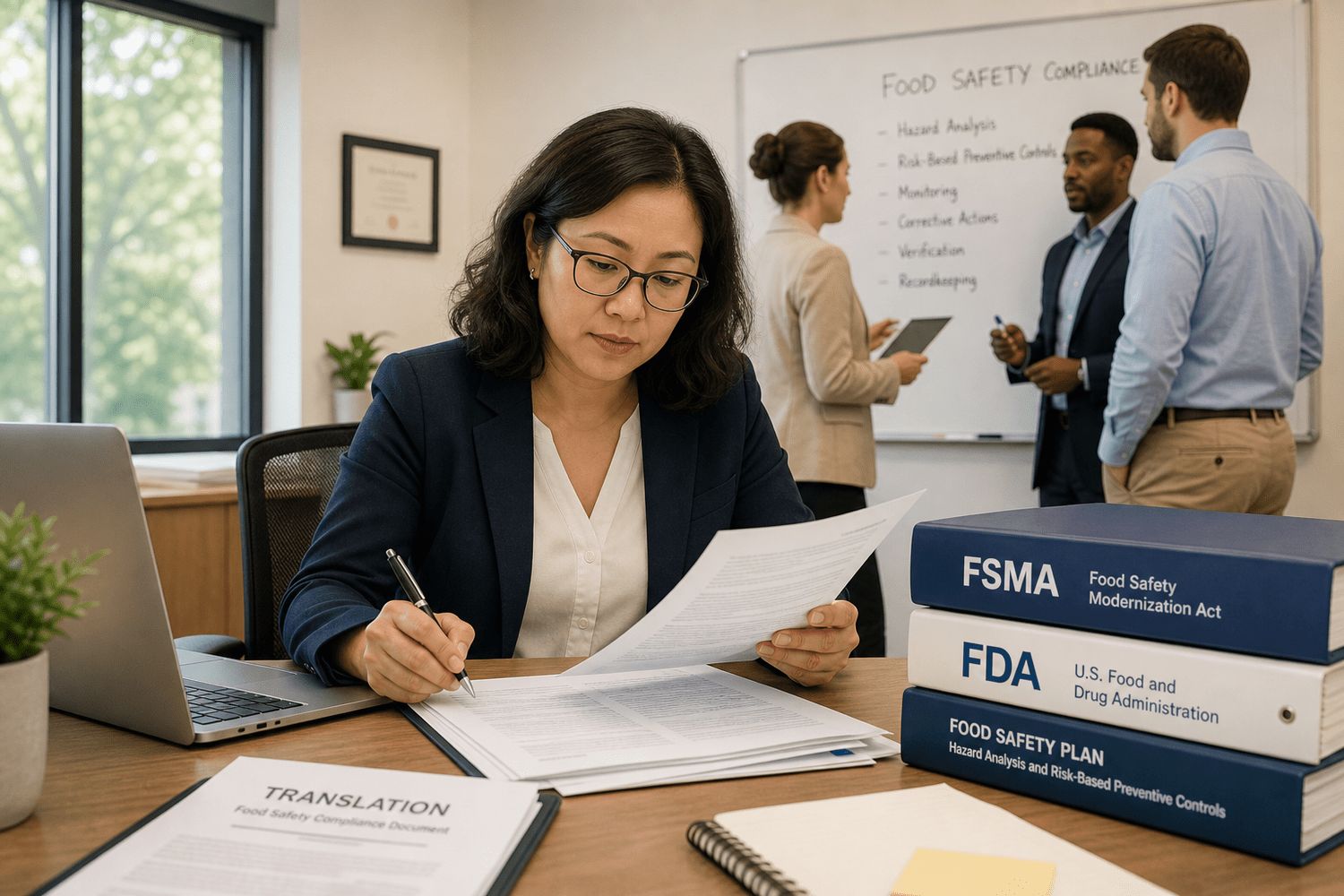
Food safety and worker safety in Indiana's food manufacturing sector depend on clear, accurate communication across every language spoken on your floor. Federal regulations make this not just a best practice but a compliance requirement — and the cost of getting it wrong is far higher than the cost of getting it right.
Need certified interpretation or translation services for your Indiana food manufacturing facility? Heartland Interpretation & Translation Services serves Evansville, Henderson, Owensboro, Jasper, and the full Tri-State region. Call us at (812) 499-1696 or request a free quote online — we'll respond within one business day.

About the author
Jacob Brown
Jacob Brown shares practical guidance from Heartland Language Services on clear, reliable communication for multilingual workplaces.
Keep reading
Related articles
July 16, 2026
OSHA Safety Training Interpreters for Indiana Manufacturers
Indiana manufacturers face OSHA violations and worker injuries when language barriers block safety training. Heartland Language's certified OSHA safety training interpreters serve Evansville, Jasper, Henderson KY, and Louisville KY — closing the gap between attendance and understanding.
Read article →June 26, 2026
Safety Data Sheet Translation for Indiana Manufacturers: OSHA HazCom Compliance and the Multilingual Workforce
Indiana manufacturers with multilingual workforces must provide OSHA HazCom-compliant Safety Data Sheets in every language their employees speak. Learn how certified SDS translation keeps your facility compliant with 29 CFR 1910.1200, GHS standards, and OSHA penalty thresholds — and how Heartland serves the Tri-State region.
Read article →May 19, 2026
Language Access in Indiana’s Auto Manufacturing Sector: How Interpreters Keep Workers Safe and Compliant
Indiana's auto manufacturers face a critical language access gap. Discover how certified interpreters protect workers, ensure OSHA compliance, and reduce costly accidents on the plant floor.
Read article →