
Insights
Language Access in Indiana’s Auto Manufacturing Sector: How Interpreters Keep Workers Safe and Compliant
Indiana's auto manufacturers face a critical language access gap. Discover how certified interpreters protect workers, ensure OSHA compliance, and reduce costly accidents on the plant floor.
Published May 19, 2026 · By Jacob Brown
Quick Summary
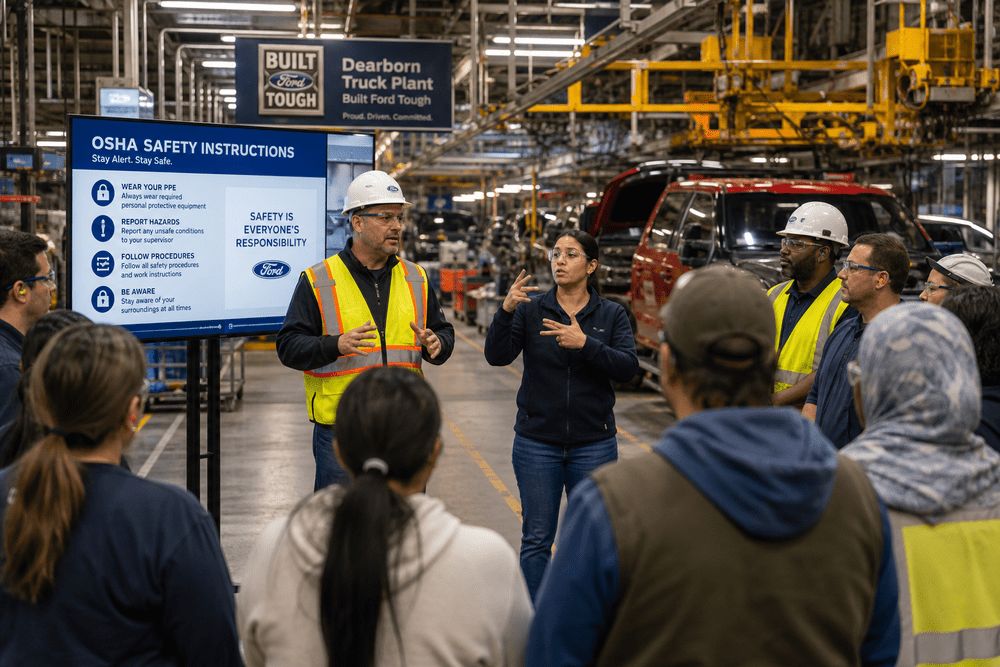
Indiana's automotive manufacturing sector employs thousands of workers who speak Spanish, Burmese, Karen, Somali, Arabic, and other languages as their primary language.
Federal OSHA regulations require that safety information be communicated in a language workers understand — language barriers are not an acceptable excuse for non-compliance.
On-site certified interpreters are the gold standard for safety briefings, hazard training, equipment walkthroughs, and incident investigations.
Heartland Interpretation & Translation Services provides on-site, VRI, and OPI language access solutions for automotive manufacturers across Southwest Indiana and the Tri-State region.
Walk into any major automotive assembly or parts manufacturing facility in Evansville, Jasper, or Henderson, Kentucky, and you'll find something remarkable: workers from dozens of countries, speaking dozens of languages, working shoulder-to-shoulder on complex, high-stakes production lines. Indiana's manufacturing workforce is one of the most linguistically diverse in the Midwest — and that diversity is a genuine competitive advantage when it's supported by proper communication infrastructure.
But when it isn't? The consequences can be devastating.
A worker who doesn't fully understand lockout/tagout procedures because training was delivered only in English. An injury report that never gets accurately filed because the injured employee couldn't communicate the details. A safety audit that reveals non-compliance — not because the company was negligent, but because the communication systems weren't built to reach every worker. These are the real costs of language gaps in automotive manufacturing, and they happen far more often than most facilities realize.
This post explores why language access is a compliance and safety imperative for Indiana's automotive manufacturers, what the regulations actually require, and how certified on-site interpretation makes the difference between a safe facility and a liability waiting to happen.
Indiana's Auto Manufacturing Workforce: Who's in the Plant?
Indiana is one of the top automotive manufacturing states in the country. From major OEM suppliers and Tier 1 parts facilities to stamping plants, powertrain facilities, and distribution centers, the industry employs tens of thousands across the state. And increasingly, that workforce speaks a broad range of languages.
The languages most commonly spoken by manufacturing workers in the Southwest Indiana and Tri-State region include:
Spanish — the most widely spoken non-English language across all manufacturing sectors in Indiana
Burmese and Karen — significant refugee and immigrant communities in Evansville and the surrounding areas
Somali — growing community presence in Henderson, KY, and the greater Tri-State area
Arabic — particularly Iraqi and Syrian communities in the broader Indiana region
Haitian Creole — present in Southern Indiana and Louisville-area facilities
French and Portuguese — among international transferees at global OEM facilities
For HR teams, EHS (Environmental Health & Safety) managers, and plant supervisors, this linguistic diversity isn't a problem to be solved — it's a fact of operational life that requires thoughtful, systematic language access planning. Heartland's automotive manufacturing interpretation services are specifically designed for this environment.
What OSHA Actually Requires (and What It Means for Your Facility)
Many plant managers understand intuitively that communicating safety information to workers is a good idea. What they may not realize is just how specifically OSHA codifies this requirement — and how language barriers factor into enforcement decisions.
The General Duty Clause (Section 5(a)(1))
OSHA's General Duty Clause requires employers to provide a workplace "free from recognized hazards that are causing or likely to cause death or serious physical harm." Courts and OSHA enforcement officers have consistently ruled that a language barrier that prevents workers from understanding safety procedures constitutes a recognized hazard — and that the employer has an obligation to address it.
This means that training a workforce in English only, when a significant portion of that workforce does not speak English as a primary language, may constitute a General Duty Clause violation. This is not a technicality — it's a legal exposure point that has been cited in OSHA citations across the manufacturing sector.
Hazard Communication Standard (29 CFR 1910.1200 — HazCom)
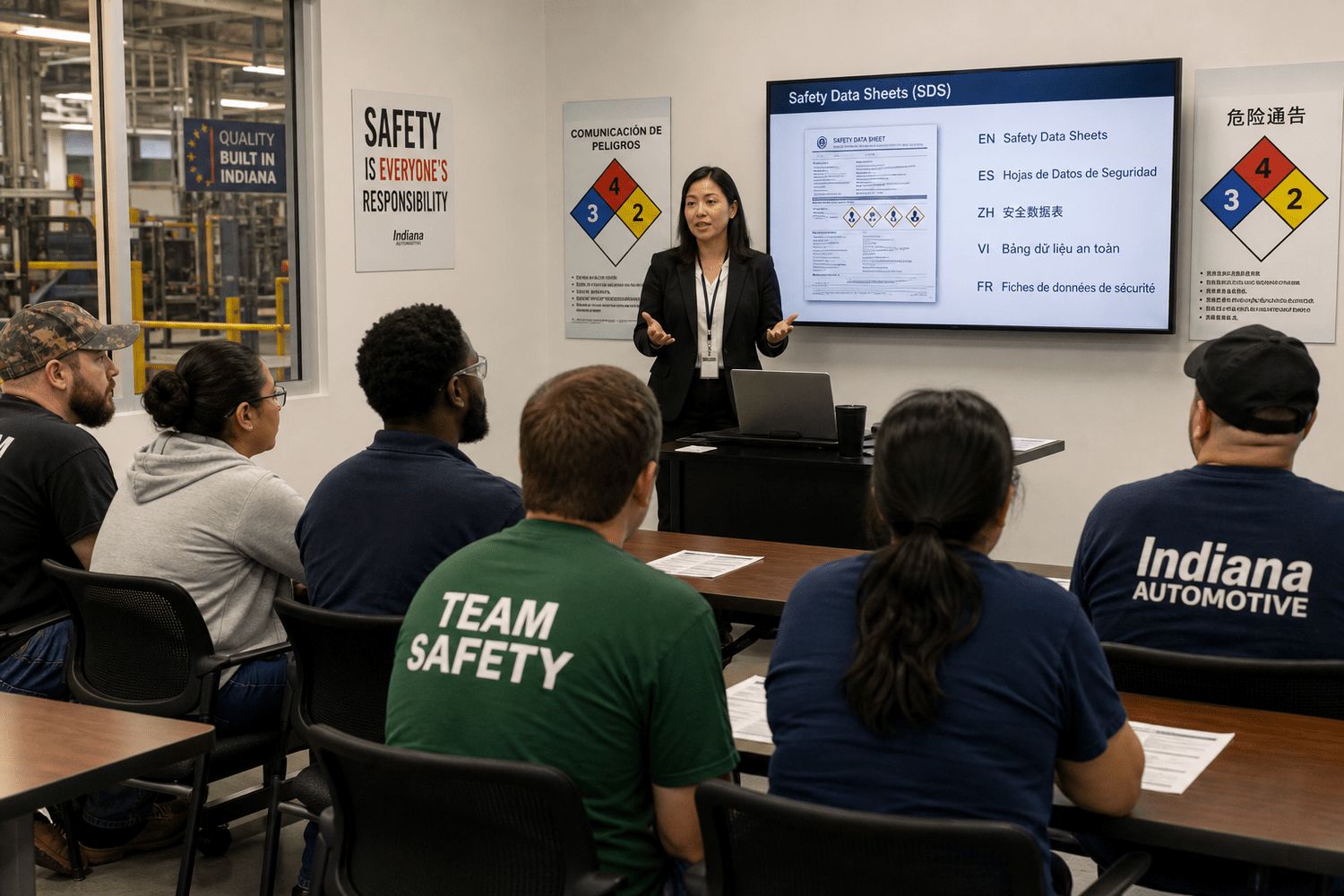
The Hazard Communication Standard — also known as HazCom or the "Right to Know" law — requires employers to inform workers about chemical hazards in the workplace, including those on Safety Data Sheets (SDS) and container labels. Critically, the standard requires that training be conducted in a manner that workers can understand.
For automotive facilities that work with paints, solvents, adhesives, lubricants, metal treatment chemicals, and other hazardous substances, this is a high-stakes compliance area. If a Karen-speaking worker applies a chemical coating without understanding the PPE requirements — not because they were negligent, but because the HazCom training was only in English — your facility faces both a safety incident and a regulatory exposure.
Lockout/Tagout (29 CFR 1910.147)
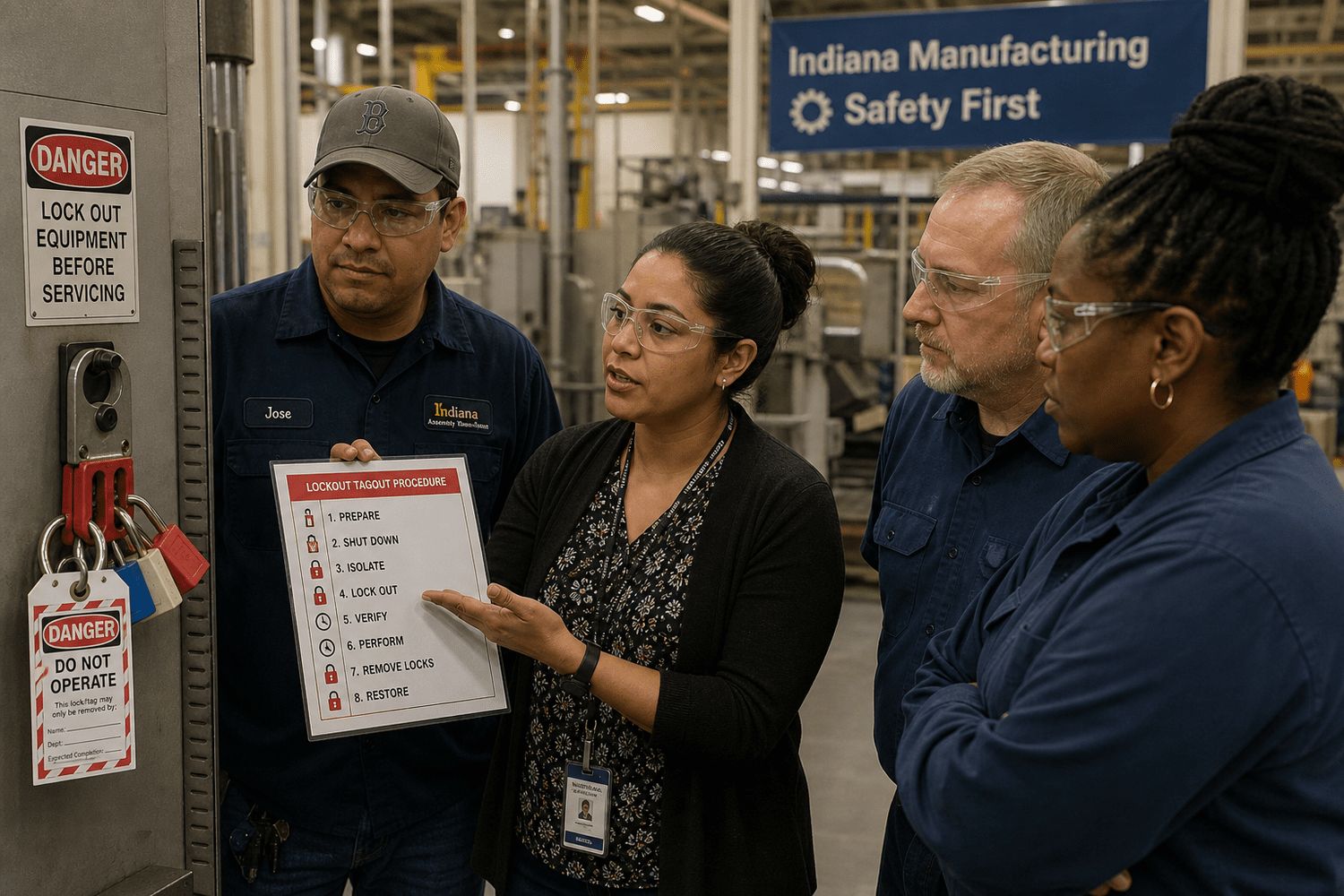
Lockout/tagout (LOTO) is one of the most critical safety procedures in any manufacturing environment. It controls hazardous energy sources during the maintenance and servicing of equipment. OSHA requires that all "authorized" and "affected" employees be trained on LOTO procedures — and that training must be in a language and vocabulary the employee can understand.
In a facility where maintenance technicians include Spanish-speaking and Burmese-speaking employees, English-only LOTO training is not sufficient. This is one of the most common gaps Heartland's clients discover when they conduct their first multilingual language needs assessment.
The Hidden Costs of Language Gaps in Auto Manufacturing
Beyond regulatory exposure, language barriers create real operational and financial costs that compound over time. These include:
Workplace Injuries and Near-Misses
Research consistently shows that workers with limited English proficiency (LEP) experience higher rates of workplace injuries than their English-speaking counterparts. This is not because LEP workers are less capable or less careful — it's because safety information simply didn't reach them in a form they could understand and act on. In automotive manufacturing, where stamping presses, robotic welding arms, and overhead lifts are part of the daily environment, the stakes are extremely high.
Incident Investigation Accuracy
When an injury or near-miss occurs, OSHA requires employers to investigate and document what happened. If the injured worker cannot communicate fluently in English, and no interpreter is present, the incident report will be incomplete at best — and inaccurate at worst. This creates legal exposure, distorts your safety data, and undermines your ability to prevent future incidents.
Workers' Compensation Costs
Facilities with higher injury rates pay more in workers' compensation premiums. A single serious injury involving an LEP worker — particularly one that could have been prevented with proper multilingual training — can generate costs in the hundreds of thousands of dollars when you account for medical care, lost productivity, investigation, and litigation.
Turnover and Workforce Instability
Workers who don't feel safe — and who don't feel that management communicates with them in a language they understand — leave. In a tight labor market across Southwest Indiana and Western Kentucky, replacing experienced manufacturing workers is expensive. Language access isn't just a safety investment; it's a retention strategy.
When Interpretation Matters Most on the Plant Floor
Certified on-site interpreters provide the highest quality language access in manufacturing environments. Here's where they make the greatest difference:
New Employee Orientation and Safety Onboarding
The first days and weeks on the job are when workers are most vulnerable to accidents — they're learning processes, navigating new equipment, and establishing work habits. Multilingual orientation ensures that safety policies, emergency procedures, PPE requirements, and facility rules are understood from day one — not approximated through a bilingual coworker's informal translation.
Annual and Refresher Safety Training
OSHA mandates regular safety training across many of its standards, including HazCom, LOTO, Powered Industrial Trucks (forklifts), Respiratory Protection, and more. When this training is provided in workers' primary languages — not just English — comprehension improves dramatically, and so does compliance.
Pre-Shift Safety Meetings
Many facilities conduct brief daily or weekly safety "toolbox talks" covering topics like near-miss reports, updated procedures, and seasonal hazards. Running these in multiple languages — or using a certified interpreter who can relay information in real time — ensures every team member receives the same critical message.
Injury and Incident Investigations
When an incident occurs, a certified interpreter enables the injured worker to give an accurate, complete account of what happened — without the pressure of performing in a second language or the distortion of informal interpretation. This protects the worker, protects the company, and produces better safety data.
OSHA Inspections and Compliance Walkthroughs
During OSHA inspections, compliance officers may request to speak directly with workers. Having a certified interpreter available demonstrates good faith and ensures that worker accounts are accurately conveyed. Facilities that can demonstrate a systematic language access program — including certified interpretation — are better positioned in enforcement proceedings.
On-Site vs. VRI vs. OPI: Choosing the Right Solution for Your Facility
Not every situation requires the same type of interpretation. Heartland offers three service modes for automotive manufacturers through our comprehensive language services:
On-Site Interpretation — A Heartland-certified interpreter is physically present at your facility. Best for safety training sessions, orientation, incident investigations, union meetings, and any high-stakes situation where a physical presence matters. On-site interpretation allows the interpreter to observe context, read body language, and engage with multiple participants.
VRI (Video Remote Interpreting) — A certified interpreter joins via secure video call. Ideal for HR conversations, disciplinary meetings, benefits enrollment, and situations where an on-site interpreter isn't available on short notice. VRI provides real-time interpretation with a visual connection.
OPI (Over-Phone Interpreting) — A phone-based option for quick, informal conversations — checking in with a worker about a concern, answering a question, or handling urgent communication when neither on-site nor VRI is available. Heartland provides 24/7 OPI access for emergency situations.
What Sets Certified Interpreters Apart from Bilingual Staff
Many facilities try to address language barriers by designating bilingual workers as informal interpreters. This approach is understandable — it's convenient and feels like the simplest solution. But it creates serious risks:
Accuracy: Speaking two languages does not make someone a skilled interpreter. Professional interpreters are trained in interpretation techniques, consecutive and simultaneous interpretation modes, and accuracy verification. A bilingual employee may omit, paraphrase, or unconsciously soften critical safety information.
Liability: When a bilingual coworker interprets safety training and gets something wrong, the company is still liable — and has no documentation showing that a certified professional was engaged.
Dual-role conflict: A bilingual employee pulled from their workstation to interpret is not doing their job — and may be under pressure to rush the interpretation to get back to their duties.
Confidentiality: For HR matters, disciplinary actions, or workers' compensation conversations, a coworker-interpreter creates an inherent conflict of interest and may breach the worker's privacy.
Certified interpreters from Heartland are vetted professionals — not just bilingual individuals. They hold industry credentials, follow strict neutrality and confidentiality standards, and are trained specifically for industrial and technical environments. You can explore all our industry verticals to understand the breadth of environments we serve.
Serving Indiana's Automotive Corridor: Evansville to Louisville
Heartland is based in Evansville, IN, and serves automotive manufacturing facilities across the Tri-State region — including Southwest Indiana (Evansville, Jasper, Princeton, Washington), Northwest Kentucky (Henderson, Owensboro, Louisville), and Southeast Illinois. Our interpreters work regularly with auto parts suppliers, Tier 1 manufacturers, stamping and assembly operations, and logistics facilities supporting the broader automotive supply chain.
Because we're embedded in the region, we understand the specific language communities present in each market. Our interpreter network includes Spanish, Burmese, Karen, Somali, Haitian Creole, Arabic, and dozens of other languages — matched to your facility's actual workforce demographics.
Frequently Asked Questions
Does OSHA require interpreters for safety training?
OSHA does not specifically mandate the use of professional interpreters, but its regulations consistently require that safety training be conducted in a language and vocabulary employees can understand. Using certified interpreters is the most legally defensible way to demonstrate compliance with this requirement. Facilities that rely solely on bilingual coworkers or English-only training face significant enforcement risk when LEP workers are involved in incidents.
How do we request an on-site interpreter for a safety training session?
Scheduling with Heartland is straightforward. Contact our team with the date, time, location, language pair needed, and estimated number of participants. We recommend at least 48 hours' notice for planned training sessions, though we accommodate urgent requests. Reach us at (812) 499-1696 or through our online scheduling portal.
Can Heartland provide interpreters for multiple language groups at the same facility?
Yes. Many of our automotive manufacturing clients have workforces that speak 3–5 different languages. We coordinate multi-interpreter deployments for large orientation sessions or all-hands safety meetings where coverage is needed across multiple language groups simultaneously.
What if we have an urgent language need during a shift — like an injury?
Heartland provides 24/7 OPI (over-phone interpreting) access for urgent situations. If a worker is injured during the night shift and cannot communicate in English, our on-call interpreters are available by phone within minutes. For injury investigations and time-sensitive HR situations, we also provide emergency on-site response when geography permits.
Do you provide written translation services for SOPs, employee handbooks, and safety manuals?
Yes — certified document translation is part of Heartland's core service offering. We translate SOPs, employee handbooks, safety data sheets, onboarding materials, warning labels, and other technical documents into Spanish, Burmese, Karen, Somali, Haitian Creole, Arabic, and 350+ other languages. Translated documents come with a certificate of accuracy.
Build a Safer, More Compliant Workforce — Starting Today
The automotive manufacturing sector operates on tight margins, demanding schedules, and uncompromising safety expectations. Language access isn't a "nice to have" in this environment — it's a foundational operational requirement. Facilities that invest in certified interpretation see measurable returns: fewer injuries, lower workers' comp costs, stronger OSHA compliance records, and more engaged workforces.
Heartland Interpretation & Translation Services has been the Tri-State's trusted language access partner for manufacturing facilities, healthcare providers, and legal organizations. Our interpreters know your industry, your regulations, and your workforce's communities.
Need professional interpretation services for your Indiana or Kentucky automotive facility? Contact the Heartland team today — call (812) 499-1696 or get a free quote online.

About the author
Jacob Brown
Jacob Brown shares practical guidance from Heartland Language Services on clear, reliable communication for multilingual workplaces.
Keep reading
Related articles
May 18, 2026
FSMA, OSHA, and Language Access: Why Indiana Food Manufacturers Can’t Afford Language Gaps
Indiana food manufacturers face FSMA and OSHA language access requirements. Learn why certified interpreters are essential for food safety compliance and worker protection.Indiana food manufacturers face FSMA and OSHA language access requirements. Learn why certified interpreters are essential for food safety compliance and worker protection.
Read article →June 26, 2026
Safety Data Sheet Translation for Indiana Manufacturers: OSHA HazCom Compliance and the Multilingual Workforce
Indiana manufacturers with multilingual workforces must provide OSHA HazCom-compliant Safety Data Sheets in every language their employees speak. Learn how certified SDS translation keeps your facility compliant with 29 CFR 1910.1200, GHS standards, and OSHA penalty thresholds — and how Heartland serves the Tri-State region.
Read article →July 16, 2026
OSHA Safety Training Interpreters for Indiana Manufacturers
Indiana manufacturers face OSHA violations and worker injuries when language barriers block safety training. Heartland Language's certified OSHA safety training interpreters serve Evansville, Jasper, Henderson KY, and Louisville KY — closing the gap between attendance and understanding.
Read article →