
Insights
On-Site Interpreters vs. Translation Apps: Why Indiana Manufacturers Can't Afford to Get This Wrong
Should Indiana hospitals use VRI or on-site interpreters? Learn when each modality meets Section 1557, HIPAA, and Joint Commission requirements — and how Heartland's hybrid model serves the Tri-State.
Published June 12, 2026 · By Jacob Brown
Quick Summary
Translation apps—Google Translate, Microsoft Translator, iTranslate—are fast and free. But on an Indiana factory floor, "fast and free" can mean misunderstood lockout/tagout procedures, incorrect chemical handling, and OSHA citations. This post explains why certified on-site interpreters outperform apps for every compliance-critical use case, and when a hybrid approach makes sense.
Picture a safety supervisor at a Jasper, Indiana, plastics plant. A new cohort of Spanish-speaking workers just finished onboarding, and tomorrow's first shift includes a chemical changeover with SDS review. The supervisor pulls out his phone, opens Google Translate, and reads the HazCom procedures aloud through the app's microphone.
It sounds modern. It sounds efficient. It sounds like a lawsuit waiting to happen.
Indiana's manufacturing sector employs more than 500,000 workers—one of the highest concentrations of factory employment in the nation. Across the Tri-State corridor (Evansville, Henderson, Louisville, and Jasper), facilities routinely operate with workforces that speak Spanish, Burmese, Karen, Somali, Arabic, and Haitian Creole as primary languages. Communicating safety-critical information to these workers is not a "nice to have." It is a legal obligation under OSHA's Hazard Communication Standard (29 CFR 1910.1200) and the General Duty Clause.
The question isn't whether to bridge the language gap. The question is: how? And for most compliance scenarios, the answer is still a certified, on-site human interpreter—not an app.
What Translation Apps Actually Do Well (and Where They Fall Apart)
It's worth being fair to translation technology. Apps like Google Translate and Microsoft Translator have improved dramatically over the past decade. Neural machine translation (NMT) now handles common conversational phrases with reasonable accuracy. For a manager who needs to ask a worker "Did you eat lunch?" or "What time did you arrive?", an app works fine.
The problems multiply the moment communication becomes technical, nuanced, or safety-critical:
1. Industrial Jargon Isn't in the Training Data
Manufacturing vocabulary is highly specialized. Terms like "lockout/tagout," "pinch point," "dunnage," "torque specification," "LOTO energy isolation," or "PSI bleed-down sequence" don't map cleanly into most target languages—especially when workers' primary languages are Burmese dialects, Karen sub-varieties, or Somali. Machine translation tools often transliterate these terms rather than translate them, leaving the worker with a phonetic approximation of an English word that means nothing to them.
A certified interpreter who has worked in manufacturing environments knows these terms. They've discussed HazCom procedures, SDS sheets, and emergency action plans in the languages your workforce speaks. They carry that domain expertise into every session.
2. Apps Can't Assess Comprehension
One of the most valuable things a professional interpreter does is check for understanding. After explaining a lockout/tagout procedure, a good interpreter notices if the worker looks confused. They ask a clarifying question. They rephrase. They catch the moment where communication breaks down—before it becomes a recordable incident.
A translation app cannot do this. It renders a string of text or spoken words into another language and stops there. The comprehension gap is invisible to the tool.
OSHA's General Duty Clause requires employers to provide a workplace "free from recognized hazards." Courts and OSHA compliance officers have consistently found that failing to ensure comprehension—not merely providing translated words—can constitute a violation. "We used an app" is not a defensible answer when a worker is injured after misunderstanding a procedure that was "translated" for them.
3. Accuracy Degrades in Noisy or High-Stress Environments
Factory floors are loud. Machinery, ventilation systems, forklifts, and alarms create ambient noise levels that degrade speech recognition accuracy significantly. Translation apps that rely on voice input fail repeatedly in these environments. Workers and supervisors end up shouting into phones, receiving garbled outputs, and filling the gaps with guesswork.
On-site interpreters are trained to communicate in difficult acoustic environments. They position themselves appropriately, use clear pacing, and adapt to the environment—something no app can do.
4. Dialect Variation Is Significant—and Ignored by Most Apps
Indiana's manufacturing workforce speaks Spanish from Mexico, Central America, and multiple South American countries. "Burmese" refers to at least three distinct language communities (Burmese, Sgaw Karen, and Kayah/Karenni) that are mutually unintelligible. "Somali" workers may come from communities with distinct regional vocabulary differences.
Most consumer translation apps default to standard or prestige forms of target languages. They don't handle Karen dialects, Haitian Creole (distinct from French), or Marshallese. If your workforce speaks one of these languages, the app isn't just inadequate—it's a source of active miscommunication.
The OSHA Framework: What "Effective Communication" Actually Requires
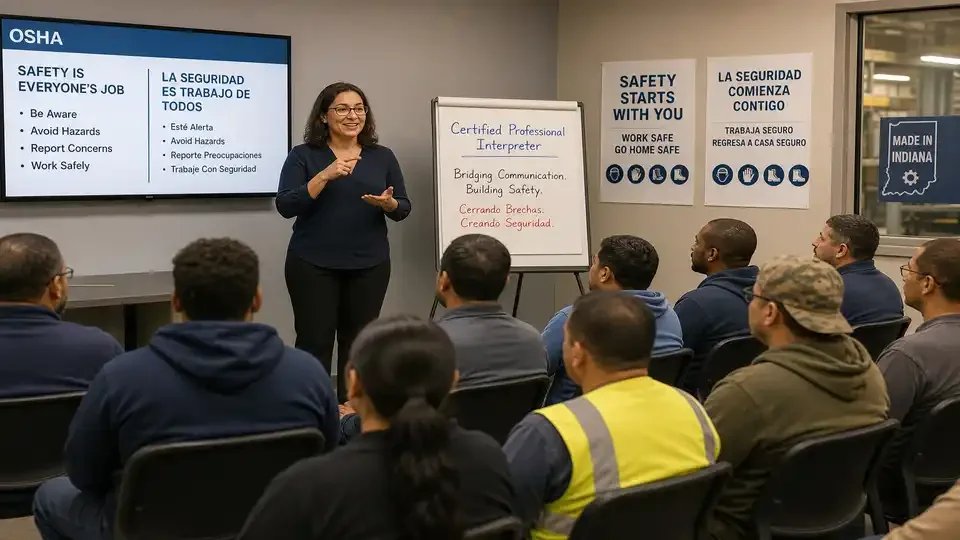
OSHA's Hazard Communication Standard (29 CFR 1910.1200) requires that employees be able to understand the hazards in their workplace. The standard doesn't specify a method—it requires an outcome. Employers are responsible for verifying that the information communicated was actually received and understood.
In practice, OSHA has cited employers who relied solely on translated documents without verifying worker comprehension. The General Duty Clause (Section 5(a)(1) of the OSH Act) has been used to cite employers where language barriers contributed to a recordable injury—even when formal HazCom training was completed on paper.
The most defensible position is a layered approach:
Certified translation of written materials (SDS sheets, emergency action plans, SOPs)
On-site interpreter during live training and walk-throughs
Verification of comprehension documented in training records
This is the standard that Heartland's manufacturing clients across Evansville, Henderson, Owensboro, and Jasper maintain. It's also the standard that holds up under a Compliance Safety and Health Officer (CSHO) review.
When Technology Genuinely Helps: The Honest Answer
We want to be clear: we're not anti-technology. The question is fit for purpose.
Translation apps are appropriate for:
Low-stakes, non-safety-critical conversational exchanges ("Where is the breakroom?")
Quick confirmation questions when a certified interpreter isn't available and the matter is not compliance-critical
Supplemental material—post-training written reference documents for workers to keep
Internal HR tasks like scheduling or attendance communication
Certified on-site interpreters are required for:
OSHA safety training (HazCom, LOTO, LOTO energy isolation, PSM, EAP, fall protection)
New hire orientation and onboarding safety modules
Post-incident investigation and witness interviews
Medical evaluations and workers' compensation proceedings
Union negotiations or disciplinary proceedings involving LEP workers
Emergency response drills
Any situation where a misunderstanding could result in injury, illness, or legal liability
The distinction is not technical. It's about stakes. When the stakes involve safety, compliance, or legal exposure, the margin for error is zero—and apps do not offer zero-margin performance.
Real Scenario: What On-Site Interpretation Looks Like in Practice
Consider a food processing plant in Henderson, KY, with approximately 180 employees. Forty percent speak Spanish as their primary language; another 12 percent speak Karen. Every six months, the plant runs mandatory HazCom refresher training for all production staff.
With an app-based approach, the safety manager would read training content into a translation app, display the output on a screen, and hope that workers understood. Post-training test scores were inconsistently low in the Karen-speaking cohort, and the safety manager wasn't sure why—but it was documented as "complete."
After partnering with Heartland, the plant now runs training with two certified interpreters: one fluent in Spanish, one fluent in Sgaw Karen. Each interpreter sits in with their language cohort, translates in real time, and pauses the session when workers have questions. Post-training comprehension tests now average 94% across all language groups. The plant has had zero HazCom-related recordable incidents in the 18 months since making the switch.
That's not anecdote. That's the documented difference between "translation happened" and "communication occurred."
Cost Objection: "Certified Interpreters Are Expensive"
This is the most common objection—and it deserves a direct response.
OSHA penalties for willful violations reach $161,323 per violation as of 2026. A single serious violation citation runs up to $16,131 per instance. A recordable incident involving a worker who misunderstood a safety procedure due to inadequate language support exposes a facility to citation, workers' compensation claims, civil liability, and reputational damage.
Against that backdrop, the cost of a half-day on-site interpreter for HazCom training is negligible. It's not an expense—it's risk mitigation with a well-documented ROI.
Heartland's manufacturing clients typically use a tiered model:
On-site interpreting for quarterly safety training, new hire cohorts, and post-incident reviews
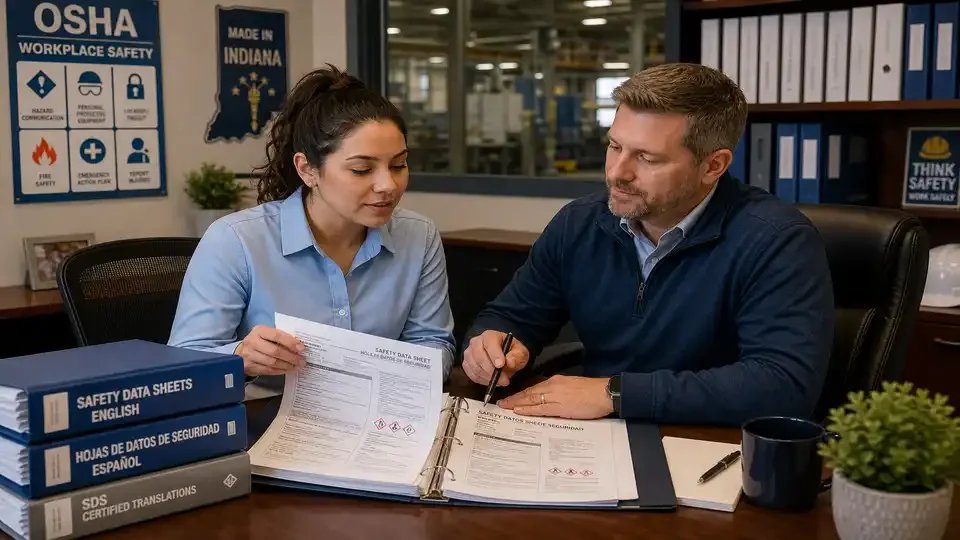
Certified document translation for SDS sheets, SOPs, employee handbooks, and emergency action plans
On-call remote interpreting (OPI) as a bridge between scheduled sessions
This hybrid model provides comprehensive coverage at a cost structure most mid-size manufacturers find manageable. And it provides the audit trail—signed comprehension forms, interpreter attendance records, translated document version logs—that satisfies CSHO review. Learn more about how Heartland structures manufacturing language support at our industries page.
Frequently Asked Questions
Can we use bilingual supervisors instead of a professional interpreter?
Bilingual supervisors are valuable and can handle conversational communication effectively. However, for safety-critical training, they are not a substitute for a certified interpreter. OSHA and courts distinguish between "someone who speaks the language" and a trained, professional interpreter who can accurately convey technical content, maintain neutrality, and document their work. Using an untrained bilingual employee for HazCom training also creates liability for the employee if a miscommunication occurs.
What languages does Heartland support for manufacturing clients?
Heartland supports 350+ languages, with deep experience in the language communities most common to Indiana and Tri-State manufacturing: Spanish (multiple dialects), Burmese, Sgaw Karen, Kayah/Karenni, Somali, Arabic, Haitian Creole, and Marshallese. For less common languages, we can typically arrange a certified interpreter with adequate lead time.
How much notice do you need to schedule an on-site interpreter?
For planned training events, 48–72 hours is generally sufficient for common languages. For same-day or emergency needs (post-incident interviews, medical evaluations), Heartland offers on-call OPI (over-phone interpreting) services that can be accessed within minutes. Learn more on our services page.
Do you provide documentation for OSHA compliance records?
Yes. Heartland provides session records, interpreter certifications on request, and can assist with building the language access documentation that OSHA compliance officers look for during site visits.
Our workforce is mostly Spanish-speaking—do we really need a professional interpreter for Spanish?
For conversational exchanges, a bilingual staff member may suffice. For safety training, yes—professional interpretation is still best practice. The legal standard doesn't exempt common languages, and dialect variation within Spanish (regional vocabulary, technical term differences) means that a certified interpreter familiar with your workers' home region will consistently outperform a generalist bilingual employee for comprehension-critical content.
How Heartland Serves Tri-State Manufacturers
Heartland Interpretation & Translation Services is based in Evansville, Indiana, and serves manufacturers throughout the Tri-State region: Southwest Indiana (Evansville, Jasper, Newburgh), Northwest Kentucky (Henderson, Owensboro), and Southeast Illinois. Our interpreters have direct experience with the manufacturing environments in this region—including food processing, plastics, aluminum, and automotive assembly.
We provide:
On-site interpreting for OSHA safety training, new hire orientation, and compliance audits
Certified document translation for SDS sheets, SOPs, employee handbooks, OSHA 300 logs, and emergency action plans
On-call OPI and VRI for day-to-day operational needs and post-incident support
Language access audits to help manufacturers identify gaps before OSHA does
The difference between "we used an app" and "we used Heartland" is the difference between a compliance gap and a documented, defensible language access program.
Ready to build that program? Get a free quote from Heartland today, or call us at (812) 499-1696. Our team is ready to help you keep every worker on your floor safe, informed, and heard.

About the author
Jacob Brown
Jacob Brown shares practical guidance from Heartland Language Services on clear, reliable communication for multilingual workplaces.
Keep reading
Related articles
June 10, 2026
VRI vs. On-Site Medical Interpretation: How Indiana Hospitals and Clinics Should Choose
Should Indiana hospitals use VRI or on-site interpreters? Learn when each modality meets Section 1557, HIPAA, and Joint Commission requirements — and how Heartland's hybrid model serves the Tri-State.
Read article →June 26, 2026
Safety Data Sheet Translation for Indiana Manufacturers: OSHA HazCom Compliance and the Multilingual Workforce
Indiana manufacturers with multilingual workforces must provide OSHA HazCom-compliant Safety Data Sheets in every language their employees speak. Learn how certified SDS translation keeps your facility compliant with 29 CFR 1910.1200, GHS standards, and OSHA penalty thresholds — and how Heartland serves the Tri-State region.
Read article →May 28, 2026
Top Languages Spoken in Indiana Healthcare Settings — And How Hospitals Can Serve Every Patient
Which languages do Indiana hospitals encounter most? Learn how Evansville-area healthcare facilities meet Section 1557 language access requirements with certified interpreters.
Read article →