
Insights
Immigration Court Interpretation in Indiana: Why Getting It Right Is a Matter of Freedom
Immigration court proceedings in Indiana require qualified, certified interpreters — not bilingual staff. Heartland provides vetted immigration interpreters in 350+ languages across Evansville, Henderson KY, and the Tri-State region. Excerpt: Immigration proceedings require certified interpreters fluent in legal terminology and immigration procedure. A single mistranslated phrase can mean denial of asylum or wrongful deportation. Heartland provides qualified immigration interpreters in 350+ languages across Southwest Indiana and the Tri-State region.
Published June 16, 2026 · By Jacob Brown

Quick Summary:
Immigration proceedings — from asylum hearings to removal proceedings — require certified interpreters who are fluent in legal terminology, immigration procedure, and the precise nuances of your client's native language. A single mistranslated phrase can mean denial of asylum, wrongful deportation, or a missed filing deadline. Heartland Interpretation & Translation Services provides qualified immigration interpreters across Southwest Indiana, Henderson KY, Louisville, KY, and the broader Tri-State region — in 350+ languages, including Spanish, Burmese, Karen, Haitian Creole, Arabic, and more.
For an immigrant facing a removal hearing, an asylum interview, or a green card application, every word matters. The difference between "I fear persecution" and "I was afraid of people" — a subtle distinction that a bilingual neighbor might blur — can determine whether a family stays together in Indiana or is deported to a country they fled in fear.
Immigration law is one of the most complex, high-stakes fields in the American legal system. And interpretation quality is one of its most underestimated variables. Indiana's growing immigrant and refugee population — concentrated in Evansville, Indianapolis, Fort Wayne, and throughout the Tri-State region — deserves interpreters who are not just bilingual, but professionally trained, vetted, and grounded in the language of immigration law.
At Heartland Interpretation & Translation Services, we work directly with immigration attorneys, legal aid organizations, and nonprofit advocacy groups across Southwest Indiana, Henderson, KY, and Louisville, KY to provide qualified immigration interpreters in over 350 languages. Here's why that expertise matters — and what the stakes look like when it's absent.
The Legal Framework: Who Must Provide Interpretation in Immigration Proceedings?
The U.S. immigration court system is governed by the Executive Office for Immigration Review (EOIR), a division of the Department of Justice. Under EOIR regulations, the U.S. government is required to provide a competent interpreter for respondents who are not proficient in English in immigration court removal proceedings (8 C.F.R. § 1240.5).
However, "competent" is not a simple bar to clear. Courts have repeatedly found that deficient interpretation constitutes a due process violation under the Fifth Amendment. Immigration judges have discretion to evaluate interpreter quality — and in some cases, poor interpretation has led to remand orders from the Board of Immigration Appeals (BIA) when it was found to have materially affected a respondent's ability to understand or present their case.
For attorney-client interviews, asylum pre-screening interviews (credible fear and reasonable fear screenings), USCIS interviews, and other non-court proceedings, the burden of providing an interpreter often falls on the attorney, the advocacy organization, or the applicant themselves. This is where professional language services become essential — and where cutting corners is most dangerous.
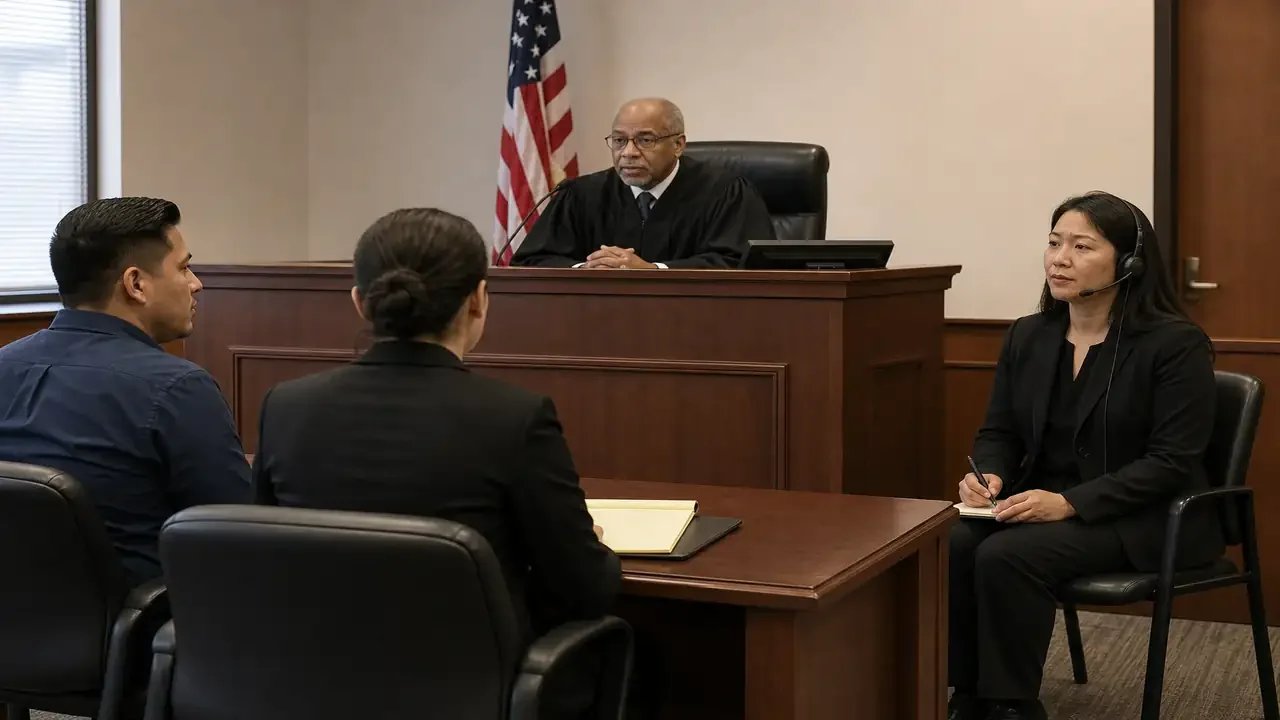
What Can Go Wrong Without a Qualified Immigration Interpreter?
The consequences of poor interpretation in immigration proceedings are not abstract. They play out in real cases, with irreversible outcomes.
1. Asylum Denials Based on Credibility Errors
Asylum cases often turn on the applicant's credibility. Immigration judges look for internal consistency in testimony — and inconsistencies, even minor ones, can be used to deny a claim. When those inconsistencies arise from interpretation error rather than dishonesty, the result is a wrongful denial. A respondent from rural Guatemala may speak an indigenous Mayan language, not Spanish. An interpreter who speaks only standard Spanish and guesses at the meaning creates a credibility trap that the applicant cannot escape.
2. Waived Rights and Missed Procedures
Immigration respondents must understand their rights and procedural options in real time. If a respondent doesn't understand that they can request voluntary departure instead of a formal removal order — because the interpreter paraphrased rather than translated — they may waive a right that would have allowed them to return legally in the future. These procedural consequences are often permanent.
3. Attorney-Client Communication Failures
Effective legal representation requires genuine attorney-client communication. When an attorney can't accurately convey what documents to bring, what to expect at the hearing, or how to answer a judge's questions — because the interpreter lacks the legal vocabulary or cultural competency — the representation suffers, and so does the client.
4. Filing Deadlines Missed Due to Miscommunication
Immigration deadlines are often non-waivable. A one-year asylum application deadline, a 30-day appeal window, and a Notice to Appear response requirement — missing these due to a communication failure with a client who didn't fully understand can eliminate viable paths to legal status.
Languages in Demand Across Indiana's Immigrant Communities
Southwest Indiana and the broader Tri-State region are home to a growing and linguistically diverse immigrant population. Heartland's interpreters regularly serve communities speaking:
Spanish — the most common language in immigration proceedings nationally, with significant regional dialect variation (Mexican Spanish, Guatemalan Spanish, Honduran Spanish)
Burmese and Karen — large refugee communities in Evansville and Southern Indiana, often fleeing political persecution from Myanmar
Haitian Creole — a growing community in the Tri-State region; a distinct language from French, requiring dedicated interpreters
Arabic — diverse regional dialects (Syrian, Iraqi, Egyptian, Yemeni) that require dialect-aware interpretation
Somali — East African refugee communities with significant immigration proceedings activity
Portuguese (Brazilian) — increasingly present in immigration courts serving the Midwest
Vietnamese, Tigrinya, Dari, Pashto — present in Evansville and Henderson areas
Heartland supports all of these languages — and over 350 more — through a vetted network of professional interpreters with immigration-specific training. We don't just provide a bilingual person; we provide a trained legal interpreter who understands the stakes.
What Makes an Immigration Interpreter "Qualified"?
Not all interpreters are equal — and in immigration proceedings, the difference matters enormously. A qualified immigration interpreter must possess:
Fluency in both languages at a professional level — including the ability to accurately convey complex legal arguments, emotional testimony, and culturally specific references without paraphrase or omission
Knowledge of immigration-specific legal vocabulary — terms like "withholding of removal," "Convention Against Torture," "credible fear," "voluntary departure," and "adjustment of status" have precise legal meanings that cannot be approximated
Consecutive and simultaneous interpretation skills — court interpretation requires the consecutive mode (speaker pauses, interpreter renders); some preparation and witness meetings may use the simultaneous mode
Ethical neutrality — an interpreter must not advocate for either side, add commentary, or filter content
Cultural competency — understanding why a respondent might answer questions in a culturally indirect way, or might not make direct eye contact, helps prevent misreadings of credibility
Heartland's interpreter vetting process screens for all of these qualifications. Our team works with interpreters who have experience in legal settings, not just general community interpreting. When you hire Heartland for an immigration matter, you're getting someone who understands what's on the line.

How Heartland Supports Immigration Attorneys and Legal Aid Organizations
Heartland partners with a range of immigration-adjacent organizations across the Tri-State area:
Private immigration law firms — providing interpreters for client intake, case preparation, court hearings, and USCIS interviews on an as-needed or recurring basis
Legal aid organizations — supporting pro bono representation with reliable, affordable professional interpretation so that low-income immigrants receive the same quality of communication as paying clients
Nonprofit refugee resettlement agencies — helping newly arrived refugees navigate benefits enrollment, housing applications, and legal screenings
Community health centers — when immigration clients need both legal and medical support (a common intersection in asylum cases involving torture or trauma), Heartland bridges both needs
We offer on-site interpretation for in-person meetings and hearings, Video Remote Interpretation (VRI) for USCIS interviews and virtual proceedings, and Over-the-Phone Interpretation (OPI) for urgent, time-sensitive communications.
Learn more about our full range of language services and how we serve legal clients across Indiana, Kentucky, and Illinois.
A Note on Certified Document Translation for Immigration Cases
Immigration proceedings require not only interpretation of spoken language — they also require certified translation of documents. The U.S. Citizenship and Immigration Services (USCIS) requires that any document submitted in a language other than English must be accompanied by a full English translation certified by a competent translator who attests that the translation is accurate and complete (8 C.F.R. § 103.2(b)(3)).
This applies to:
Birth certificates, marriage certificates, and death certificates
Police clearance letters and court records from foreign countries
Country condition documentation in asylum cases
Medical records documenting torture or persecution
School records and diplomas
Heartland provides certified document translation services in addition to interpretation. Our translators produce USCIS-compliant certified translations with the required attestation statement, formatted to meet government submission standards. Visit our legal services page to learn more about our immigration document translation capabilities.
Frequently Asked Questions: Immigration Interpretation in Indiana
Does the government provide a free interpreter for immigration court hearings?
For removal proceedings in immigration court, yes — EOIR is required to provide a government interpreter. However, for attorney-client preparation meetings, asylum pre-screening interviews with USCIS asylum officers, and other non-court proceedings, the cost of interpretation is typically the responsibility of the attorney or the client. Heartland provides affordable professional interpretation for all stages of the immigration process.
Can I use a family member or bilingual friend as my interpreter in immigration proceedings?
While some informal settings may tolerate it, it is strongly inadvisable for any substantive immigration proceeding. Untrained interpreters routinely paraphrase, omit details, and introduce errors that are invisible to everyone in the room — including the judge. Family members also carry emotional involvement that can distort interpretation. Courts have found due process violations based on deficient interpretation, and a professional interpreter protects both the respondent and the record.
What languages does Heartland provide for immigration cases?
Heartland supports over 350 languages, including Spanish (all major dialects), Burmese, Karen, Haitian Creole, Somali, Arabic (with dialect awareness), Dari, Pashto, Tigrinya, Vietnamese, Portuguese, and many others. If you have a language need, contact us — we almost certainly have a vetted interpreter available.
How quickly can Heartland provide an immigration interpreter?
For many major languages, we can provide same-day or next-day availability, particularly for phone or VRI interpretation. On-site interpreter scheduling for hearings typically requires 48–72 hours’ advance notice to ensure proper matching. Emergency situations are handled on a case-by-case basis — call us at (812) 499-1696 to discuss urgent needs.
Do you provide interpretation for USCIS naturalization interviews?
Yes. While the naturalization interview itself is conducted in English (applicants are expected to demonstrate English proficiency), there are exceptions for elderly applicants and those with qualifying disabilities, and preparation meetings with attorneys often require interpretation. Heartland supports all phases of the naturalization process.
The Bottom Line: Language Access Is a Justice Issue
Immigration proceedings are among the most consequential legal events in a person's life. The outcome can mean the difference between safety and deportation, family unity and separation, a path to citizenship and permanent legal limbo. Interpretation quality is not a logistics detail — it is a justice issue.
Heartland Interpretation & Translation Services exists to make sure that language is never the reason a Tri-State immigrant loses their case. We serve Evansville, Henderson, KY, Louisville, KY, Owensboro, Jasper, and communities throughout Southwest Indiana and Southeast Illinois with professional, vetted interpretation in over 350 languages.
If your law firm, legal aid organization, or nonprofit serves immigrant clients in Indiana, Kentucky, or Illinois, we're here to help. Call us at (812) 499-1696 or request a free quote online, and let's make sure every client has a fair chance to be heard.
— The Heartland Team

About the author
Jacob Brown
Jacob Brown shares practical guidance from Heartland Language Services on clear, reliable communication for multilingual workplaces.
Keep reading
Related articles
July 13, 2026
Workers' Compensation Interpreters in Indiana: A Guide for Law Firms
Indiana and Kentucky law firms rely on qualified workers’ compensation interpreters to protect injured workers, preserve accurate records, and support depositions, IMEs, and hearings. Heartland Language serves Evansville, Henderson, Louisville, and the Tri-State region.
Read article →July 10, 2026
Spanish Interpretation Services in Evansville, Indiana
Businesses across Evansville and the Tri-State area rely on professional Spanish interpretation to communicate clearly, protect compliance, and serve multilingual communities. Learn how Heartland Language supports healthcare, legal, manufacturing, and business teams.
Read article →July 2, 2026
Pediatric Medical Interpreters in Indiana: Protecting Every Child's Right to Care
Qualified pediatric medical interpreters help protect non-English-speaking children and families across Indiana by ensuring diagnoses, consent, discharge instructions, and follow-up care are clearly understood. This guide explains why trained interpreters are essential for pediatric clinics, hospitals, and specialty practices serving Evansville, Henderson, Louisville, Jasper, and SE Illinois.
Read article →