
Insights
Section 1557 Language Access Compliance: What Indiana Healthcare Providers Must Know in 2026
Published June 4, 2026 · By Jacob Brown


When a Spanish-speaking mother walks into Deaconess Hospital in Evansville, unsure whether her child's symptoms are serious, or when a Burmese-speaking construction worker arrives at a Henderson, KY, urgent care clinic after an accident on the job, the quality of communication they receive isn't just a courtesy — it's a legal requirement.
Section 1557 of the Affordable Care Act is the federal law that governs language access in healthcare. And in 2026, with HHS finalizing a major rule update in 2024 and OCR enforcement activity ramping up, Indiana, Kentucky, and Illinois healthcare providers can no longer afford a wait-and-see posture on compliance.
This guide covers what Section 1557 requires, what's changed, and exactly how Tri-State healthcare providers can meet their obligations — without the compliance headaches.
📋 Quick Summary
Section 1557 of the ACA prohibits discrimination in health programs receiving federal funding — including language-based discrimination against LEP patients.
The 2024 HHS Rule Update reinstated robust language access requirements, including mandatory use of qualified interpreters and translated notices.
Indiana healthcare providers in the Evansville/Henderson/Louisville Tri-State area serve significant LEP populations — Spanish, Burmese, Karen, Haitian Creole, Somali, Arabic, and more.
Covered entities must provide free interpreter services, translate vital documents, and maintain a Language Access Plan.
Heartland Interpretation & Translation Services provides HIPAA-compliant qualified interpreters and certified document translation for Tri-State healthcare facilities.
What Is Section 1557 — and Who Does It Cover?
Section 1557 of the Affordable Care Act (42 U.S.C. § 18116) is the first federal civil rights law specifically protecting individuals in health programs and activities. It prohibits discrimination on the basis of race, color, national origin, sex, age, and disability in:
Any health program or activity that receives federal financial assistance from HHS
Health programs administered by HHS
Health insurance Marketplaces and plans offered through them
"National origin" discrimination under Section 1557 includes discrimination based on limited English proficiency (LEP). That means if your hospital, clinic, or health system accepts Medicaid, Medicare, or any HHS grant funding — and virtually all do — you are legally required to provide meaningful language access to patients who speak limited English.
In practical terms, this applies to:
Hospitals and health systems
Physician practices and medical groups
Federally Qualified Health Centers (FQHCs)
Community mental health centers
Home health and hospice agencies
Ambulatory surgery centers
Dental practices billing Medicaid
Long-term care facilities with federal funding
If you serve patients in Evansville, Henderson, Owensboro, Louisville, Jasper, or anywhere in the Tri-State region and accept any form of federal healthcare funding, Section 1557 applies to you.
What Changed in the 2024 HHS Rule Update
The history of Section 1557 enforcement has been shaped by regulatory back-and-forth. The Obama-era 2016 rule established detailed requirements for language access. A 2020 rule significantly scaled those back. Then in 2024, HHS issued a final rule restoring and strengthening language access protections.
Here's what the 2024 rule reinstated and added for Tri-State healthcare providers:
1. Qualified Interpreter Requirement Is Back — and Stronger
Covered entities must provide qualified interpreters to LEP patients at no cost. A "qualified interpreter" means someone who has demonstrated proficiency in both languages, has knowledge of specialized healthcare terminology, and follows interpreter ethics, including confidentiality and impartiality.
Critically, the rule explicitly addresses who does not qualify:
A bilingual staff member (physician, nurse, or front-desk employee) whose primary role is not interpreting
A family member or friend of the patient — including adult children or spouses
A minor child in any circumstances
Unvetted telephone translation apps or machine translation tools without human oversight
This matters enormously for Tri-State providers. The practice of "language-brokering" — asking a bilingual nurse to interpret, or allowing a patient's adult daughter to translate during a consult — is common in understaffed clinics but creates significant legal exposure under the 2024 rule.
2. Mandatory Taglines in 15+ Languages
Every significant communication to the public must include taglines in the top 15 languages spoken by LEP individuals in the state. For Indiana, Kentucky, and Illinois, this includes Spanish, Burmese, Karen, Haitian Creole, Somali, Arabic, and several others.
These taglines must inform individuals that free language assistance is available. They need to appear in patient-facing materials: discharge instructions, appointment reminders, consent forms, billing notices, website pages, and signage.
3. Translated Vital Documents
Vital documents — those critical to accessing or participating in a health program — must be translated into each language spoken by a significant number or percentage of LEP individuals served or encountered. HHS defines "vital" to include:
Informed consent forms
Patient intake forms
Discharge instructions and care summaries
Financial aid and billing documents
Grievance and appeals notices
Notices of eligibility or denial
4. Language Access Plan Required
Covered entities with 15 or more employees must develop, maintain, and implement a written Language Access Plan (LAP). The LAP must include an assessment of the language needs of the LEP populations served, procedures for providing language assistance, staff training protocols, and a process for monitoring and updating the plan.
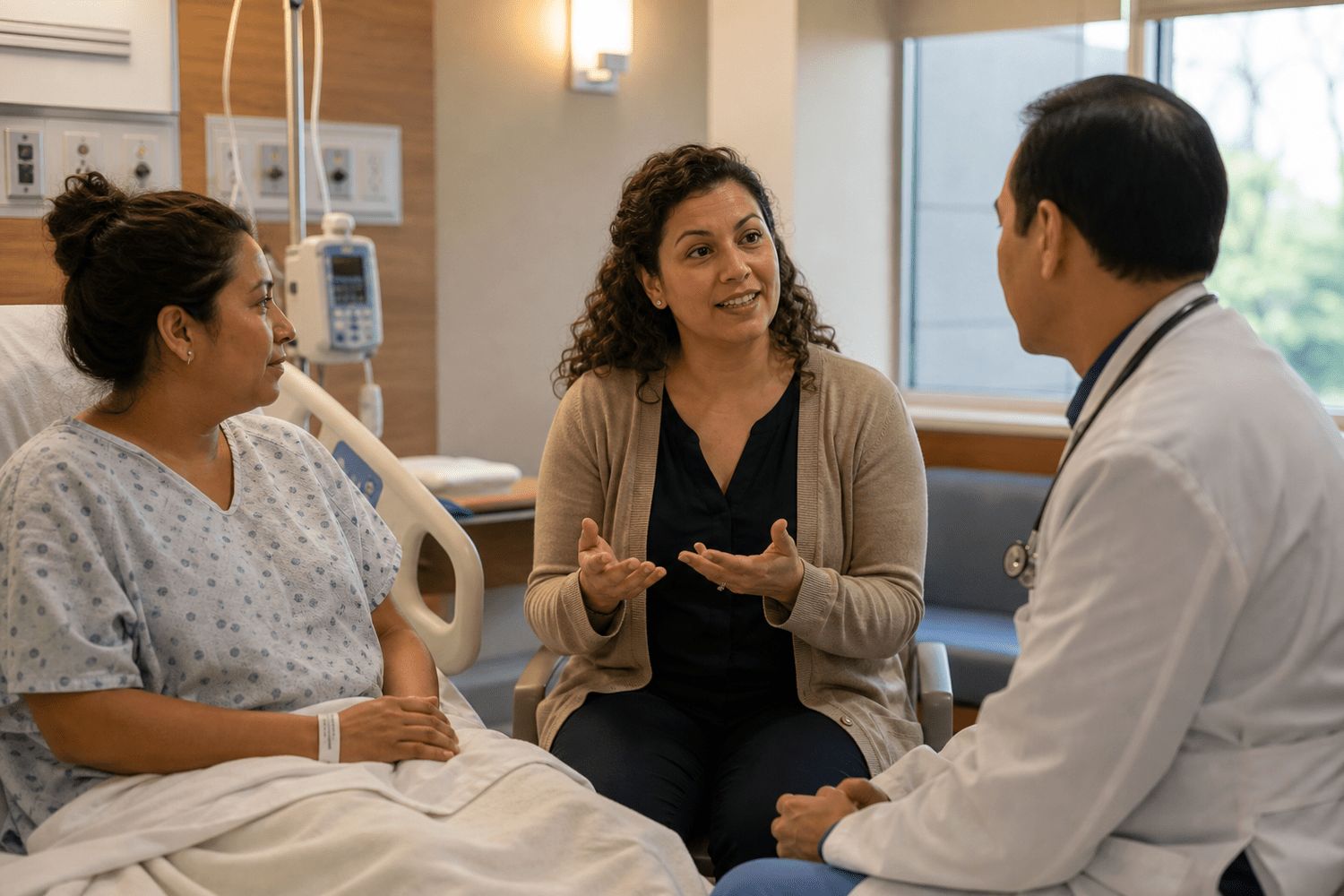
The LEP Landscape in Indiana's Tri-State Region
Understanding who your LEP patients are is the starting point for any compliant language access strategy. In the Tri-State area — Southwest Indiana, Northwest Kentucky, and Southeast Illinois — the linguistic landscape is more diverse than many providers realize.
Based on U.S. Census and Indiana Department of Health data, the primary LEP language communities in the region include:
Spanish: The largest LEP group across Evansville, Henderson, and Jasper — with significant presence in agricultural and manufacturing worker communities in Daviess County and Gibson County.
Burmese and Karen: Large refugee resettlement communities in Evansville through Catholic Charities and similar resettlement agencies. Karen and Karenni are distinct languages from Burmese — many providers mistakenly assume a Burmese interpreter covers Karen-speaking patients.
Haitian Creole: A growing community in Evansville is tied to both resettlement programs and employment in food processing industries.
Somali: Present particularly in healthcare and manufacturing employment corridors.
Arabic: Concentrated in both professional and working-class communities across the region.
Marshallese and Karenni: Smaller but growing communities with very limited English proficiency — and very limited options for qualified interpreting if not proactively arranged.
For any Tri-State healthcare provider, a Section 1557-compliant Language Access Plan must account for at a minimum Spanish, Burmese, Karen, and Haitian Creole — and likely several additional languages depending on patient population demographics.
What "Meaningful Access" Actually Means in Practice
The legal standard under Section 1557 is not just that an interpreter was theoretically available — it's that the patient received meaningful access to the health program. HHS evaluates meaningful access based on:
Timeliness: Was interpretation available when the patient needed it, not two days later?
Adequacy: Was the interpreter qualified to handle the complexity of the clinical encounter (e.g., a behavioral health assessment vs. a routine check-in)?
Accuracy: Were clinically relevant details accurately conveyed in both directions — including dosing instructions, informed consent, and discharge directions?
Impartiality: Was the interpreter free of conflicts of interest? (A bilingual family member is not impartial — they may soften, filter, or editorialize medical information.)
OCR investigations routinely center on situations where a patient claims a family member interpreted and key medical information was lost, or where a telephone interpreter app was used for a sensitive behavioral health intake. The standard isn't whether you made an effort — it's whether the patient received equivalent access to care as an English-speaking patient would have.
Three Common Section 1557 Compliance Gaps in Tri-State Clinics
In our work serving healthcare providers across Evansville, Henderson, Owensboro, and the surrounding region, Heartland's team frequently encounters the same categories of compliance gaps. Here are the three most common:
Gap 1: Relying on Bilingual Staff Without Vetting Interpreter Competency
Having a bilingual medical assistant on staff feels like a convenient solution — until that employee is the only person available at a busy urgent care at 7 PM, and they're asked to interpret a psychiatric evaluation in a language they speak conversationally but not professionally. Staff bilingualism is an asset. It is not a substitute for a vetted, qualified interpreter.
Gap 2: Using Phone Apps for Consent and High-Stakes Encounters
Machine translation apps and even some telephone interpretation lines are appropriate for low-stakes, informational tasks. They are not appropriate for informed consent, discharge instructions, behavioral health assessments, cancer diagnoses, or pediatric emergencies. The 2024 rule's qualified interpreter standard implicitly addresses this — a machine cannot satisfy the ethics, confidentiality, and impartiality requirements of a qualified human interpreter.
Gap 3: No Written Language Access Plan
Most small practices and even mid-sized health systems in the Tri-State region do not have a current, written LAP. Creating one is not onerous if you have the right partner. A proper LAP documents: which LEP languages are served, what interpretation modalities are available (on-site, VRI, OPI), how staff are trained to access interpretation, and how the plan is reviewed annually.
How Heartland Helps Tri-State Healthcare Providers Comply
Heartland Interpretation & Translation Services has spent years building the infrastructure that makes Section 1557 compliance practical — not just possible — for healthcare providers in Southwest Indiana, Northwest Kentucky, and Southeast Illinois.
Our medical interpretation services are designed specifically around the qualified interpreter standard: our linguists are vetted for medical terminology fluency, trained in HIPAA confidentiality requirements, and held to a professional code of ethics. We support on-site, Video Remote Interpreting (VRI), and Over-the-Phone Interpreting (OPI) modalities, so providers can match the right access model to each clinical encounter.
Here's how we support compliance across the four main requirement areas:
Qualified Interpreter Access
We provide certified interpreters in 350+ languages with documented medical interpretation competency. For the Evansville area's most common LEP languages — Spanish, Burmese, Karen, Haitian Creole, Somali, Arabic — we maintain an active roster of credentialed interpreters available for scheduled and same-day on-site appointments, as well as 24/7 emergency remote access for after-hours and ER situations.
Vital Document Translation
Our certified document translation team handles informed consent forms, discharge instructions, patient intake forms, and care summaries. Certified translations include attestation of accuracy, which is required for any legal or regulatory submission. Our translators are subject-matter experts in medical terminology — not generalist translators applying a medical glossary.
Language Access Plan Development
We partner with healthcare organizations to develop and implement written Language Access Plans that meet HHS requirements. This includes LEP population assessments, documentation of access modalities, staff orientation materials, and annual review processes. Our team has helped hospitals, FQHCs, behavioral health centers, and specialty practices across the Tri-State complete their LAP requirements.
Staff Training
We offer training programs for front-desk, clinical, and administrative staff on how to identify LEP patients, access interpretation services, and avoid the use of untrained interpreters. Our trainers understand the Tri-State region's specific linguistic communities — including the difference between Burmese and Karen, and why that distinction matters clinically.
Explore our full language services for healthcare or learn more about the Heartland team and our background serving the region.

Frequently Asked Questions: Section 1557 and Indiana Healthcare
Does Section 1557 apply to small physician practices?
Yes, if the practice receives any federal financial assistance, including Medicare and Medicaid reimbursement. The 15-employee threshold applies specifically to the written Language Access Plan requirement. All covered entities, regardless of size, must provide meaningful access to LEP patients.
Can a bilingual employee serve as an interpreter if the patient consents?
The 2024 HHS rule emphasizes that "qualified interpreter" means someone with demonstrated competency in both languages AND healthcare interpreting. Simply having the patient's consent to use an unqualified interpreter does not satisfy the law. OCR has found violations even where patients appeared to agree to non-qualified interpretation.
Does HIPAA interact with Section 1557?
Yes. HIPAA's Privacy Rule requires that PHI be communicated accurately, which has language access implications. Using an interpreter who misunderstands or misrepresents clinical information creates both HIPAA and Section 1557 exposure. HIPAA also requires that interpreters maintain patient confidentiality. Family-member interpreters inherently compromise this principle in many clinical situations.
What are the penalties for Section 1557 violations?
OCR can investigate complaints, require corrective action plans, and, in cases of intentional discrimination, refer matters to the DOJ. Providers found in violation may face loss of federal funding — a significant consequence for any practice dependent on Medicare and Medicaid revenue. Civil rights attorneys can also bring private lawsuits under Section 1557.
How quickly can Heartland provide an interpreter for an emergency situation?
Our OPI and VRI services provide 24/7 access with average connection times under 60 seconds for the most common Tri-State languages. For on-site interpretation, same-day scheduling is available for most languages in the Evansville, Henderson, and Owensboro service areas. For less common languages, advance scheduling ensures availability.
Does Section 1557 cover telehealth encounters?
Yes. HHS has clarified that telehealth services provided by covered entities must meet the same language access requirements as in-person care. VRI (Video Remote Interpreting) is an effective and compliant modality for telehealth encounters when conducted with a qualified interpreter.
Building a Proactive Language Access Strategy
The most effective approach to Section 1557 compliance is not reactive — waiting for an OCR complaint before auditing your language access practices. It's proactive: assessing your LEP patient population, implementing a written Language Access Plan, training your staff, and building relationships with qualified interpretation providers before a high-stakes clinical encounter demands it.
Indiana's Tri-State region has one of the most linguistically diverse healthcare patient populations in the Midwest, and it's growing. Evansville continues to receive refugee resettlements. Henderson and Jasper's manufacturing workforce draws Spanish-speaking workers from across the region. Louisville's healthcare corridor serves an increasingly multilingual patient base in the Clark and Floyd County suburbs.
For providers in this region, language access isn't a compliance checkbox — it's a core competency of high-quality patient care. Patients who receive care in their language have better outcomes: higher medication adherence, fewer readmissions, lower rates of adverse events, and higher satisfaction scores. Section 1557 compliance and quality care are not in tension — they're the same goal.
Get Started with Section 1557-Compliant Language Access
Whether you need a single certified interpreter for a scheduled procedure, a full Language Access Plan, or certified translation of patient consent forms, Heartland's team is ready to help. We serve healthcare providers across Evansville, Henderson, Owensboro, Louisville, Jasper, and the broader Tri-State region.
Need professional interpretation or translation services in Indiana, Kentucky, or Illinois? Contact Heartland Language Services in Evansville — call (812) 499-1696 or get a free quote online.

About the author
Jacob Brown
Jacob Brown shares practical guidance from Heartland Language Services on clear, reliable communication for multilingual workplaces.
Keep reading
Related articles
December 30, 2025
Certified Medical Document Translation: What Healthcare Providers in Illinois Must Know
Read article →July 14, 2026
Certified Medical Interpreter Evansville, IN: HIPAA, Section 1557 & Patient Safety
Clear communication is a patient-safety requirement. Learn how qualified medical interpreters help Evansville-area healthcare providers protect privacy, support Section 1557 language access, and reduce preventable communication errors.
Read article →June 22, 2026
Behavioral Health Interpretation in Indiana: Why Certified Interpreters Are Essential for Mental Health Care
Language barriers in behavioral health settings can delay diagnosis, erode trust, and put patients at risk. Here's what Indiana mental health providers need to know about certified interpreter access.
Read article →