
Insights
Certified Legal Translation Services for Indiana Law Firms: What You Need to Know
Published June 1, 2026 · By Jacob Brown


Quick Summary: Indiana law firms that serve non-English-speaking clients must provide certified legal translation and interpretation under Title VI of the Civil Rights Act, the Americans with Disabilities Act, and Indiana court rules. Using uncertified staff or machine translation exposes your firm—and your clients—to serious risk. Heartland Interpretation & Translation Services provides certified legal linguists for the Tri-State region: Evansville IN, Henderson KY, Louisville KY, and SE Illinois.
When a client can't read their own contract, can't follow a deposition, or can't understand what they're signing—your practice has a problem. Not just an ethical one. A legal one.
Language barriers in legal settings aren't edge cases. In Southwest Indiana, Northwest Kentucky, and SE Illinois, significant portions of the working-age population speak Spanish, Burmese, Karen, Arabic, Haitian Creole, or Somali as a primary language. For law firms handling immigration, personal injury, labor disputes, criminal defense, real estate, or family law, that means certified legal language services aren't optional—they're a baseline professional obligation.
This post breaks down what Indiana law firms need to know about certified legal translation, when you need interpretation vs. translation, what Title VI and the ADA actually require, and how to protect your clients—and your firm—with the right language partner.
Interpretation vs. Translation: Understanding the Difference
These terms are often used interchangeably, but they describe different services with different use cases:
Interpretation is spoken-language conversion in real time. An interpreter sits in a deposition, appears in court, or joins a client consultation via phone or video and conveys spoken communication between parties.
Translation is a written-language conversion. A translator renders a document—a contract, a will, a court filing, an evidence exhibit—from one written language to another.
Law firms typically need both. A client interview might require an interpreter. The lease agreement they're disputing might require certified translation. A deposition conducted in Spanish requires a certified court interpreter. A foreign-language medical record submitted as evidence requires certified document translation.
The keyword in both cases is certified.
What Makes Legal Translation "Certified"?
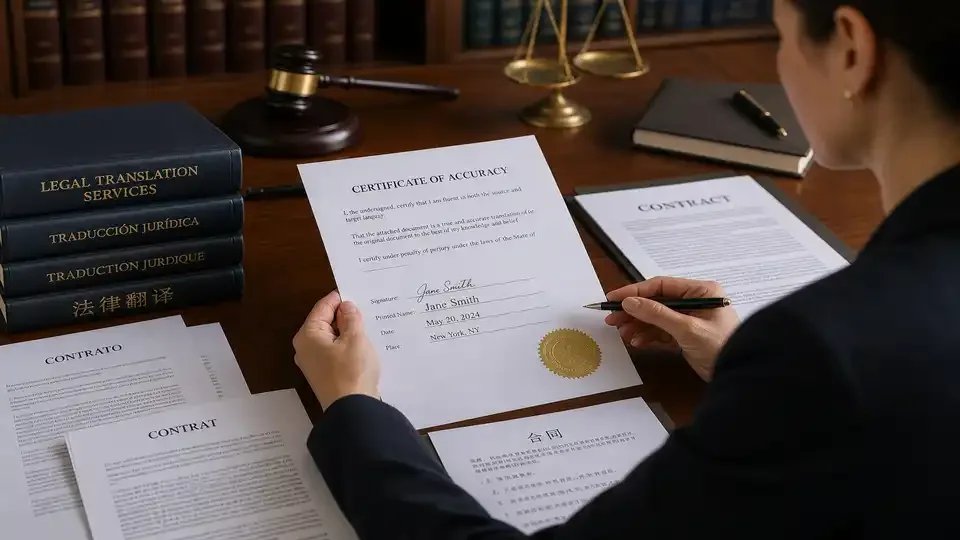
A certified translation includes a signed statement by the translator attesting that the translation is accurate and complete to the best of their knowledge. This statement—sometimes called a "Certificate of Accuracy" or "Translator's Certification"—is what courts and legal proceedings require when submitting translated documents.
Without certification:
Courts may reject the document as inadmissible
Opposing counsel may challenge the translation's accuracy
Your client's case may be materially weakened
Your firm may face professional responsibility questions
Machine translation (Google Translate, DeepL) cannot produce a certified translation. Neither can a bilingual paralegal unless they are also a qualified, credentialed linguist. Certification requires a human translator who is professionally competent in both the source and target languages and is willing to stand behind their work with a signed attestation.
At Heartland's legal language services, every certified translation is produced by a vetted professional linguist and includes the necessary certification statement accepted by Indiana courts and federal proceedings.
Title VI of the Civil Rights Act: What It Means for Indiana Law Firms
Title VI of the Civil Rights Act of 1964 prohibits discrimination on the basis of national origin in programs that receive federal funding. For law firms, the most relevant application comes through two channels:
Court-appointed representation: If your firm receives any federal or state funding—public defender contracts, legal aid grants, federally funded programs—you are subject to Title VI language access requirements. Under Executive Order 13166 (2000) and its implementing guidance, you must take reasonable steps to provide meaningful access to limited-English-proficient (LEP) individuals.
Court and administrative proceedings: Indiana courts operate under their own language access plans. The Indiana Supreme Court has adopted court interpreter rules requiring certified interpreters in court proceedings. When your client needs an interpreter to participate meaningfully in their own case, the court—and by extension, effective counsel—must ensure that access.
Even for private firms not subject to Title VI directly, the ethical obligation under the Indiana Rules of Professional Conduct is real. Rule 1.4 (Communication) requires that lawyers "explain a matter to the extent reasonably necessary to permit the client to make informed decisions." If your client cannot communicate in English, that duty cannot be discharged without a qualified interpreter.
ADA Considerations in Legal Settings
Title III of the Americans with Disabilities Act requires places of public accommodation—which includes private law offices—to provide effective communication to individuals with disabilities. Deaf and hard-of-hearing clients who use American Sign Language (ASL) fall squarely within this requirement. So do clients with other communication-related disabilities.
For ASL interpretation, unqualified interpreters are not sufficient. Courts have found that using a family member, a front-desk employee who "knows some sign language," or a video relay service not suited for legal proceedings fails the ADA standard. Indiana law firms serving Deaf clients need certified ASL interpreters for client meetings, depositions, and proceedings.
Heartland's interpreter network includes certified ASL interpreters serving Evansville, Henderson, and the broader Tri-State region, available on-site or via VRI (video remote interpreting) for scheduling flexibility.
When Your Law Firm Needs Certified Translation
Here's a practical checklist for Indiana law firms:
Documents That Require Certified Translation
Contracts and agreements to be signed by an LEP client
Foreign-language exhibits submitted to the court
Medical records in a personal injury or workers' comp case
Immigration documents (I-94, foreign birth certificates, marriage certificates, court records)
Wills, powers of attorney, and estate documents for non-English speakers
Foreign corporate records in commercial litigation
Police reports or incident documentation in a foreign language
Business contracts or lease agreements for clients with LEP
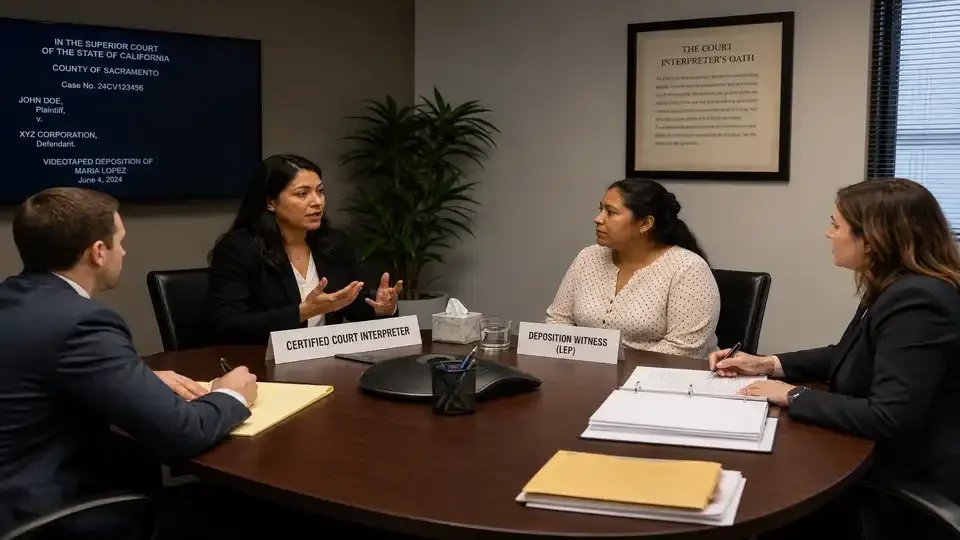
When You Need a Certified Court Interpreter
Client interviews and consultations where the client is LEP
Depositions and examinations under oath
Hearings, trials, and other court proceedings
Negotiations and mediations with LEP parties
Signing meetings for important documents
Calls with opposing counsel where LEP clients are present
The Danger of "Gist" Interpretation in Legal Proceedings
Legal proceedings hinge on precision. A deposition question that means "Did you stop?" is fundamentally different from one that means "Were you able to stop?" A contract clause that "generally" means ownership may omit the specific conditions under which ownership transfers.
Using a bilingual staff member, a family member, or a Google-translated summary—sometimes called "gist" interpretation—is a recognized source of legal risk. Indiana courts have seen cases overturned and findings challenged because of inadequate interpretation in depositions or proceedings. Courts take language access seriously; your firm should too.
Certified legal interpreters and translators are trained to render precise equivalents, not summaries. They understand legal terminology in both languages and are bound by professional codes of ethics that include confidentiality, impartiality, and accuracy. Learn more about our full range of language services for legal practice areas.
Languages Your Tri-State Law Firm May Encounter
Evansville, Henderson, Louisville, and surrounding communities have seen significant demographic shifts over the past two decades. Today's Tri-State legal client base may include individuals whose primary language is:
Spanish — The largest LEP population in Southwest Indiana and the most common language need for law firms across personal injury, immigration, labor, and family law
Burmese and Karen — A substantial refugee and immigrant community resettled in Evansville, Henderson, and Louisville, including many who have never had documents or legal experiences in English
Haitian Creole — A growing community in the Tri-State, often in need of immigration and family law services
Arabic — Present across the region, with needs in business, estate, and immigration practice
Somali — Part of the refugee community resettled in Indiana, frequently needing immigration and criminal defense support
Vietnamese — Present in Louisville and surrounding areas, with needs across practice areas
Heartland supports over 350 languages, ensuring that even less-common language needs can be met with a vetted professional—not a last-minute improvisation.
On-Site, Phone, and Video Interpretation for Legal Proceedings
Not every legal interpretation need is the same. Heartland offers three modalities to fit your timeline and setting:
On-Site Interpretation
Best for depositions, complex client consultations, mediations, trials, and any proceeding where nuance and in-person presence matter. The interpreter is physically present and can pick up on nonverbal cues, documents, and the room dynamics that remote interpreters can't see. Heartland provides on-site interpreters throughout the Tri-State region.
Over-the-Phone Interpretation (OPI)
Useful for short, straightforward calls or urgent consultations when on-site scheduling isn't possible. Available on short notice and suitable for preliminary client screening, quick follow-up calls, or time-sensitive communications.
Video Remote Interpretation (VRI)
A strong middle-ground option—especially for ASL interpretation, where visual communication is essential but a certified ASL interpreter may not be locally available. Also useful for remote proceedings or when you need to confirm interpreter credentials visually.
Frequently Asked Questions
Does my Indiana law firm need a certified translator, or can I use Google Translate for documents?
For any document with legal significance—contracts, court filings, signed agreements, evidence exhibits—Google Translate is not acceptable. Courts require human-certified translations, and using machine translation for client documents creates professional responsibility exposure. For client communications that are informal and non-binding, a machine translation may help orient a conversation, but never use it as a final product for legal purposes.
How long does certified legal translation take?
Standard turnaround for certified translation is typically 2–5 business days depending on document length and language pair. Rush turnaround (24–48 hours) is available for most common language pairs. Heartland serves the full Tri-State region and works with law firms on both standard and urgent timelines.
Can I use a bilingual staff member instead of a professional interpreter?
Only if the bilingual staff member is also a qualified professional interpreter. Bilingualism alone does not confer interpreter competence—legal interpreting requires specific training, legal vocabulary knowledge, and adherence to professional ethics codes. Using unqualified bilingual staff in depositions or hearings is a recognized source of error and can create grounds for appeals or ethical complaints.
Does Heartland provide certified translations that Indiana courts will accept?
Yes. Every certified translation from Heartland includes a signed Certificate of Accuracy by a qualified professional translator. These certifications are accepted by Indiana state courts, federal courts, USCIS, and other government agencies. Contact us if you have specific certification format requirements for your jurisdiction.
Are interpretation services confidential?
Yes. Professional interpreters operating under a code of ethics—including Heartland's interpreters—are bound by strict confidentiality. Attorney-client privilege extends to interpreters working within the scope of legal representation. Heartland's linguists understand and respect the confidentiality requirements of legal proceedings.
Partnering with Heartland for Legal Language Services
Heartland Interpretation & Translation Services has been serving law firms, courts, and legal professionals across Southwest Indiana, Northwest Kentucky, and SE Illinois for years. We understand the precision required in legal language work, the confidentiality obligations of legal practice, and the compliance landscape Indiana firms navigate.
Whether you need a certified court interpreter for a deposition in Evansville, a certified Spanish translation of a contract for a Henderson client, or a Burmese interpreter for a criminal defense consultation in Jasper—Heartland has the qualified professional linguists to deliver.
Don't leave language access to chance—or to Google. Request a free quote from Heartland and ensure your firm is meeting its legal and ethical language access obligations.
Need professional legal interpretation or translation services in Indiana, Kentucky, or Illinois? Contact Heartland Language Services in Evansville — call (812) 499-1696 or get a free quote online.

About the author
Jacob Brown
Jacob Brown shares practical guidance from Heartland Language Services on clear, reliable communication for multilingual workplaces.
Keep reading
Related articles
May 7, 2026
Why Indiana Courts Require Certified Interpreters — And What Law Firms Need to Know
Read article →June 22, 2026
Behavioral Health Interpretation in Indiana: Why Certified Interpreters Are Essential for Mental Health Care
Language barriers in behavioral health settings can delay diagnosis, erode trust, and put patients at risk. Here's what Indiana mental health providers need to know about certified interpreter access.
Read article →March 11, 2026