
Insights
OSHA Safety Training Interpreters for Indiana Manufacturers
Indiana manufacturers face OSHA violations and worker injuries when language barriers block safety training. Heartland Language's certified OSHA safety training interpreters serve Evansville, Jasper, Henderson KY, and Louisville KY — closing the gap between attendance and understanding.
Published July 16, 2026 · By Jacob Brown
Quick Summary
Every year, Indiana manufacturers face OSHA citations and worker injuries that trace back to one preventable root cause: language barriers during safety training. If your workforce includes Spanish, Burmese, Arabic, or any other non-English speakers, you need a certified OSHA safety training interpreter — not a bilingual coworker, not a translation app. This guide explains what OSHA requires, what's at stake, and how Heartland Language's certified interpreters serve Evansville, Henderson KY, Jasper IN, Louisville KY, and the broader Tri-State manufacturing corridor.
When a workplace injury happens on an Indiana manufacturing floor, investigators often find the same thing at the root: a worker who attended the required OSHA safety training but never truly understood it. That's where an OSHA safety training interpreter Indiana manufacturers rely on becomes not just a best practice — it's a liability shield.
Heartland Language has partnered with Tri-State manufacturers for over a decade, providing certified interpreters for everything from OSHA 10 and 30 courses to machine-specific lockout/tagout training, chemical hazard briefings, and emergency evacuation drills. Language access isn't optional when workers' lives depend on what they understand.
Why OSHA Safety Training Must Be Understood — Not Just Attended
Attending a training is not the same as understanding it. OSHA's general duty clause (Section 5(a)(1) of the Occupational Safety and Health Act) requires employers to provide a workplace free from recognized hazards. That obligation does not pause for language barriers.
Beyond the general duty clause, specific OSHA standards explicitly require that training be communicated in a way workers understand:
29 CFR 1910.132(f) — Personal Protective Equipment training must be provided in a manner that employees can understand.
29 CFR 1910.1200 (HazCom) — Employees must be trained on chemical hazards in a language they understand.
29 CFR 1910.147 — Lockout/Tagout procedures must be communicated in terms workers understand.
"Training in a language they understand" is not a suggestion. It appears across OSHA's standards for PPE, hazard communication, confined space entry, fall protection, and more. Providing English-only training to a predominantly Spanish-speaking or Burmese-speaking workforce is a compliance gap — and a citation waiting to happen.
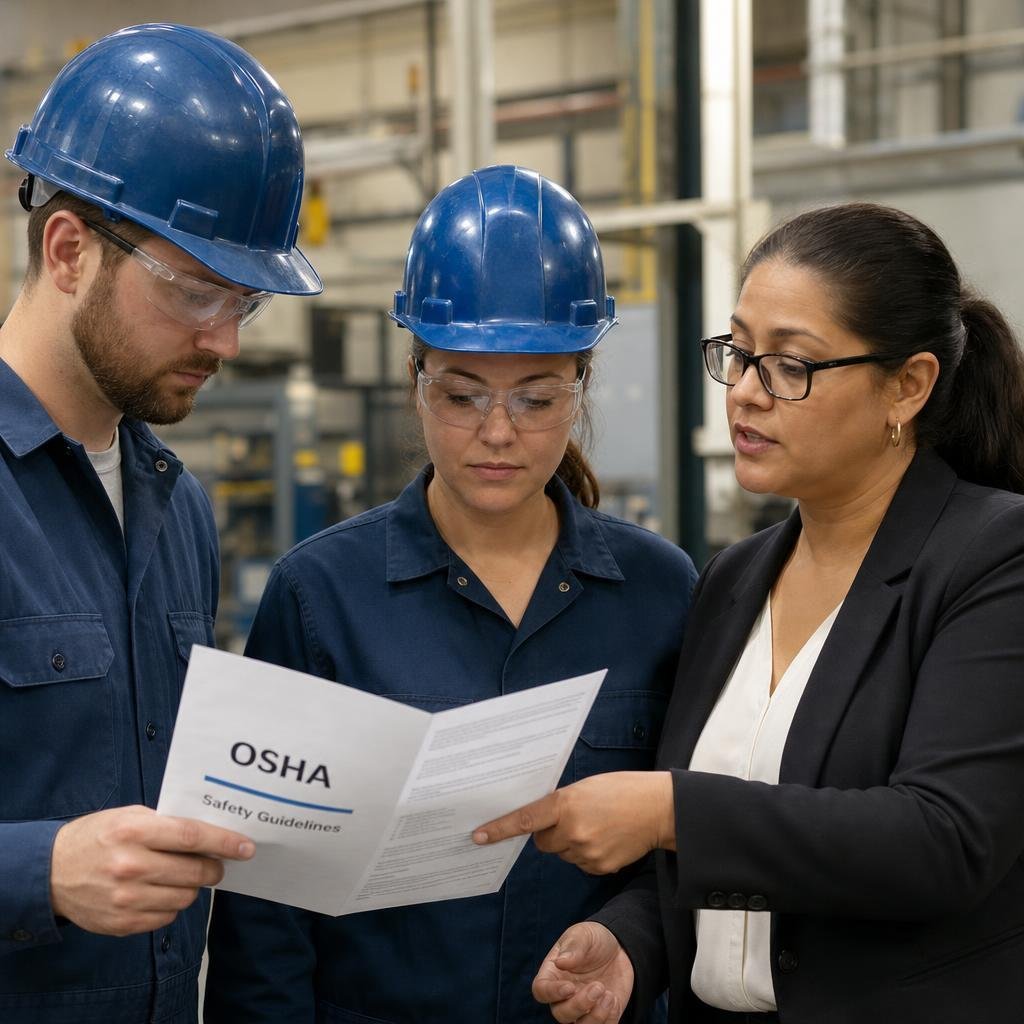
An OSHA interpreter reviews safety guidelines with Indiana factory workers.
The Real Cost of Language Gaps in OSHA Training
OSHA Citations. Willful or repeated violations for inadequate training can reach $165,514 per violation as of 2026. A single audit of a multilingual workforce that received English-only training could produce multiple citations — one for each affected standard.
Workers' Compensation Claims. Injuries that result from misunderstood safety procedures drive up workers' compensation premiums for every Indiana manufacturer in affected risk pools.
Liability Exposure. If a worker is injured because they did not understand a safety procedure due to a language barrier, the employer's exposure in litigation increases substantially.
Workforce Trust. Workers who feel unsafe are workers who leave or file complaints. High turnover in skilled manufacturing positions costs far more than professional interpretation services.
How Certified OSHA Safety Training Interpreters Support Indiana Manufacturers
A certified OSHA safety training interpreter Indiana facilities can rely on brings more than bilingual fluency. They bring:
Technical Vocabulary. Safety training is dense with industry-specific terms — lockout/tagout, confined space, PPE, MSDS, SDS, GHS. Certified interpreters have training in these domains so nothing gets softened or lost in translation.
Consecutive and Simultaneous Modes. Depending on training format, interpreters can work consecutively (trainer speaks, interpreter translates) or in simultaneous mode for real-time delivery in larger group settings.
Confidentiality Standards. Where workers disclose health conditions that affect their PPE or job assignments, certified interpreters maintain appropriate confidentiality consistent with professional ethical standards.
Documentation Support. Heartland Language can support post-training documentation — sign-off sheets, quizzes, and acknowledgment forms — to create a language-appropriate paper trail for your compliance records.
Heartland Language works directly with plant safety directors, EHS managers, and third-party OSHA trainers who need a certified interpreter on-site at Indiana manufacturing facilities (/auto-manufacturing), on time and familiar with your environment.
Types of OSHA Training That Require Interpretation in Indiana Manufacturing Facilities
Virtually every mandatory OSHA training topic benefits from professional interpretation when your workforce is multilingual. The most commonly requested at Heartland Language include:
Lockout/Tagout (LOTO) Training. Machine-specific procedures that vary by equipment; interpretation errors in this setting are fatal.
Hazard Communication / SDS Training. Workers must understand chemical hazards, PPE requirements, and emergency response procedures. See: /blog/safety-data-sheet-translation-indiana-manufacturers-osha-hazcom
Personal Protective Equipment (PPE) Training. Selection, fit-testing, donning and doffing procedures require demonstration and clearly understood verbal instruction.
Emergency Action Plans and Evacuation Drills. A drill in which Spanish-speaking workers do not understand muster point instructions is not a compliant drill.
New Employee Safety Orientation. See: /blog/employee-handbook-translation-indiana-manufacturers
OSHA 10 and OSHA 30 Hour Courses. Multi-day, multi-topic courses for supervisors and workers. Heartland Language provides on-site interpreters for full courses or specific sessions.
Confined Space Entry Briefings. Permit-required confined space procedures under 29 CFR 1910.146 demand that every person entering — and every attendant — understands their roles without ambiguity.
Serving Indiana's Tri-State Manufacturing Corridor
Evansville, IN — Home to Toyota, Berry Global, Alcoa, and dozens of mid-market plastics, food, and industrial manufacturers
Jasper, IN — Indiana's furniture and cabinet manufacturing hub, with a significant Spanish-speaking workforce
Henderson, KY — Autoneum, LG&E, and a growing advanced manufacturing base across the river from Evansville
Louisville, KY — Ford Motor Company's truck plant, GE Appliances, and pharmaceutical manufacturing requiring multilingual compliance
SE Illinois — Olney, Mount Vernon, and Carmi-area manufacturers relying on the Tri-State interpretation network
Learn how other Indiana manufacturers have partnered with a certified manufacturing interpreter (/blog/manufacturing-interpreter-workplace-safety-indiana) to close their language access gaps.
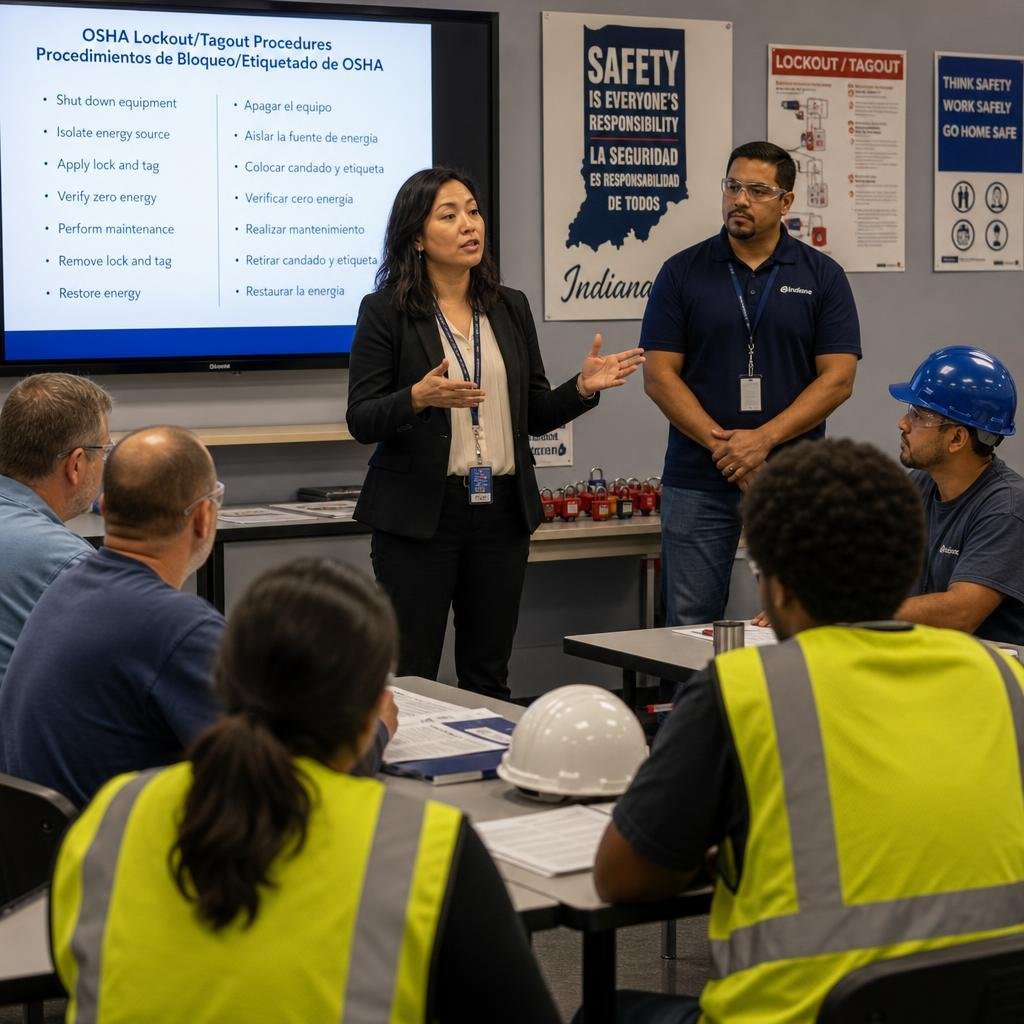
OSHA interpreter explaining lockout/tagout training to Indiana factory workers.
Why Heartland Language — E-E-A-T Credentials for OSHA Training Interpretation
Heartland Language is the Tri-State's dedicated language services provider, with certified interpreters across 350+ languages. Our manufacturing-specific interpretation team includes:
Interpreters with formal certification in occupational and technical interpretation
Documented experience with OSHA 10, OSHA 30, and industry-specific safety curricula
Familiarity with OSHA 1910 and 1926 standards, HazCom GHS, and LOTO protocols
Spanish, Burmese, Arabic, Somali, Haitian Creole, Vietnamese, and other Evansville-area community languages
On-site availability for same-day or short-notice scheduling across the Tri-State
Heartland Language is not a staffing agency providing bilingual employees. We are a professional language services organization whose interpreters follow ASTM F2089 standards, maintain professional ethics, and carry appropriate certifications for the industrial environments in which they work.
Frequently Asked Questions About OSHA Safety Training Interpreters in Indiana
Does OSHA require an interpreter for safety training?
OSHA does not mandate a certified interpreter by name, but its standards require that training be provided "in a manner the employee is able to understand." Using a certified interpreter is the clearest way to document that you met this requirement. Using an untrained bilingual coworker or a translation app leaves compliance gaps that OSHA citations and civil litigation will expose.
Can I use a bilingual employee to interpret OSHA training?
Only if they are trained and capable of accurate technical interpretation in both languages. Bilingual employees often lack the technical vocabulary, ethical neutrality, and consecutive or simultaneous interpreting skills required for complex OSHA training. A certified interpreter is the defensible choice for compliance documentation.
What languages does Heartland Language offer for manufacturing interpretation?
We serve 350+ languages, with the strongest depth in Spanish, Burmese, Arabic, Somali, Vietnamese, and Haitian Creole — the most commonly spoken non-English languages in Indiana, Kentucky, and SE Illinois manufacturing workforces.
How much lead time do I need to schedule an OSHA training interpreter?
We prefer 48–72 hours for most manufacturing sites. For large-scale OSHA 30 sessions or multi-shift rollouts, two weeks allows us to confirm the right interpreter and prepare for your specific training content.
Do you interpret just the training, or can you also translate the written materials?
Both. Heartland Language provides live interpretation of training sessions and certified translation of written safety materials — SDS sheets, LOTO procedures, evacuation plans, employee handbooks, and more.
Ready to close the language gap in your OSHA safety training? Heartland Language serves manufacturers across Evansville, Jasper, Henderson KY, Louisville KY, and SE Illinois. Request a quote at: /quote

About the author
Jacob Brown
Jacob Brown shares practical guidance from Heartland Language Services on clear, reliable communication for multilingual workplaces.
Keep reading
Related articles
May 18, 2026
FSMA, OSHA, and Language Access: Why Indiana Food Manufacturers Can’t Afford Language Gaps
Indiana food manufacturers face FSMA and OSHA language access requirements. Learn why certified interpreters are essential for food safety compliance and worker protection. Indiana food manufacturers face FSMA and OSHA language access requirements. Learn why certified interpreters are essential for food safety compliance and worker protection.
Read article →October 13, 2026
Fall Protection Training Interpreters Indiana Manufacturing: Closing the Height-Safety Language Gap
Fall protection training only works if every worker understands anchor points, harness inspection, and rescue plans in their own language. See how Tri-State manufacturers close that gap before someone gets hurt.
Read article →July 6, 2026
Manufacturing Interpreter Indiana: Protecting Workers Through Language Access
Manufacturing interpreter services help Indiana employers reduce safety risk, improve HR communication, and support multilingual teams across Evansville, Henderson, Louisville, Jasper, and Southeast Illinois.
Read article →