
Insights
Bridging the Safety Gap: How Workplace Translation Drives Productivity in Midwest Manufacturing
Published March 23, 2026 · By Jacob Brown
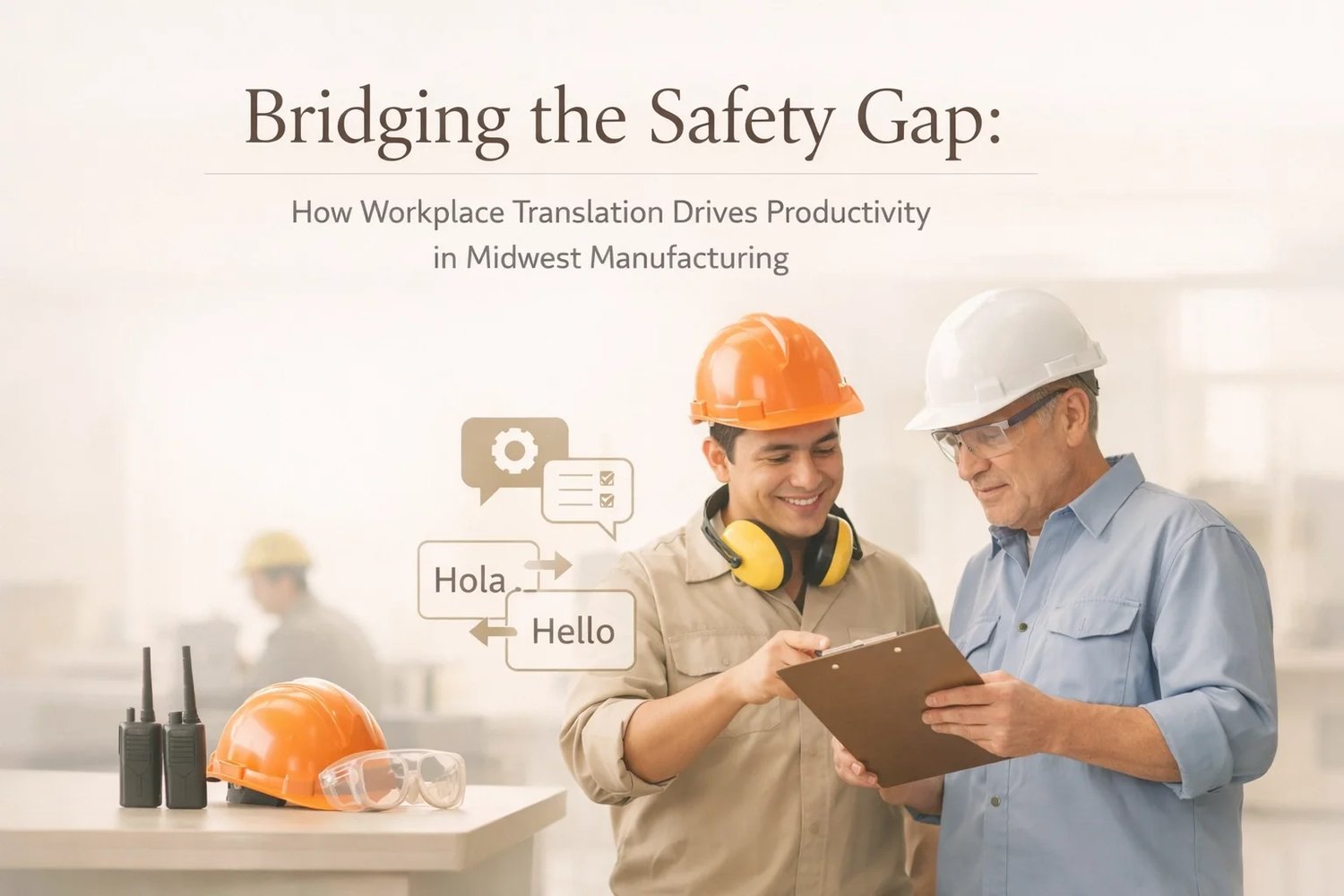
Across the sprawling industrial corridors of the American Midwest, from the automotive assembly lines in Indiana to the heavy machinery plants of Illinois and Kentucky, a silent transformation is taking place. The traditional image of the factory floor is evolving as a more diverse, multilingual workforce steps in to power the region’s economic engine. While this demographic shift brings a wealth of talent and labor to the manufacturing sector, it also introduces a significant operational challenge that many facility managers are only beginning to grasp. The ability to communicate safety protocols and technical instructions across language barriers is no longer just a human resources concern; it is a fundamental pillar of operational productivity and legal compliance.
In high-pressure manufacturing environments, clarity is the most valuable currency. When a technician cannot understand a warning label or a new hire struggles to follow a complex safety-related briefing, the risk of a workplace-related injury skyrockets. This is where workplace translation becomes more than a convenience. It serves as a life-saving bridge that ensures every individual on the production floor, regardless of their native tongue, operates with the same level of precision and awareness as their English-speaking counterparts. At Heartland Language Services, we have observed that the most successful Midwest manufacturers are those that stop viewing language access as an afterthought and start treating it as a strategic investment in their most important asset: their people.
The Occupational Safety and Health Administration (OSHA) has long maintained that training must be provided in a language and vocabulary that workers can understand. In a region where limited-English proficiency is becoming more common among the industrial labor force, generic English-only signage and verbal instructions are often insufficient to meet these federal standards. Non-compliance does not just result in heavy fines; it creates a culture of uncertainty. When workers are unsure of the safety-critical steps required to operate a lathe or a forklift, they naturally slow down, second-guess their movements, or, worse, take risks that lead to catastrophic failures. By implementing professional language services, companies can effectively mitigate these risks, ensuring that every safety manual, warning sign, and instructional video is translated with technical accuracy.
Beyond the immediate concerns of physical safety, the economic impact of language barriers on productivity is staggering. Industry research suggests that a significant majority of manufacturing professionals report that communication gaps directly reduce the efficiency of their sites. In many Midwest plants, it is common practice to rely on a "bilingual buddy" system, where an employee who speaks both English and a secondary language is pulled away from their primary duties to act as an ad-hoc interpreter for their colleagues. While well-intentioned, this approach is remarkably costly. These unofficial translators often lose several hours every week, which translates to thousands of dollars in lost labor costs per employee annually. Furthermore, because these individuals are not trained linguists, the risk of a mistranslated technical term or a misunderstood safety warning remains dangerously high.
True productivity gains are realized when a facility moves away from these informal arrangements and adopts a structured approach to technical communication. For example, a major automotive manufacturer recently discovered that by integrating professional translation into their workflow, they could reduce the time required for a major project rollout from months to just a few weeks. This acceleration is possible because professional linguists understand the nuances of manufacturing terminology and can produce high-quality, culturally appropriate materials that do not require constant correction or clarification. When instructions are clear the first time, the need for repetitive training and the frequency of errors during the production process decrease significantly.
The integration of technology into the translation process has further revolutionized how Midwest plants operate. Modern AI-driven platforms, when overseen by human experts, allow for the rapid subtitling of training videos and the translation of facility-wide updates in near real-time. This is particularly crucial during a shift change or an emergency situation where information must be disseminated instantly to a multilingual team. By utilizing interpreting services, management can ensure that town hall meetings and safety briefings are inclusive, allowing every worker to feel like a well-informed member of the organization. This sense of inclusion is not just a moral victory; it is a retention strategy. In a competitive labor market, workers are far more likely to remain with an employer who prioritizes their safety and provides them with the tools they need to succeed in their native language.

Furthermore, the legal landscape for manufacturers in states like Kentucky and Indiana is becoming increasingly complex. As regional expansion continues, companies are finding that their legal and operational files must be meticulously maintained in multiple languages to protect against liability. Whether it is a workplace-related injury claim or a dispute over a contract, having a paper trail of certified translations is essential. This is where a partnership with a professional agency provides peace of mind. Ensuring that every document: from the employee handbook to the complex technical specifications of a new assembly line: is handled by a specialist prevents the kind of costly misunderstandings that can end up in a courtroom.
Another critical area where workplace translation drives growth is in the onboarding process. The first few weeks of an employee’s tenure are the most dangerous and the most critical for long-term engagement. If a new hire with limited-English skills is given a stack of English-only paperwork and a quick verbal tour, they are being set up for failure. A professional approach involves providing a fully translated onboarding suite that covers everything from benefits enrollment to the intricacies of the lockout-tagout procedure. This level of detail demonstrates a commitment to the employee’s well-being and ensures they can hit their productivity targets much faster than they would through trial and error.

As we look toward the future of manufacturing in the Tri-State area, the role of language will only grow in importance. The push for smarter, more automated factories requires a workforce that can interact with sophisticated software interfaces and read digital readouts. If these interfaces are not localized, the technology meant to increase efficiency can actually become a bottleneck. Professional language services ensure that the digital transformation of the Midwest industrial sector is accessible to everyone, regardless of their linguistic background. This allows companies to scale their operations across borders and within our own diverse communities without losing the human touch or compromising on safety standards.
In conclusion, the gap between a multilingual workforce and a high-performing manufacturing facility can only be bridged through intentional, professional communication strategies. By moving beyond ad-hoc solutions and embracing a comprehensive approach to translation and interpretation, Midwest manufacturers can safeguard their employees, satisfy OSHA requirements, and unlock new levels of productivity. The cost of a language barrier is far higher than the investment required to remove it. When everyone on the floor speaks the same language of safety and efficiency, the entire region wins. For those ready to take the next step in optimizing their multilingual operations, the path forward begins with a commitment to clarity, compliance, and the professional expertise that turns a diverse workforce into a unified, powerhouse team.

About the author
Jacob Brown
Jacob Brown shares practical guidance from Heartland Language Services on clear, reliable communication for multilingual workplaces.
Keep reading
Related articles
January 23, 2026
Safety Without Borders: Why Manufacturing Plants in Henderson, KY Need Professional Workplace Translation
Read article →March 14, 2026
The Operations Manager's Guide to Workplace Translation: Ensuring Safety for Your Diverse Team
Read article →January 8, 2026