
Insights
The Patient-First Approach: Why Relying on Ad-Hoc Interpreters Puts Your Healthcare Practice at Risk
Published March 26, 2026 · By Jacob Brown
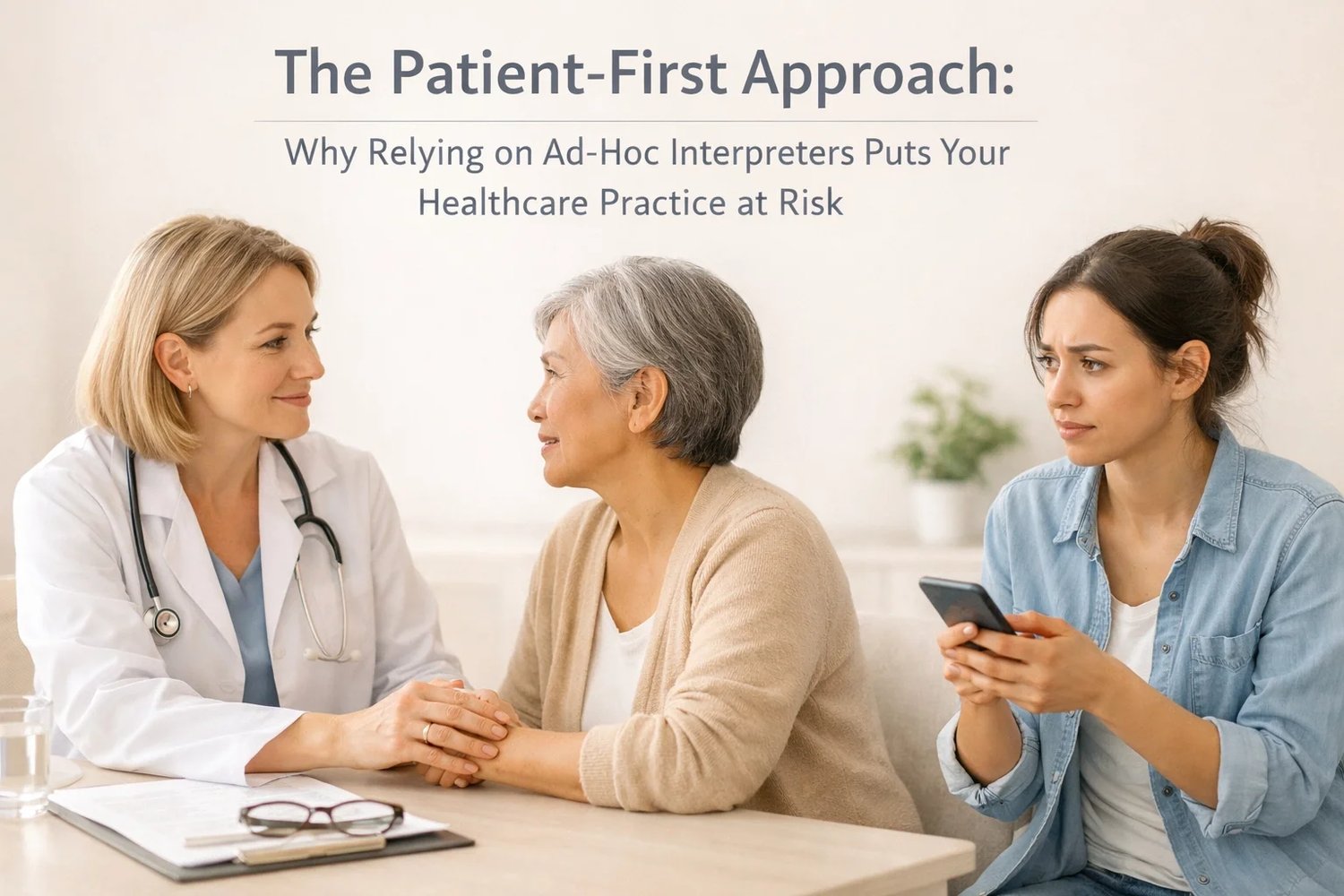
In the modern healthcare landscape, the phrase patient-first has become more than just a buzzword. It represents a fundamental shift in how providers approach their work, moving away from a purely clinical or transactional model toward one that prioritizes the dignity, comfort, and holistic well-being of the individual. For a medical practice in the Midwest, this means ensuring that every person who walks through the door receives the same high-quality care, regardless of their native language. However, a significant gap often exists between the intention of providing inclusive care and the actual execution of communication strategies. When a provider encounters a patient with limited English proficiency, the temptation to reach for the nearest available solution: whether that is a bilingual staff member, a family member, or even a child: is often high. This reliance on ad-hoc interpreters is one of the most dangerous shortcuts a healthcare practice can take, as it undermines the very foundation of patient safety and legal compliance.
True patient-centered care requires clear, accurate, and confidential communication. When a physician relies on a well-meaning relative to translate complex medical instructions, the risk of a life-altering misunderstanding skyrockets. These ad-hoc individuals, though they may speak both languages fluently in a social context, rarely possess the specialized vocabulary required to navigate the nuances of a clinical diagnosis or a surgical consent form. The result is a dangerous game of telephone where critical details about dosages, side effects, or symptoms are lost in the shuffle. To avoid these pitfalls, forward-thinking practices are increasingly turning to professional language interpretation and translation services to ensure that every interaction is handled with the precision it deserves.

The dangers of ad-hoc interpretation extend far beyond simple linguistic errors. There is a profound psychological burden placed on patients when they are forced to use an informal interpreter for sensitive health discussions. Imagine a patient needing to discuss reproductive health, a history of trauma, or a terminal diagnosis while their teenage child or a complete stranger from the front office stands in the middle of the conversation. This dynamic inherently compromises patient privacy and often leads to the withholding of vital information. A patient may feel too embarrassed to disclose specific symptoms or lifestyle choices in front of a family member, leading to an incomplete medical history and, consequently, an inaccurate diagnosis. This is where the role of a certified linguist becomes indispensable. A professional is trained not only in language but in the ethics of confidentiality and the maintenance of professional boundaries, allowing the patient to speak freely and honestly.
From a regulatory perspective, the use of unqualified interpreters is a direct threat to the financial and legal health of a practice. Federal mandates, including Section 1557 of the Affordable Care Act and Title VI of the Civil Rights Act, are very clear about the obligations of healthcare providers to provide meaningful access to individuals with limited English proficiency. Relying on an untrained staff member to fill this role can lead to significant compliance mistakes that result in heavy fines, loss of federal funding, and debilitating malpractice lawsuits. These regulations are designed to protect the patient, but they also serve as a framework for high-standard care. When a practice fails to meet these benchmarks, they are essentially signaling that some patients are less deserving of clear communication than others.
The technical complexity of medical terminology is another reason why a professional-grade solution is the only viable option for a serious healthcare provider. A bilingual staff member might understand the general gist of a conversation but may struggle with the specific terminology required for medical interpreting. For instance, the difference between a minor side effect and a contraindication can be subtle in casual speech but monumental in a clinical setting. Professional linguists undergo rigorous training and testing to ensure they can handle high-stakes environments where a single mistranslated word can lead to a medication error or a failed procedure. This level of expertise is not something that can be picked up on the fly; it requires a deep commitment to the craft of translation and a thorough understanding of the medical field.

Furthermore, the rise of telehealth and digital health platforms has introduced new challenges for language access. As more practices move toward remote consultations, the need for integrated, HIPAA-compliant software and video-based interpreting solutions has never been greater. Many practices in the Louisville area and across the Tri-State region are discovering that a VRI platform provides the perfect balance of immediacy and professional quality. These tools allow doctors to connect with a qualified interpreter in seconds, ensuring that the patient-first approach is maintained even in a virtual environment. It eliminates the delay associated with waiting for an on-site interpreter while maintaining a much higher standard of care than an ad-hoc phone call to a relative.
One must also consider the hidden costs of using ad-hoc interpreters. While it might seem like a cost-saving measure to use a bilingual nurse or receptionist, the reality is quite the opposite. When a clinical staff member is pulled away from their primary duties to interpret, the efficiency of the entire office suffers. The nurse is no longer performing triage, and the receptionist is no longer managing the front desk. This leads to longer wait times, increased stress for the staff, and a decrease in the overall volume of patients that can be seen. Moreover, the lack of professional interpretation often results in longer consultation times as the doctor struggles to be understood, and a higher rate of follow-up appointments due to the patient’s initial confusion. Investing in professional services is not just a clinical necessity; it is a sound business decision that improves the operational flow of the practice.

The issue of informed consent is perhaps the most critical area where ad-hoc interpretation fails. For a patient to give truly informed consent for a procedure, they must understand the risks, benefits, and alternatives presented to them. If this information is filtered through an untrained intermediary, the validity of that consent is legally and ethically questionable. In the event of an adverse outcome, a practice that relied on an ad-hoc interpreter will find themselves in a nearly indefensible position during a legal review. By contrast, using a certified linguist provides a clear record of professional engagement, demonstrating that the practice took every necessary step to ensure the patient was fully aware of their medical decisions.
Cultural competency is another vital component of the patient-first approach that ad-hoc interpreters often lack. Language is inextricably linked to culture, and a professional interpreter acts as a cultural bridge, helping the provider understand the context of a patient's responses. They are trained to recognize when a patient might be nodding out of respect rather than agreement, or when a specific cultural belief might influence a patient’s willingness to follow a treatment plan. This level of insight is rarely present in a casual translation scenario, where the focus is strictly on the literal meaning of words rather than the underlying intent.

In conclusion, the path to a truly patient-first practice requires a rejection of the "good enough" mentality when it comes to language access. Relying on ad-hoc interpreters is a gamble that puts the safety of the patient, the integrity of the medical profession, and the financial stability of the practice at risk. By partnering with professional services and utilizing qualified linguists, healthcare providers can ensure that every patient is treated with the respect and clarity they deserve. This commitment to professional standards does more than just satisfy a legal requirement; it builds a foundation of trust that leads to better health outcomes and a more resilient healthcare system for everyone in our community. The transition away from informal methods toward a structured, professional language access plan is an investment in the very heart of healthcare: the relationship between the provider and the patient.

As we look toward the future of medicine in the Midwest and beyond, the integration of high-quality language services will only become more central to the delivery of care. Whether through on-site presence or advanced digital platforms, the goal remains the same: to remove the barriers that stand between a patient and their health. By choosing professional interpretation, you are choosing to put your patients first in the most literal and impactful way possible. It is a choice that defines the quality of your practice and the safety of the individuals you serve every single day. Growing your practice means growing your capacity to communicate, and there is no better way to achieve that than by ensuring a professional voice is present in every conversation.
For more information on how Heartland Language Services can support your practice with professional medical interpreting and translation, visit our homepage.

About the author
Jacob Brown
Jacob Brown shares practical guidance from Heartland Language Services on clear, reliable communication for multilingual workplaces.
Keep reading
Related articles
November 14, 2025
Are You Only Using 20% of Your On-Demand App? 5 Untapped Ways to Expand Your Reach
When you first partnered with Heartland for on-demand interpreting, you likely had one big challenge to solve: a patient at the front desk, a customer on the phone, or a new family enrolling in school. But what if that was just the beginning?
Read article →September 1, 2026
Manufacturing Onboarding Interpreters Indiana: Day-One Guide
A new hire's first week is the highest-risk week for safety comprehension. This guide helps Tri-State manufacturers onboard every employee in a language they understand.
Read article →August 13, 2026
Prenatal Care Interpreters Indiana: Maternity Guide
A planned interpreter workflow turns a rushed maternity appointment into a conversation the patient can actually follow, from the first prenatal visit through postpartum care.
Read article →