
Insights
Diabetes Education Interpreters Indiana: Teaching Chronic Care Across Languages
Diabetes self-management depends on skills patients use alone, without a clinician present. This guide shows how qualified interpreters keep diabetes education understood by every Tri-State patient.
Published October 4, 2026 · By Heartland Language Team

By the Heartland Language Team
Diabetes education interpreters Indiana clinics rely on turn a one-time diagnosis visit into a skill a patient can use every day: reading a glucose meter, counting carbohydrates, adjusting insulin, and recognizing the early signs of a low. None of that teaching works if the patient only catches half of it.
Quick summary
- Diabetes self-management education is an ongoing teaching relationship, not a single appointment, and it needs consistent interpretation at every visit.
- Core skills — glucose monitoring, carbohydrate counting, insulin administration, and hypoglycemia recognition — depend on precise, repeatable vocabulary.
- A patient who nods along without fully understanding a dosing change is a safety risk, not a completed education session.
- Family members should support care, not substitute for a qualified interpreter during clinical teaching.
- Clinics that serve federally funded programs have language-access obligations that diabetes education visits fall squarely under.
Why diabetes education interpreters Indiana clinics use are a safety issue, not a convenience
Diabetes is a condition patients manage mostly on their own, between appointments, with decisions made in a kitchen or a bathroom rather than an exam room. The National Institute of Diabetes and Digestive and Kidney Diseases describes day-to-day management as a mix of monitoring blood glucose, timing meals and medication, and recognizing warning signs — all tasks a patient has to carry out correctly without a clinician standing over their shoulder. Clinics and hospitals that receive federal financial assistance also have language-access obligations under 45 CFR Part 92, the regulation implementing Section 1557 of the Affordable Care Act, which diabetes education visits fall under like any other clinical encounter.
A rushed or informal interpretation during diabetes education does not just create a compliance gap. It sends a patient home to make daily insulin or monitoring decisions based on a partial understanding of what they were taught.
Where language gaps put diabetes self-management at risk
Carbohydrate counting depends on exact numbers. A patient who misunderstands grams of carbohydrate per serving, or confuses a ratio with a flat dose, can under- or over-treat a meal without realizing it.
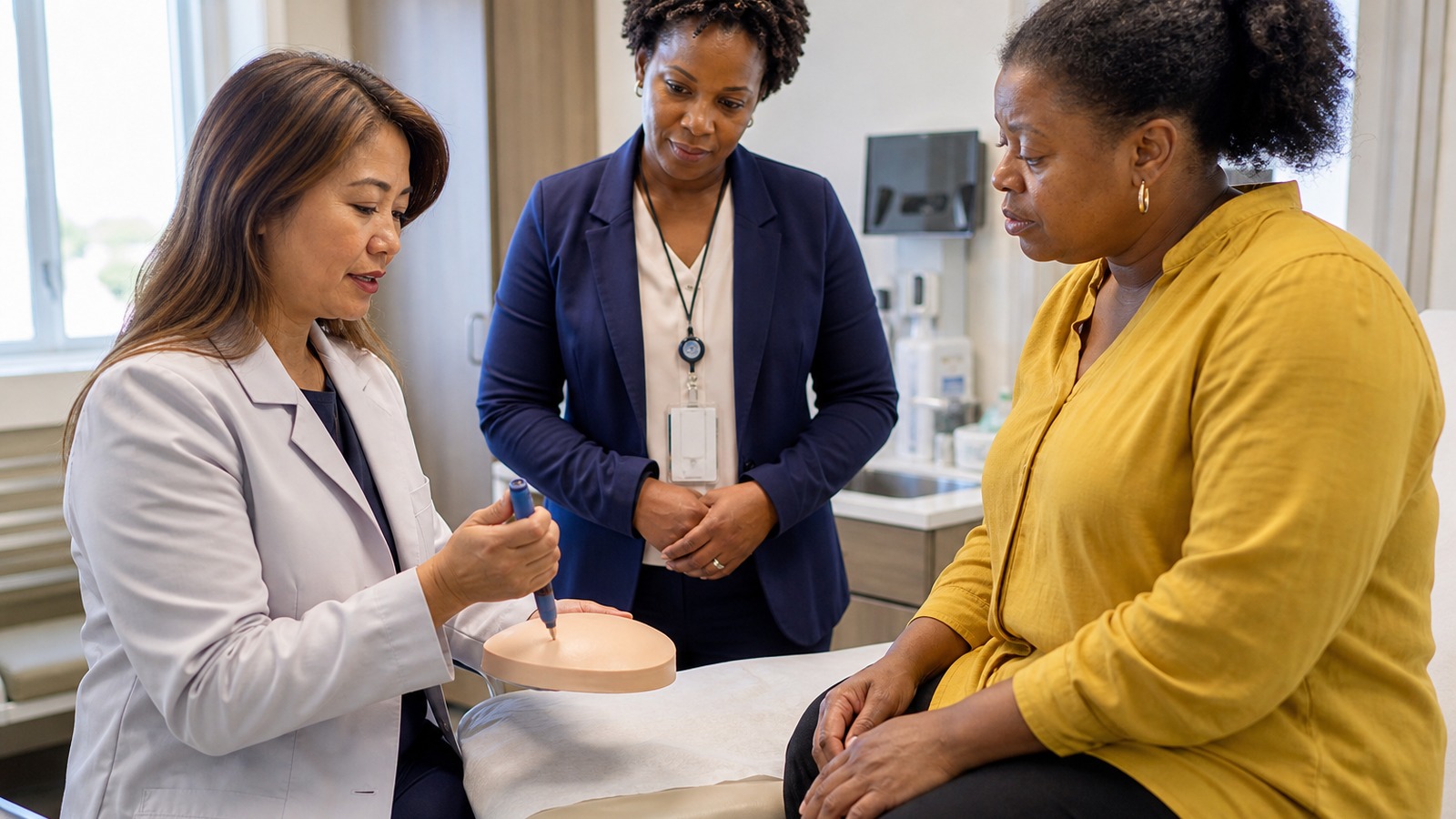
Insulin administration instructions are not general advice. Which insulin to take, how much, when, and how it differs from a sliding-scale adjustment are specific instructions — a summarized version of "take your insulin before meals" loses the detail that actually keeps a patient safe.
Hypoglycemia recognition has to be immediate, not looked up later. A patient needs to recognize shakiness, confusion, or sweating as low blood sugar in the moment, and know the exact steps to treat it, not reconstruct the lesson days later from memory.
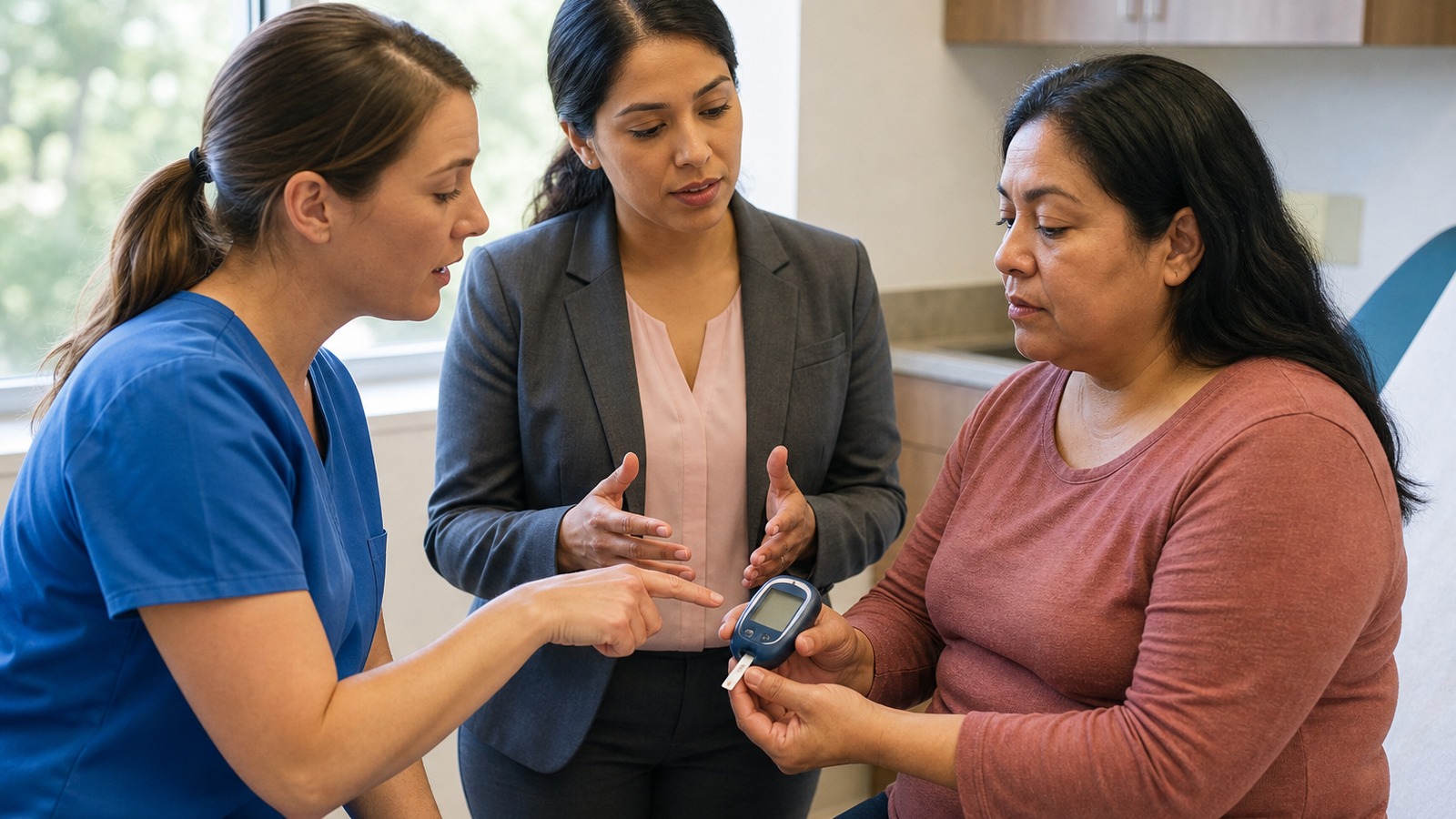
Glucose meter and continuous monitor instructions involve technical steps. Calibration, test strip handling, and reading a result correctly are procedural skills that a vague translation does not transfer reliably.
Sick-day and medication-adjustment rules change the usual routine. Patients need to understand when illness, missed meals, or other medications require a different approach than their everyday plan — an area where a partial understanding is especially risky.
Building a diabetes education program that patients can actually use
A diabetes education program only works if every patient leaves able to repeat back what they were taught, in their own words.
Interpret the full teaching session, not a condensed summary. Carbohydrate counting, insulin technique, hypoglycemia response, and monitoring steps should all be interpreted in full, every time, for any patient who is not fully fluent in English.
Fix the vocabulary once and reuse it. Terms like "carbohydrate," "ratio," "hypoglycemia," and "calibrate" should have one agreed translation that stays consistent across every visit and every clinician the patient sees.
Use teach-back through the interpreter, not a signature alone. Before ending a session, ask the patient to explain — through the interpreter, in their own words — what they will do the next time their glucose is low, or how they will count carbohydrates at their next meal.
Interpret printed materials and device instructions, too. A patient who followed the spoken lesson but cannot read the meter's quick-reference card or a medication label has not fully closed the gap.
Reserve family members for support, not interpretation. A spouse or adult child can help a patient remember and follow through at home, but clinical teaching benefits from a qualified interpreter who is not also managing their own worry about a family member's diagnosis.
Document the language each session was conducted in. Recording the patient's language alongside the visit note gives the clinic a reliable record and flags who may need a follow-up session in their own language.
Diabetes education interpretation checklist for Tri-State clinics
- Confirm the patient's preferred language before scheduling a diabetes education visit, not after the appointment starts.
- Interpret the full session — monitoring, carbohydrate counting, insulin technique, and hypoglycemia response — not a condensed version.
- Fix the exact translation of core terms like carbohydrate, ratio, hypoglycemia, and calibrate, and use it consistently across visits.
- Use teach-back through the interpreter to confirm the patient can explain their own plan in their own words.
- Interpret printed handouts, meter instructions, and medication labels in addition to the spoken lesson.
- Avoid relying on a family member to interpret clinical teaching, even when they are present and willing to help.
- Document the language each education session was conducted in alongside the visit note.
- Schedule a follow-up interpreted session after any change to the patient's insulin plan or monitoring routine.
This checklist is an operational starting point. Clinics should confirm their specific language-access and documentation obligations with their own compliance and legal professionals.
Diabetes education language access for Evansville, Henderson, Louisville, and Jasper patients
Hospitals, endocrinology practices, and primary care clinics across the Tri-State region see a growing number of patients managing diabetes who speak Spanish, Haitian Creole, Marshallese, and other languages alongside English-speaking care teams. Heartland supports healthcare organizations with on-site and phone spoken-language interpreting for diabetes education, follow-up visits, and device training, across the languages spoken by patients across Evansville, Henderson, Louisville, Jasper, and Southeast Illinois.
Diabetes education sits alongside other medication- and discharge-related teaching that depends on precise interpretation. Our guide to pharmacy medication counseling interpreters in Indiana covers a closely related visit type, and our overview of hospital discharge instructions interpreters in Indiana explains how the same precision applies when a patient leaves the hospital.
Teaching patients instructions they can actually follow at home
Diabetes self-management only works as well as the teaching behind it. Qualified interpretation for monitoring, carbohydrate counting, insulin technique, and hypoglycemia response, plus documented teach-back, gives Tri-State clinics a reliable education record and gives patients instructions they can apply the next time they are checking a glucose reading on their own.
Need interpreter coverage for diabetes education or other chronic care visits? Request a quote from Heartland Language and include your site, the languages your patients speak most, and whether you need on-site or phone coverage.
Frequently Asked Questions
Is interpretation required for diabetes education visits?
Clinics and hospitals that receive federal financial assistance have language-access obligations under 45 CFR Part 92, implementing Section 1557 of the Affordable Care Act, which cover diabetes education visits like any other clinical encounter involving a patient with limited English proficiency.
Can a family member interpret a diabetes education session instead of a professional interpreter?
A family member can support a patient at home, but diabetes education benefits from a qualified interpreter who is not also processing their own concern about a relative's diagnosis, especially for carbohydrate counting, insulin dosing, and hypoglycemia response, where precision matters more than familiarity.
What makes diabetes education interpretation different from a routine visit?
Diabetes education teaches skills a patient will perform alone, without a clinician present, so the interpretation has to transfer exact numbers, device steps, and warning signs clearly enough that the patient can recall and apply them days or weeks later.
How often should diabetes education be repeated with interpretation?
Patients benefit from a follow-up interpreted session whenever their insulin plan, monitoring device, or overall treatment changes, in addition to any refresher sessions their care team's standard protocol calls for.
About the author
Heartland Language Team
Heartland Language Team shares practical guidance from Heartland Language Services on clear, reliable communication for multilingual workplaces.
Keep reading
Related articles
October 1, 2026
Electrical Safety Training Interpreters Indiana: Arc-Flash Boundary Guide
Arc-flash boundaries and PPE categories are precise numbers, not general caution. This guide shows Tri-State manufacturers how qualified interpreters keep electrical safety training understood by every worker.
Read article →September 28, 2026
Pediatric Interpreters Indiana: Well-Child Visit Guide
A pediatric visit only works if the parent understands it too. This guide shows Tri-State practices how qualified interpreters keep vaccine, dosing, and screening conversations clear for every family.
Read article →September 25, 2026
Confined Space Entry Interpreters Indiana Manufacturing
A permit-required confined space entry has no room for a missed instruction. This guide shows Tri-State manufacturers how qualified interpreters keep every entry, test, and rescue plan understood.
Read article →