
Insights
Emergency Department Interpreters Indiana: ER Guide
Triage, treatment, and discharge decisions happen fast in an ER. This guide helps Tri-State hospitals interpret emergency care correctly under real time pressure.
Published August 29, 2026 · By Heartland Language Team

By the Heartland Language Team
An emergency department doesn't get to schedule its patients in advance, and it doesn't get to schedule its languages either. A triage nurse has minutes, sometimes seconds, to understand what's wrong, and a patient with limited English proficiency needs that same speed of understanding in return. When an ER relies on a family member, a gesture, or a guess instead of a qualified interpreter, both the diagnosis and the discharge instructions carry more risk. Reliable emergency department interpreters Indiana hospitals can call on around the clock close that gap when there's no time to spare.
Hospitals and urgent care centers across Evansville and Jasper, Indiana; Henderson and Louisville, Kentucky; and Southeast Illinois see emergency patients whose primary language isn't English at every hour of every shift. An ER's language access plan has to work at 3 a.m. on a holiday weekend as reliably as it works at 10 a.m. on a Tuesday.
Quick summary
- Federal law requires hospitals to screen and stabilize every emergency patient, and civil rights law requires that screening and treatment to be understandable regardless of language.
- On-demand phone and video remote interpreting (VRI) matter more in an ER than in almost any other care setting, because emergency patients rarely arrive with advance notice.
- Interpret triage, treatment decisions, and discharge instructions as three distinct moments, each with its own accuracy risk if rushed.
- A family member or bystander is not a substitute for a qualified interpreter, especially for consent, medication instructions, or a pediatric or behavioral health emergency.
- Discharge instructions need the same interpretation quality as the triage conversation; a patient who doesn't understand follow-up care is more likely to return by ambulance.
The standard for emergency department interpreters Indiana hospitals must meet
The Emergency Medical Treatment and Labor Act, known as EMTALA, requires hospitals with emergency departments to provide a medical screening examination and stabilizing treatment to anyone who arrives, regardless of ability to pay. That screening exam only satisfies its purpose if the patient can actually communicate their symptoms and understand what the clinical team tells them. A screening conducted through a confused, informal interpretation arrangement is not the same screening EMTALA envisions.
Civil rights obligations layer on top of that duty. Hospitals receiving federal funds have a documented responsibility to provide meaningful language access to patients with limited English proficiency, and an emergency department is exactly the setting where language barriers create the most immediate patient-safety risk. A hospital that maintains excellent interpreter access for scheduled clinic visits but leaves the ER without a fast, dependable option hasn't closed the highest-risk gap in its language access plan.
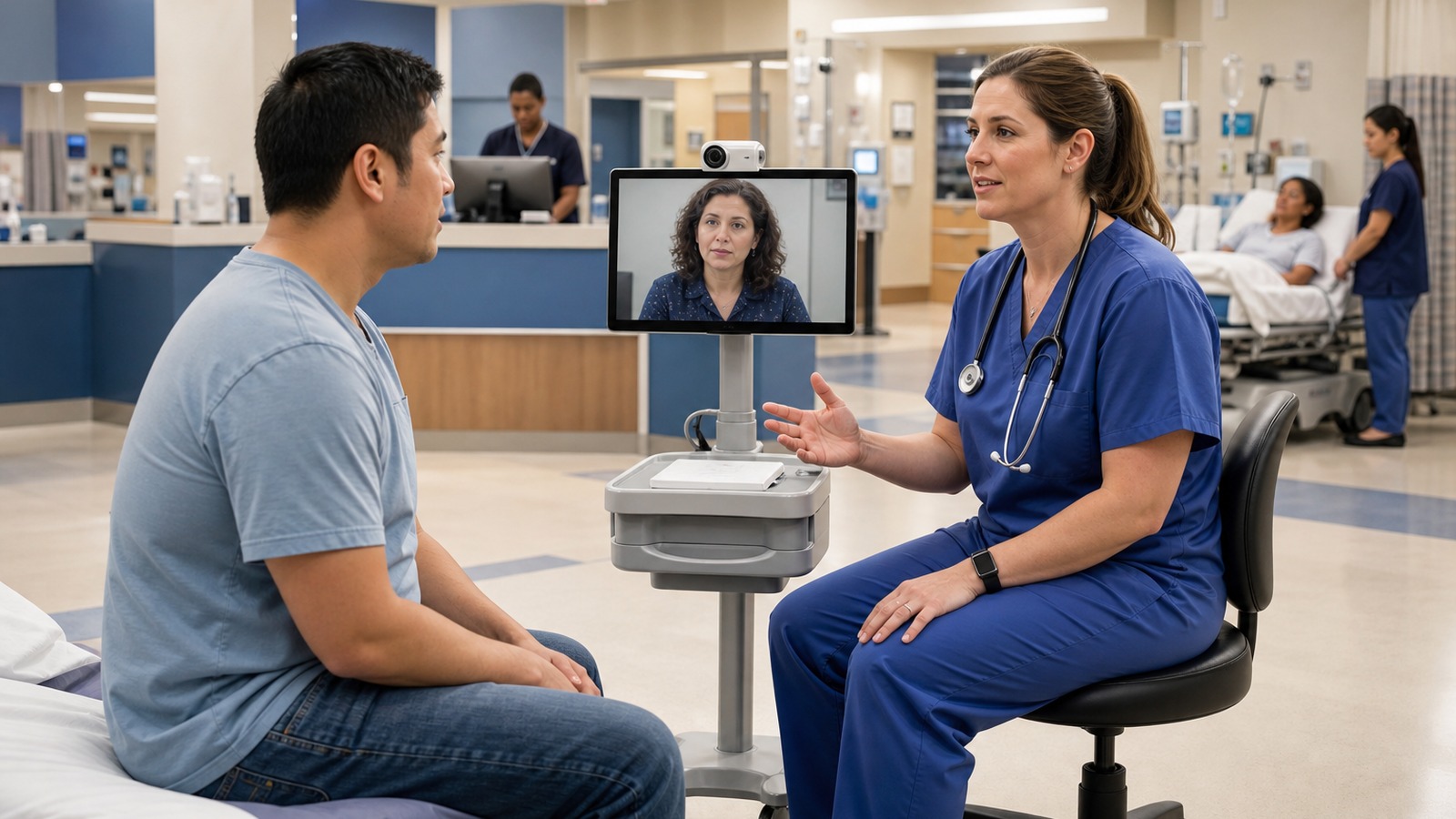
Choose interpreters available around the clock for on-demand emergencies
Unlike a scheduled clinic appointment, an ER encounter can start at any hour with no notice. A dependable interpreter plan for emergency care leans heavily on phone and video remote interpreting that a triage nurse or physician can activate in under a minute, backed by on-site interpreters for languages or situations where phone or video access isn't sufficient.
Confirm your ED's VRI equipment is charged, positioned at every triage and treatment bay, and that staff know the activation steps without hunting for instructions during a live emergency. An interpreting service that's excellent on paper doesn't help a patient if the cart is in a supply closet and no one remembers the password.
Structure triage, treatment, and discharge for interpretation
Treat interpreted emergency care as three distinct moments, each with different pacing and stakes.
Triage happens fast and often under real distress. The interpreter needs to convey symptom severity, onset, and pain level accurately enough for the triage nurse to assign an appropriate acuity level, without adding delay that could push a serious complaint down the queue.
Treatment and consent conversations, especially for procedures, imaging with contrast, or admission decisions, need enough time for the interpreter to fully render the physician's explanation and the patient's questions. Rushing this stage to save two minutes risks a consent that wouldn't hold up as informed.
Discharge instructions are where interpretation quality gets tested the most and monitored the least. A patient who leaves without truly understanding medication dosing, wound care, or return precautions is a patient more likely to come back by ambulance instead of by follow-up appointment.
Interpret time-sensitive consent and treatment decisions accurately
Emergency consent conversations move fast, but the interpreter's accuracy still has to hold up to the same standard as a scheduled surgical consent. Brief the interpreter on the specific procedure, medication, or admission decision before the conversation whenever the pace allows even thirty seconds for that, and confirm the interpreter relays the patient's own questions back to the clinical team rather than summarizing or skipping them.
For a true life-threatening emergency where no interpreter is immediately available, document the interim communication method used and arrange qualified interpretation as soon as the patient is stabilized, rather than treating the gap as resolved once the crisis passes.
Handle multiple languages during a high-volume ED shift
A busy ER can have several limited-English-proficient patients in different languages at once, each needing accurate, real-time communication. Depend on a VRI or phone interpreting vendor with genuine capacity across your ED's most common languages, not a single on-call interpreter who becomes a bottleneck the moment two encounters need the same language simultaneously.
Heartland supports healthcare providers across the Tri-State region with on-demand emergency interpreting and scheduled clinical interpreting, as part of broader spoken interpretation services built for around-the-clock hospital environments.
Document interpreted care for compliance and continuity
Record the interpreter's name or vendor ID, the language interpreted, and the modality (phone, video, or on-site) in the patient's emergency record for triage, treatment, and discharge. This documentation protects the hospital if care is reviewed later, and it also helps the next clinician, in urgent care, a specialist follow-up, or a readmission, know what language support the patient needs.
Keep any translated discharge materials on file the same way the English version is kept, so what the patient actually received is verifiable.

Discharge instructions and follow-up care communication triggers
Interpret discharge instructions as their own dedicated conversation, not a rushed summary delivered while a patient is already gathering their belongings. Confirm the patient can repeat back medication timing, wound care steps, and specific return precautions in their own words through the interpreter. Apply that same discharge-interpretation standard for every language in the department, not just the hospital's majority language, since discharge misunderstanding is one of the most common drivers of preventable ER returns.
Emergency department interpreter checklist
- 1. Confirm phone or video interpreting is activated and accessible at every triage and treatment bay.
- 2. Interpret triage quickly but completely enough to support accurate acuity assignment.
- 3. Give treatment and consent conversations enough time for full interpretation, not a rushed summary.
- 4. Never substitute a family member or bystander for consent, medication, or high-stakes conversations.
- 5. Document interim communication and arrange qualified interpretation promptly if none was available during a life-threatening emergency.
- 6. Depend on a vendor with real capacity across your ED's common languages, not a single bottlenecked interpreter.
- 7. Record the interpreter, language, and modality in the emergency record.
- 8. Confirm patient understanding of discharge instructions through the interpreter before the patient leaves.
This checklist is an operational starting point. Hospitals should confirm their specific EMTALA, civil rights, and clinical documentation obligations with qualified compliance and legal professionals.
Faster, safer emergency care starts with a language access plan
An emergency department's language access plan is tested every time a patient arrives who can't communicate in English, and it's tested with no advance warning. On-demand interpreting for triage, unhurried interpretation for consent, and confirmed understanding at discharge give Tri-State hospitals a defensible way to deliver the same standard of emergency care in every language their community speaks.
Planning interpreter coverage for your emergency department? Request a quote from Heartland Language and include your ED's volume, common languages, and current on-demand interpreting setup.
Frequently Asked Questions
Does EMTALA require interpreter services in the emergency department?
EMTALA requires a medical screening exam and stabilizing treatment for every patient regardless of ability to pay. That screening only meets its purpose if the patient can communicate, and separate civil rights obligations require hospitals receiving federal funds to provide meaningful language access, making qualified interpretation a practical necessity for EMTALA compliance.
Can a family member interpret for a patient in the emergency department?
A family member should not be relied on for consent, medication instructions, or high-stakes clinical conversations. They may lack medical vocabulary, may filter or soften difficult information, and put an already-stressed family member in the position of delivering emergency medical news.
What interpreting method works best for an unscheduled ER arrival?
Phone and video remote interpreting activated within a minute at triage and treatment bays covers the unpredictable timing of ER visits, backed by on-site interpreters for languages or situations that need in-person support.
What should an ER document when a patient's care was interpreted?
Record the interpreter's name or vendor ID, the language interpreted, and the modality used, at triage, during treatment and consent, and at discharge, in the patient's emergency record.
About the author
Heartland Language Team
Heartland Language Team shares practical guidance from Heartland Language Services on clear, reliable communication for multilingual workplaces.
Keep reading
Related articles
September 4, 2026
Hospital Discharge Instructions Interpreters Indiana Guide
A rushed discharge conversation is a top cause of preventable readmissions. This guide helps Tri-State hospitals interpret discharge instructions correctly the first time.
Read article →August 6, 2026
Medical Consent Interpreters Indiana: Clinic Guide
Informed consent depends on a real conversation. This guide helps Tri-State healthcare teams plan qualified interpretation before procedures, treatment decisions, and follow-up.
Read article →September 7, 2026
Manufacturing Performance Review Interpreters Indiana Guide
A performance review or disciplinary write-up is one of the few conversations an employer may have to defend later. This guide helps Tri-State manufacturers interpret it correctly the first time.
Read article →