
Insights
Electrical Safety Training Interpreters Indiana: Arc-Flash Boundary Guide
Arc-flash boundaries and PPE categories are precise numbers, not general caution. This guide shows Tri-State manufacturers how qualified interpreters keep electrical safety training understood by every worker.
Published October 1, 2026 · By Heartland Language Team
By the Heartland Language Team
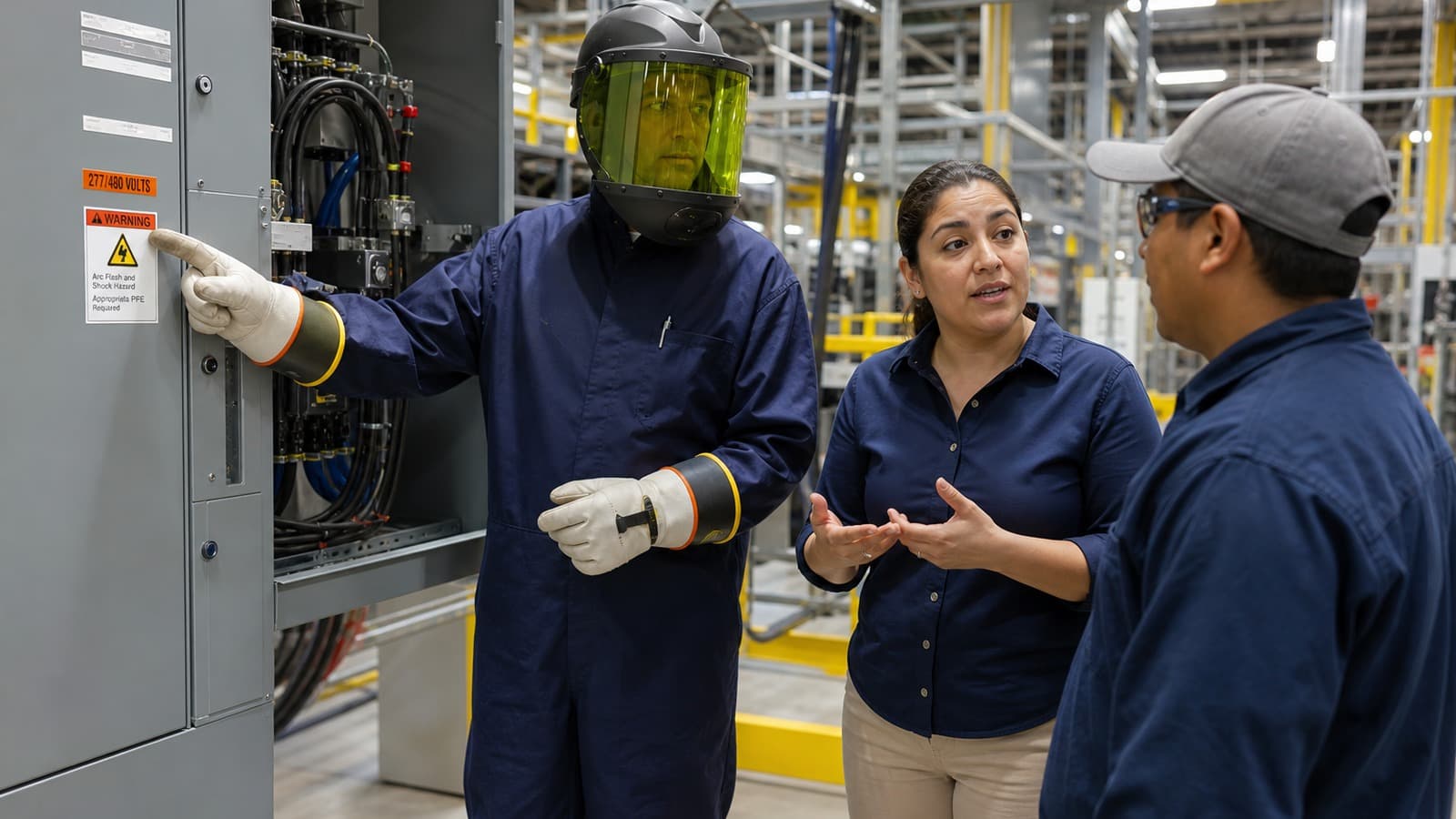
A qualified electrician and an unqualified one can stand in front of the same panel and face very different rules about how close they may get to it. Electrical safety training interpreters Indiana manufacturing plants rely on make sure every worker near energized equipment — not just the electricians — understands exactly where those boundaries are, what PPE a task requires, and what to do if something goes wrong.
Quick summary
- OSHA's electrical safety-related work practices standard sets different rules for "qualified" and "unqualified" workers, and both groups need to understand which one they are.
- Arc-flash boundaries and PPE categories are precise, numeric limits — a rough or improvised translation defeats the purpose of the boundary.
- Electrical safety training is a distinct requirement from lockout/tagout energy control, even though the two overlap on many jobs.
- A qualified interpreter for electrical safety training is not the same as a bilingual coworker relaying instructions during a live task.
- Documenting the language each worker was trained in gives a plant a defensible record and flags where retraining is due.
Why electrical safety training interpreters Indiana manufacturing plants need are a compliance and life-safety issue
Electrical work carries hazards that are invisible until something goes wrong: shock, arc flash, and arc blast can injure or kill a worker who never touched a live conductor directly. OSHA's electrical safety-related work practices standard, 29 CFR 1910.332, requires employers to train employees who face a risk of electric shock on the specific safety-related work practices that apply to their job, and it draws a sharp line between "qualified persons" — trained and authorized to work on or near exposed energized parts — and "unqualified persons," who are not. OSHA's electrical topic page describes the standard's intent plainly: the training has to match the actual hazard a worker will face, not a generic safety overview.
None of that protection holds up if a worker cannot tell which category applies to them, cannot read an arc-flash warning label, or does not understand the exact boundary distance a task requires before someone unqualified has to stay back.
Where language gaps put electrical work at risk
Qualified-versus-unqualified status gets lost in translation. A worker who is unclear on whether they are authorized to work near exposed energized parts may approach equipment they should never touch, or hesitate to report a hazard they were actually trained to flag.
Arc-flash boundary distances are exact numbers, not general caution. A label listing an arc-flash boundary and required PPE category communicates a specific distance and a specific gear requirement — an approximate or summarized translation gives a worker a false sense of how close is too close.
PPE category requirements vary by task, not by habit. The gloves, face shield, and flame-resistant clothing required for one panel may not match what a worker wore for a different task yesterday; a worker who does not fully understand the label is more likely to default to what feels familiar instead of what the task requires.
Lockout/tagout and live-work rules get blurred together. Electrical safety training and energy-control procedures overlap but are not identical — a worker who only partially understands the distinction may assume a locked-out circuit removes every electrical hazard, when arc-flash and residual-energy risks can still apply during testing and verification steps.
New and temporary electricians are the most exposed. Contractors and recently hired maintenance workers are less likely to have absorbed plant-specific electrical hazard vocabulary informally, and they are exactly the workers most likely to be assigned unfamiliar panels.
Building an electrical safety training program that holds up
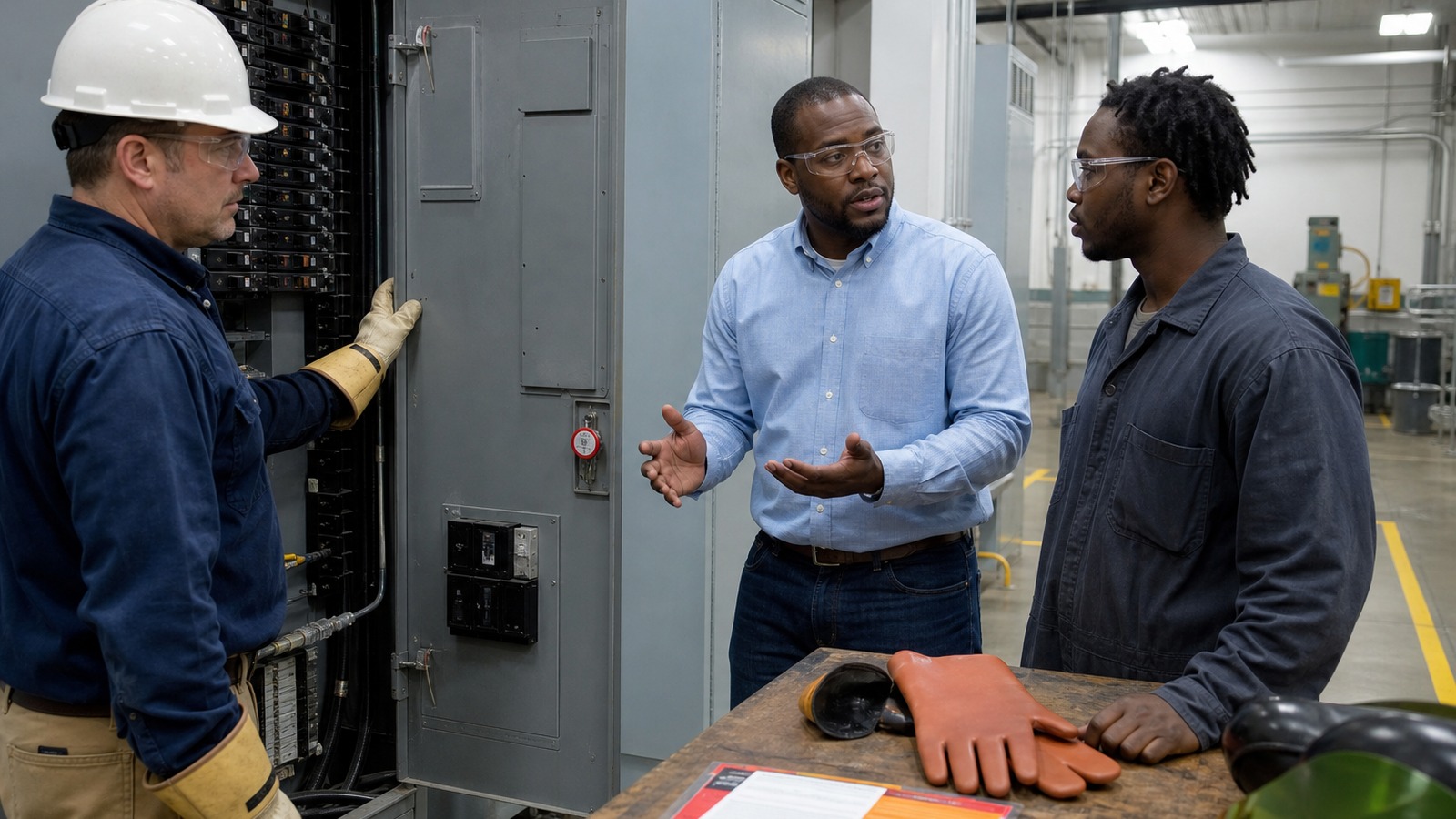
A strong electrical safety program treats interpretation as part of the training record, not an add-on for a single session.
Interpret the full training, not a condensed version. Qualified/unqualified classification, arc-flash boundaries, PPE categories, and de-energization verification steps should all be interpreted in full for any worker who is not fully fluent in English — not summarized to save time.
Pre-translate the safety-critical vocabulary. "Qualified," "arc-flash boundary," "PPE category," "de-energized," and "verify absence of voltage" should have a fixed, agreed translation that every trained worker recognizes the same way every time.
Confirm understanding with teach-back, not a signature alone. Before a training record is signed, ask each worker to state back — through the interpreter, in their own words — their qualified/unqualified status and the PPE required for their typical tasks.
Interpret warning labels and panel signage, too. A worker who understood the classroom training but cannot read the arc-flash label on the actual panel in front of them has not fully closed the gap.
Coordinate with lockout/tagout training instead of treating it as a separate silo. Where a task involves both energy control and possible live work — testing, troubleshooting, verification — the interpreter should help the worker understand how the two procedures interact with each other.
Document the language used for the training. Recording which language each worker was trained in, alongside the training record, gives the plant a defensible record and flags exactly who needs retraining if a procedure changes.
Electrical safety training checklist for Tri-State manufacturers
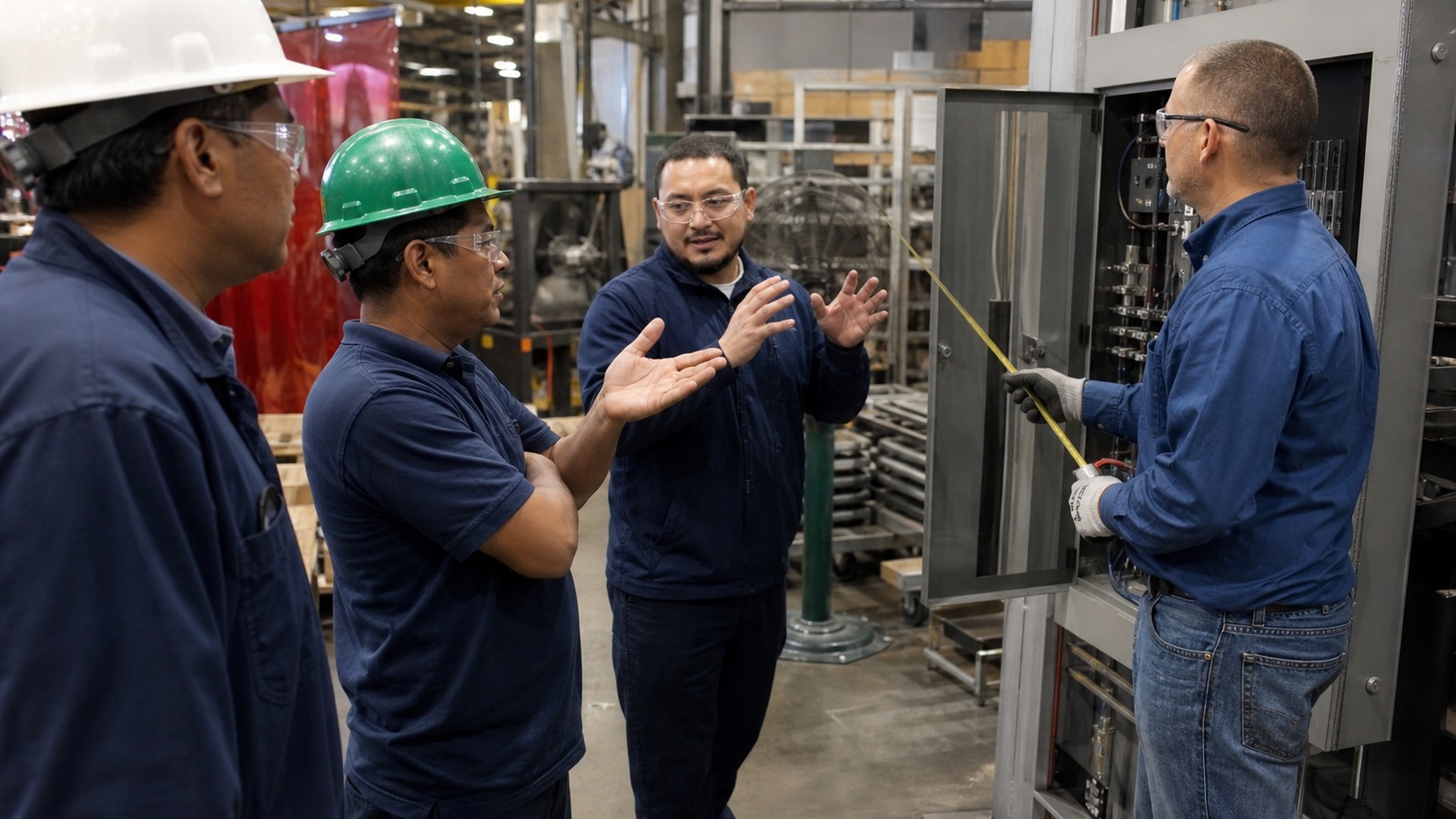
- Identify every worker's working language before scheduling electrical safety training.
- Interpret the full training — qualified/unqualified classification, arc-flash boundaries, PPE categories, and verification steps — not a summarized version.
- Fix the exact translation of qualified, arc-flash boundary, PPE category, and verify absence of voltage, and use it consistently.
- Use teach-back through the interpreter to confirm each worker understands their classification and the PPE their tasks require.
- Interpret warning labels and panel signage in addition to the classroom training.
- Coordinate electrical safety training with lockout/tagout training so workers understand how the two procedures work together.
- Document the language each worker's training was conducted in alongside the training record.
- Retrain and re-verify understanding whenever a worker's job tasks or an affected panel's hazard classification changes.
This checklist is an operational starting point. Manufacturers should confirm their specific OSHA, state, and insurer obligations with their own safety and legal professionals.
Electrical safety language access for Evansville, Henderson, Louisville, and Jasper manufacturers
Food, metal, plastics, and automotive-parts plants across the Tri-State region train electricians and maintenance workers on electrical safety every year, and many of those crews include Spanish, Haitian Creole, and Marshallese speakers working alongside English-speaking supervisors. Heartland supports manufacturing plants with on-site and phone spoken-language interpreting for electrical safety training, panel-label review, and toolbox talks, across the languages common on Tri-State manufacturing floors.
Electrical safety training sits alongside a plant's broader safety-communication program. Our guide to lockout/tagout training interpreters in Indiana covers the related energy-control procedure, and our overview of confined space entry interpreters in Indiana manufacturing explains how permit-required entries handle a similarly precise, life-safety training requirement.
Training every worker can act on around live equipment
Electrical safety training only protects a crew as well as the understanding behind it. Qualified interpretation for classification, boundaries, and PPE requirements, plus documented teach-back, gives Tri-State manufacturers a defensible training record and gives every worker instructions they can apply the moment they are standing in front of a panel.
Need interpreter coverage for electrical safety training or other high-hazard safety programs? Request a quote from Heartland Language and include your site, the languages your crew speaks most, and whether you need on-site or phone coverage for training.
Frequently Asked Questions
Does OSHA require an interpreter for electrical safety training?
OSHA's electrical safety-related work practices standard, 29 CFR 1910.332, does not name interpretation specifically, but it requires employees facing a risk of electric shock to be trained on the practices that apply to their job. When a worker is not fully fluent in English, a qualified interpreter is a practical way to meet that training requirement and to document it.
What is the difference between electrical safety training and lockout/tagout training?
Electrical safety training covers qualified-versus-unqualified status, approach boundaries, and PPE for work on or near energized equipment. Lockout/tagout training covers the procedure for de-energizing and locking out equipment before service. Many tasks involve both, and workers benefit from understanding how the two procedures fit together.
Can a bilingual coworker interpret electrical safety training instead of a professional interpreter?
A bilingual coworker can help day to day, but electrical safety training benefits from a qualified interpreter who is not also performing another safety role, especially for arc-flash boundary distances, PPE category requirements, and qualified/unqualified classification, where precision matters more than familiarity.
How often should electrical safety training be repeated?
Workers should be retrained whenever their job tasks change, whenever a panel's hazard classification changes, or at the interval a plant's written program sets, with every worker — regardless of language — able to demonstrate they understand their classification and the PPE their tasks require.
About the author
Heartland Language Team
Heartland Language Team shares practical guidance from Heartland Language Services on clear, reliable communication for multilingual workplaces.
Keep reading
Related articles
September 25, 2026
Confined Space Entry Interpreters Indiana Manufacturing
A permit-required confined space entry has no room for a missed instruction. This guide shows Tri-State manufacturers how qualified interpreters keep every entry, test, and rescue plan understood.
Read article →September 19, 2026
Manufacturing Equipment Training Interpreters Indiana
A new machine only pays off if every operator understood the vendor's commissioning and safety training. This guide helps Tri-State manufacturers get equipment installation and training right in every language on the floor.
Read article →August 24, 2026
Lockout/Tagout Training Interpreters Indiana: Machine Safety Guide
A locked-out machine only stays safe if every worker near it understands what the lock means. This guide helps Tri-State manufacturers interpret lockout/tagout training correctly.
Read article →