
Insights
Manufacturing Performance Review Interpreters Indiana Guide
A performance review or disciplinary write-up is one of the few conversations an employer may have to defend later. This guide helps Tri-State manufacturers interpret it correctly the first time.
Published September 7, 2026 · By Heartland Language Team

By the Heartland Language Team
A performance review or a written corrective action is one of the few workplace conversations an employer will have to defend later, in an unemployment hearing, an EEOC charge, or a wrongful-termination claim. For a limited-English-proficient employee, that conversation is also one of the easiest to get wrong: a supervisor reads from a template, a form gets signed, and nobody confirms the employee actually understood what was said. Reliable manufacturing performance review interpreters Indiana employers bring into these conversations turn a signature on a form into a conversation the employee can actually explain back.
Manufacturers across Evansville and Jasper, Indiana; Henderson and Louisville, Kentucky; and Southeast Illinois manage annual reviews, corrective-action write-ups, and final warnings for LEP employees on the floor every week. A plant that interprets orientation and safety training carefully, then hands an LEP employee an English-only write-up at the moment their job is on the line, has left its highest-liability HR moment uninterpreted.
Quick summary
- A performance review or disciplinary write-up is a document an employer may need to defend in an unemployment or discrimination proceeding, which raises the stakes of the employee actually understanding it.
- EEOC guidance treats consistent, understandable communication with LEP employees as part of nondiscriminatory HR practice, not an optional courtesy.
- A signed acknowledgment form proves paper changed hands; it does not prove the employee understood the rating, the corrective action, or what happens at the next incident.
- Treat the performance review and the disciplinary conversation as two distinct interpreted moments, since each carries different stakes and a different need for the employee's own words to come through.
- Pulling in a bilingual supervisor or coworker instead of a qualified interpreter raises real liability in a conversation that could end in termination.
The compliance case for manufacturing performance review interpreters Indiana employers can defend
The Equal Employment Opportunity Commission's guidance on national origin discrimination makes clear that inconsistent treatment tied to an employee's limited English proficiency can raise discrimination concerns, particularly when a company applies performance standards or discipline unevenly because a review process wasn't built for employees who don't read workplace English fluently. A plant that reviews English-speaking employees in a language they understand, then reviews LEP employees through a rushed summary or a form nobody explains, is treating two groups of employees differently at the exact moment that difference is easiest to scrutinize later.
EEOC's guidance on prohibited employment policies and practices reinforces the same point from the discipline side: an employment decision, including a negative review or a termination, has to rest on a process the employee could actually participate in, not one that only looks neutral on paper. A write-up an employee couldn't read and a review meeting an employee couldn't follow both weaken an employer's position if that decision is ever challenged.
Documentation without comprehension is a liability, not a defense
A signed performance review or corrective-action form is often the centerpiece of an employer's file when a termination gets challenged. That signature is much weaker evidence than it looks if the employee who signed it never actually understood the rating, the specific behavior being corrected, or the consequence of a repeat incident. An unemployment hearing officer or an EEOC investigator who learns the employee signed through a bilingual coworker's rough, unrecorded summary will treat that signature very differently than one obtained through a qualified interpreter.
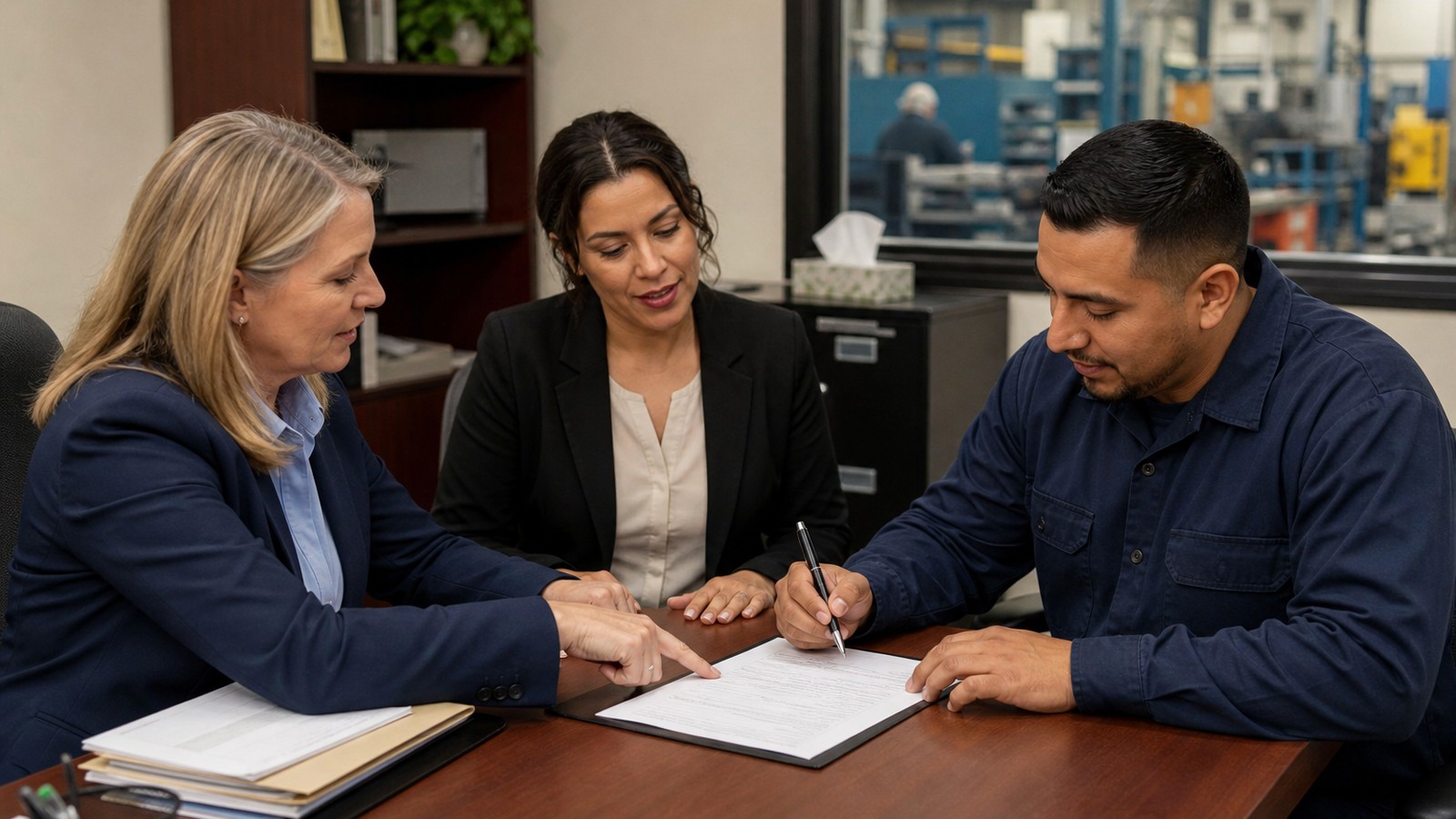
Building a qualified interpreter into the review or disciplinary meeting itself, not just into the paperwork afterward, gives the employer a defensible record: the employee heard the specific performance concern, asked their own questions through the interpreter, and confirmed understanding before signing anything.

Structure the performance review and the disciplinary conversation as separate interpreted moments
A performance review and a disciplinary write-up carry different stakes, and each deserves its own interpreted approach.
A performance review covers a longer stretch of work and often includes both praise and areas for improvement. The interpreter needs enough time to convey specific examples accurately, not just an overall rating, so the employee understands what to keep doing and what to change.
A corrective action or final warning moves faster and carries higher immediate stakes. The interpreter's job is to convey the specific policy violated, the exact consequence of a repeat incident, and the employee's own explanation back to the supervisor, without softening the message or skipping the employee's response.
Give both conversations enough time for full interpretation. A performance review or a final warning rushed to fit a ten-minute slot between shifts is a conversation neither side can later prove actually happened the way the form says it did.
Never substitute a bilingual coworker or supervisor for a review or disciplinary conversation
Pulling a bilingual coworker off the line to interpret a performance review or a write-up is the most common shortcut, and it's also the riskiest one available. A coworker may soften a harsh rating out of sympathy, may not know the specific corrective-action language HR expects documented, and is put in an uncomfortable position between a peer and a supervisor in a conversation that could end in that peer's termination.
A bilingual supervisor delivering their own discipline through their own informal translation carries a different risk: without a neutral interpreter in the room, there's no independent record of what was actually said if the employee later disputes the account. A qualified, neutral interpreter protects both the employee's understanding and the employer's documentation.
Building interpreter access into HR reviews across the Tri-State region
Tri-State manufacturers serving Evansville, Henderson, Louisville, Jasper, and the surrounding Southeast Illinois communities run annual reviews and corrective-action processes across food processing, plastics, automotive supply, and aluminum operations with meaningfully multilingual workforces. Heartland supports manufacturing employers across the region with on-site interpreting for review cycles and disciplinary meetings, paired with corporate language training for HR and supervisory staff who manage LEP employees day to day, as part of broader spoken-language interpreting built around real HR scheduling, not just plant floor emergencies.
Scheduling interpreter coverage for known review cycles, the same way a plant schedules coverage for new-hire onboarding, keeps HR's highest-liability conversations from being the ones handled with the least preparation.
Performance review interpretation mistakes that increase legal exposure
Handing an LEP employee an English-only review form to sign at the end of the meeting, after interpreting only a verbal summary, creates a document the employee can't independently verify matches what they were told. If the written rating or corrective-action language differs from what was interpreted aloud, the employer has created its own inconsistency.
Skipping the employee's own response is the second common mistake. A review or disciplinary conversation that only flows from supervisor to employee, without the interpreter relaying the employee's explanation or pushback back to the supervisor, produces a one-sided file that looks worse, not better, if it's ever reviewed by an investigator or a hearing officer.
Manufacturing performance review interpreter checklist
- Schedule a qualified interpreter for the review or disciplinary meeting itself, not only for translating the paperwork afterward.
- Give performance reviews and corrective-action conversations separate time slots long enough for full interpretation.
- Interpret specific examples and the exact consequence of a repeat incident, not just an overall rating.
- Relay the employee's own explanation or questions back to the supervisor through the interpreter, every time.
- Never substitute a bilingual coworker or the disciplining supervisor for a neutral, qualified interpreter.
- Confirm the written form matches what was interpreted aloud before asking the employee to sign it.
- Document the interpreter's name or vendor ID and the language used alongside the review or write-up itself.
- Apply the same interpreted-review standard consistently across every language spoken on the floor.
This checklist is an operational starting point. Manufacturers should confirm their specific EEOC, documentation, and labor-relations obligations with qualified employment counsel.
Fair performance conversations start with an interpreted HR process
A performance review or a disciplinary write-up is one of the few workplace conversations an employer may have to defend months or years later. An interpreted review, an interpreted corrective-action conversation, and a written record that actually matches what was said give Tri-State manufacturers a defensible, consistent way to manage every employee's performance in a language they understand.
Building interpreter coverage into your review and disciplinary process? Request a quote from Heartland Language and include your review cycle, common floor languages, and current HR documentation process.
Frequently Asked Questions
Does skipping an interpreter for a performance review create legal exposure?
Yes. EEOC guidance treats consistent, understandable communication with LEP employees as part of nondiscriminatory HR practice, and a review process an employee couldn't follow weakens an employer's position if that review or a later termination is ever challenged.
Can a bilingual coworker or supervisor interpret a disciplinary write-up?
A coworker may soften a harsh rating or miss specific corrective-action language, and a disciplining supervisor interpreting their own discipline removes the neutral, independent record an employer needs if the employee later disputes what was said.
Does a signed acknowledgment form protect an employer if the employee didn't understand the review?
A signature proves paper changed hands, not comprehension. An investigator or hearing officer who learns the signature came after an unrecorded, informal translation will weigh that signature very differently than one obtained through a qualified interpreter.
What manufacturing HR moments beyond onboarding most need a qualified interpreter?
Annual performance reviews, corrective-action write-ups, final warnings, and termination meetings all carry documentation and legal stakes that a bilingual coworker or a translated form alone cannot reliably cover.
About the author
Heartland Language Team
Heartland Language Team shares practical guidance from Heartland Language Services on clear, reliable communication for multilingual workplaces.
Keep reading
Related articles
September 4, 2026
Hospital Discharge Instructions Interpreters Indiana Guide
A rushed discharge conversation is a top cause of preventable readmissions. This guide helps Tri-State hospitals interpret discharge instructions correctly the first time.
Read article →August 24, 2026
Lockout/Tagout Training Interpreters Indiana: Machine Safety Guide
A locked-out machine only stays safe if every worker near it understands what the lock means. This guide helps Tri-State manufacturers interpret lockout/tagout training correctly.
Read article →September 1, 2026
Manufacturing Onboarding Interpreters Indiana: Day-One Guide
A new hire's first week is the highest-risk week for safety comprehension. This guide helps Tri-State manufacturers onboard every employee in a language they understand.
Read article →