
Insights
Occupational Health Clinic Interpreters Indiana
A pre-employment physical, respirator clearance, or injury visit only counts if the employee actually understood it. This guide helps Tri-State manufacturers get occupational health clinic visits right in every language on the floor.
Published September 16, 2026 · By Heartland Language Team

By the Heartland Language Team
A pre-employment physical, a respirator medical evaluation questionnaire, and a post-injury workers' compensation visit all happen in the same building for most Tri-State manufacturers: the occupational health clinic contracted to serve the plant. Occupational health clinic interpreters Indiana employers bring to those visits are what turn a signed intake form into a clinician who actually knows whether an employee can safely wear a respirator, has passed an audiometric baseline, or has accurately described how an injury happened. Skip the interpreter, and the visit still happens — it just produces paperwork nobody in the room can fully stand behind.
Occupational health clinics serving Evansville and Jasper, Indiana; Henderson and Louisville, Kentucky; and Southeast Illinois run a steady volume of pre-employment physicals, respirator clearances, hearing tests, drug screens, and injury evaluations for manufacturing and food-processing employers with meaningfully multilingual workforces. A plant that interprets floor-level safety training carefully, then sends employees to the clinic alone for the exams that gate their ability to do the job, has left a compliance-critical step uninterpreted at the one visit where a misunderstanding carries the most consequence.
Quick summary
- OSHA's respirator medical evaluation requires a physician or licensed health care professional to review a questionnaire the employee has to understand well enough to answer honestly.
- OSHA's hearing conservation standard requires an accurate audiometric baseline, which depends on the employee understanding test instructions, not just wearing headphones correctly.
- A workers' compensation injury visit is where an inaccurate or incomplete history, taken without an interpreter, can shape the entire claim.
- Occupational health visits happen off the plant floor, often without the safety staff or HR interpreter support available on-site, which makes the clinic itself responsible for arranging interpretation.
- A bilingual coworker or family member is not a substitute for a qualified interpreter during a clinical evaluation.
The compliance case for occupational health clinic interpreters Indiana employers can defend
OSHA's respirator protection standard, published at 29 CFR 1910.134, requires every employee who wears a respirator to complete a medical evaluation before fit testing, using a questionnaire a physician or other licensed health care professional reviews to determine fitness to wear the respirator. The standard depends on the employee understanding and answering the questionnaire honestly; a form completed with guesswork because the employee could not read or understand the English questions does not give the reviewing clinician the information the standard requires.
The same logic applies to hearing conservation. OSHA's hearing conservation standard requires an accurate audiometric baseline and annual testing for employees exposed to high noise levels, which depends on the employee correctly understanding test instructions, when to respond, what to expect. A clinic that skips interpretation for the five-minute instruction before a hearing test has introduced a source of inaccurate baseline data into a program built to catch hearing loss early.
Pre-employment physicals and audiometric baseline testing need real comprehension, not a signature
A pre-employment physical typically combines a health history intake, a physical exam, a drug screen, and often an audiometric baseline in a single visit. Each piece depends on the employee understanding what is being asked and what is happening: a health history question about a prior injury or condition, a physical capacity test tied to the job's actual demands, or a hearing test instruction about when to press the button. An employee who nods through a rushed, uninterpreted intake because the clinic is busy and the appointment is short has completed the paperwork without giving the clinic anything it can actually rely on.
Manufacturing employers who verify a candidate's job-specific physical capacity, lifting limits, repetitive motion tolerance, respirator fit, get the most defensible result when the candidate actually understood each instruction and question well enough to respond accurately, not when a rushed visit produced a completed form.
Respirator medical evaluation questionnaires fail when the employee can't understand the questions
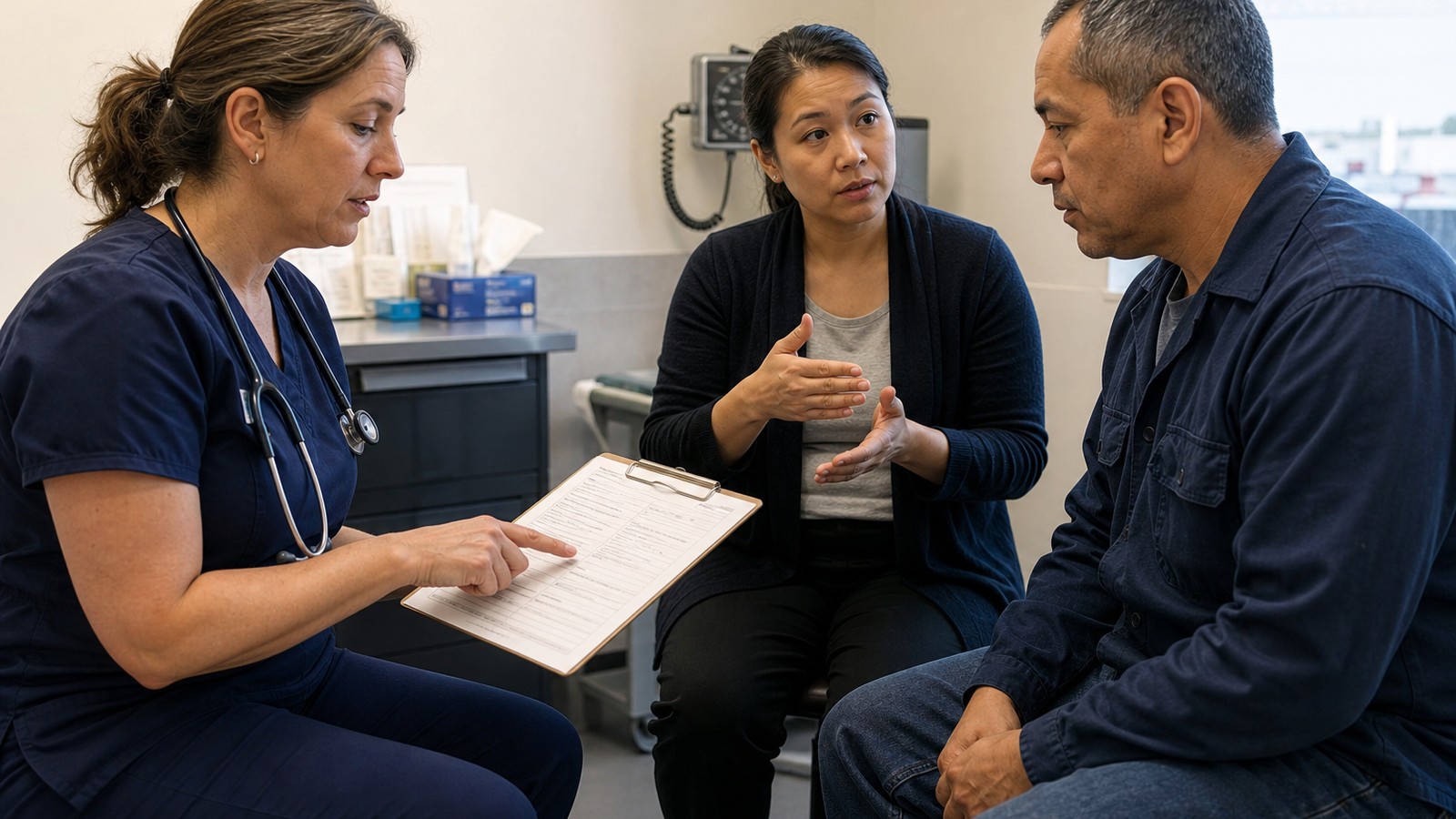
The respirator medical evaluation questionnaire asks specific, sometimes technical health history questions, about heart conditions, breathing difficulty, prior respirator use, that determine whether an employee can safely wear a respirator on the job. An employee guessing at unfamiliar English medical terminology risks answering inaccurately in either direction: understating a real condition that should have been flagged, or overstating symptoms out of confusion, both of which give the reviewing clinician bad information to work from.
An interpreter present for the questionnaire, whether completed on paper with the interpreter relaying each question or during a follow-up conversation with the reviewing clinician, closes that gap. The reviewing clinician gets an accurate history, and the employee gets a clearance decision based on their actual health status rather than a misread form.
Workers' compensation injury visits are where a missed interpreter creates the biggest liability
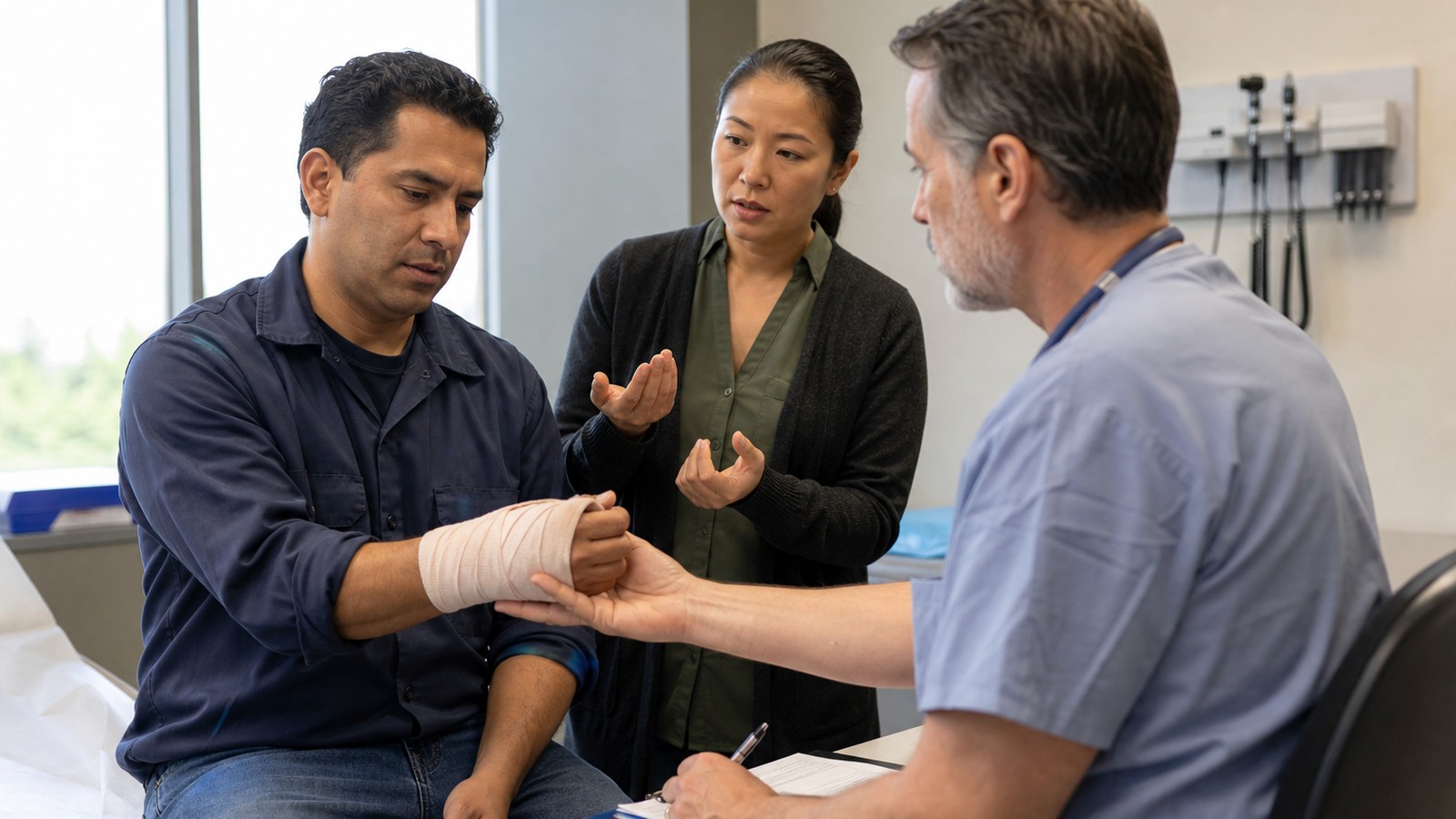
An employee injured on the floor and sent to the occupational health clinic for evaluation is often stressed, in pain, and trying to describe exactly what happened in a language that is not their first. The clinician's notes from that visit, the mechanism of injury, the employee's own description of symptoms, the initial diagnosis, become the foundation of the workers' compensation claim and the return-to-work plan that follows.
An inaccurate history taken without an interpreter can misdescribe how the injury happened, understate the employee's pain or limited range of motion, or produce a return-to-work recommendation that does not match the employee's actual condition. Employers who insist on interpreter coverage for the initial injury visit get a cleaner, more accurate record from the start, one that holds up better if the claim is later questioned, and an employee who was genuinely understood during a stressful appointment.
Never substitute a bilingual coworker for an occupational health clinic visit
Sending an injured or nervous employee to a clinic appointment with a bilingual coworker or family member standing in for a qualified interpreter is a common shortcut, and it creates real risk at exactly the visits where accuracy matters most. A coworker without medical interpreter training may not know respirator, audiometric, or injury-specific vocabulary, may unintentionally soften or summarize what the employee actually said, and is placed in the uncomfortable position of relaying sensitive health information about a colleague.
A clinician who cannot confirm the history came through accurately has no reliable way to know whether a questionnaire answer, an injury description, or a symptom report reflects what the employee actually experienced or what a well-meaning but untrained interpreter approximated.
Building interpreter access into Tri-State occupational health programs
Tri-State manufacturers and food-processing employers serving Evansville, Henderson, Louisville, Jasper, and the surrounding Southeast Illinois communities send employees to contracted occupational health clinics year-round for pre-employment physicals, respirator clearances, hearing tests, and injury evaluations across meaningfully multilingual workforces. Heartland supports manufacturing employers with on-site and clinic-based interpreting for these exact visits, paired with corporate language training for HR and safety staff who coordinate clinic scheduling, as part of broader spoken-language interpreting built around pre-employment cycles, annual audiometric testing windows, and on-demand injury visits.
Scheduling interpreter coverage for a known clinic appointment, the same way a plant schedules coverage for new-hire orientation, keeps a compliance-critical exam from becoming the one visit an employee gets through without being fully understood.
Occupational health clinic interpretation mistakes that increase risk
Assuming the clinic will arrange its own interpreter is the most common mistake. Many contracted occupational health clinics do not have interpreter coverage built into a standard appointment, which leaves the employer's own scheduling as the only reliable way to guarantee one shows up.
Treating a translated intake packet as sufficient for a health history is the second common mistake. A form an employee reads and checks boxes on alone does not create the back-and-forth a clinician needs to catch an ambiguous answer or ask a necessary follow-up question before making a clearance decision.
Occupational health clinic interpreter checklist
- Confirm interpreter coverage before scheduling any pre-employment physical, respirator clearance, or audiometric baseline appointment.
- Brief the interpreter on the visit type, respirator questionnaire, hearing test, or injury evaluation, before the appointment begins.
- Keep the interpreter present for the full visit, not just the intake paperwork.
- Schedule interpreter coverage for every workers' compensation injury visit, not only the ones that seem serious at first report.
- Never rely on a bilingual coworker or family member in place of a qualified interpreter for a clinical appointment.
- Confirm with the contracted clinic in advance whether it provides its own interpreter or expects the employer to arrange one.
- Document the interpreter's name or vendor ID alongside the employee's clinic visit record.
- Apply the same standard across every language spoken in the plant's workforce.
This checklist is an operational starting point. Employers should confirm their specific OSHA and workers' compensation obligations with their own safety compliance and claims professionals.
Occupational health clinic visits Tri-State employers can trust, not guess through
An occupational health clinic visit is only as reliable as what the clinician and the employee actually understood about each other. Interpreted pre-employment physicals, respirator medical evaluations, audiometric testing, and injury evaluations give Tri-State manufacturers a defensible record and give employees a clinic visit they can genuinely follow, in every language on the plant floor.
Scheduling interpreter coverage for your occupational health clinic visits? Request a quote from Heartland Language and include your employee count, common floor languages, and current clinic appointment volume.
Frequently Asked Questions
Does OSHA require an interpreter for a respirator medical evaluation?
OSHA's respirator standard requires a physician or licensed health care professional to review a questionnaire the employee understands well enough to answer accurately, which makes qualified interpretation a practical necessity when an employee isn't fluent in the language the questionnaire is written in.
Is a translated intake packet enough for a pre-employment physical?
No. A packet an employee reads and checks boxes on alone doesn't create the back-and-forth a clinician needs to catch an ambiguous answer or ask a necessary follow-up question before making a clearance decision.
Who is responsible for arranging an interpreter at an occupational health clinic visit?
Many contracted occupational health clinics do not build interpreter coverage into a standard appointment, so employers should confirm in advance whether the clinic provides one or whether the employer needs to schedule its own.
Can a bilingual coworker interpret a workers' compensation injury evaluation?
A bilingual coworker typically lacks medical interpreter training and injury-specific vocabulary, may unintentionally soften or summarize what the employee said, and is placed in the uncomfortable position of relaying a colleague's sensitive health information.
About the author
Heartland Language Team
Heartland Language Team shares practical guidance from Heartland Language Services on clear, reliable communication for multilingual workplaces.
Keep reading
Related articles
September 13, 2026
Forklift Operator Certification Interpreters Indiana
A forklift certification only counts if the operator actually understood it. This guide helps Tri-State manufacturers certify every operator in a language they understand.
Read article →July 27, 2026
Multilingual Incident Reporting Indiana: A Manufacturing Guide
When a safety concern, injury, near miss, or equipment issue must be reported, every employee needs a practical way to speak up and be understood. This guide helps Tri-State manufacturers plan language support before an incident occurs.
Read article →September 1, 2026
Manufacturing Onboarding Interpreters Indiana: Day-One Guide
A new hire's first week is the highest-risk week for safety comprehension. This guide helps Tri-State manufacturers onboard every employee in a language they understand.
Read article →