
Insights
Hearing Conservation Interpreters Indiana: Keeping Noise Safety Training Understood
OSHA's hearing conservation standard requires training workers actually understand. This guide shows how qualified interpreters keep noise safety, hearing protector fitting, and audiometric testing clear for every Tri-State worker.
Published October 7, 2026 · By Heartland Language Team
By the Heartland Language Team
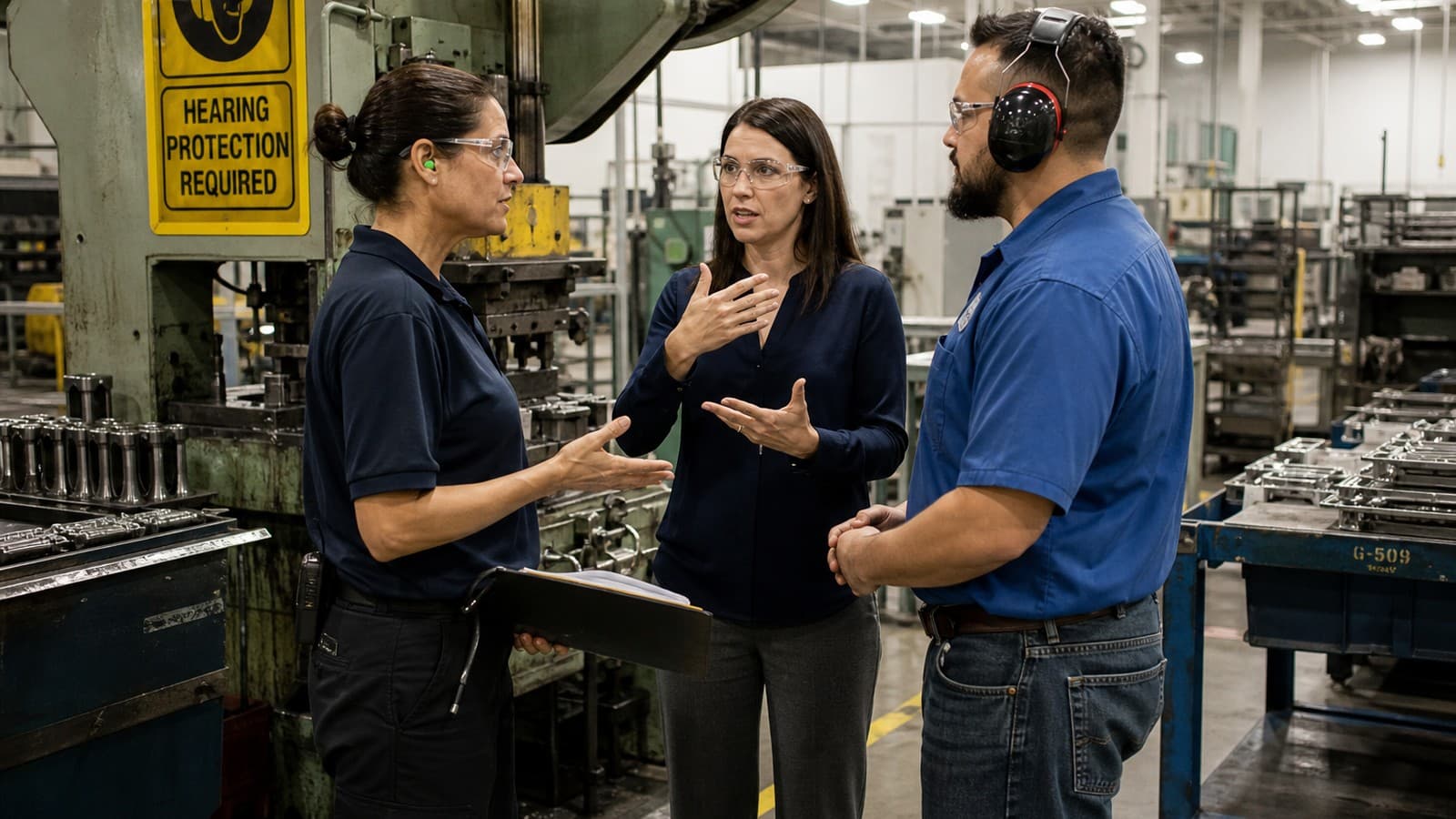
Hearing conservation interpreters Indiana manufacturers rely on do more than translate a safety poster — they make sure a worker actually understands what protects their hearing. OSHA's hearing conservation standard requires employers to make noise safety training understandable to every worker it covers, and a stamping press floor or a food-processing line is exactly where that promise is tested every shift.
Quick summary
- OSHA's hearing conservation standard applies once an employee's noise exposure reaches an 8-hour time-weighted average of 85 decibels, and it requires annual training repeated for as long as that exposure continues.
- The training must cover the effects of noise on hearing, how to select, fit, use, and care for hearing protectors, and what audiometric testing involves and measures.
- A worker who cannot follow fitting instructions for earplugs or earmuffs in a language they understand is unprotected even while wearing the device.
- Audiometric test booths and hearing protector fitting sessions both depend on precise, real-time spoken communication, not a translated handout read later.
- Manufacturers that document the language each training session was conducted in build a defensible record alongside their noise monitoring and audiometric data.
Why hearing conservation interpreters Indiana plants rely on are a compliance and safety issue
Noise-induced hearing loss happens gradually and painlessly, which is part of what makes hearing conservation training so important and so easy to deliver poorly. 29 CFR 1910.95, OSHA's occupational noise exposure standard, requires employers to train every employee exposed at or above an 8-hour time-weighted average of 85 decibels, and to repeat that training annually with content updated to match current protective equipment and work processes. OSHA's noise topic page confirms that hearing conservation programs built around this standard combine monitoring, audiometric testing, hearing protectors, and training into one connected requirement, not a single checklist item.
A training session that technically occurred but was not understood does not satisfy that standard in any meaningful sense — it leaves a worker exposed to a hazard they cannot fully protect themselves against.
Where language gaps put hearing conservation training at risk
Hearing protector fitting instructions are physical and sequential. Rolling and inserting a foam earplug correctly, or adjusting an earmuff's headband tension, depends on a worker following step-by-step spoken instruction in the moment, not reconstructing it later from a translated pamphlet.
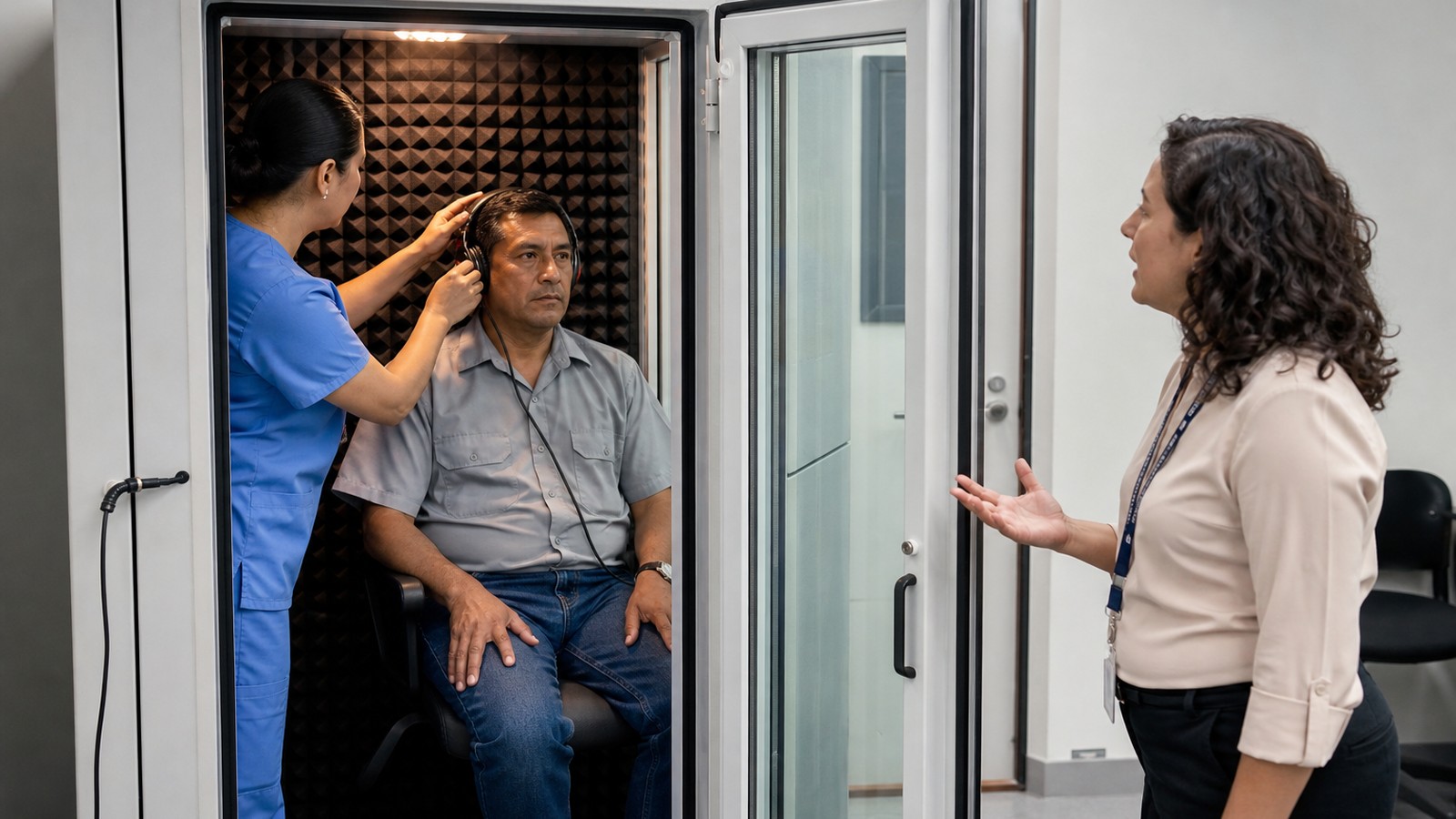
Audiometric test instructions have to be followed precisely to produce a valid result. A worker who does not understand when and how to respond during a hearing test can produce an audiogram that misrepresents their actual hearing status — undermining the entire early-detection purpose of the test.
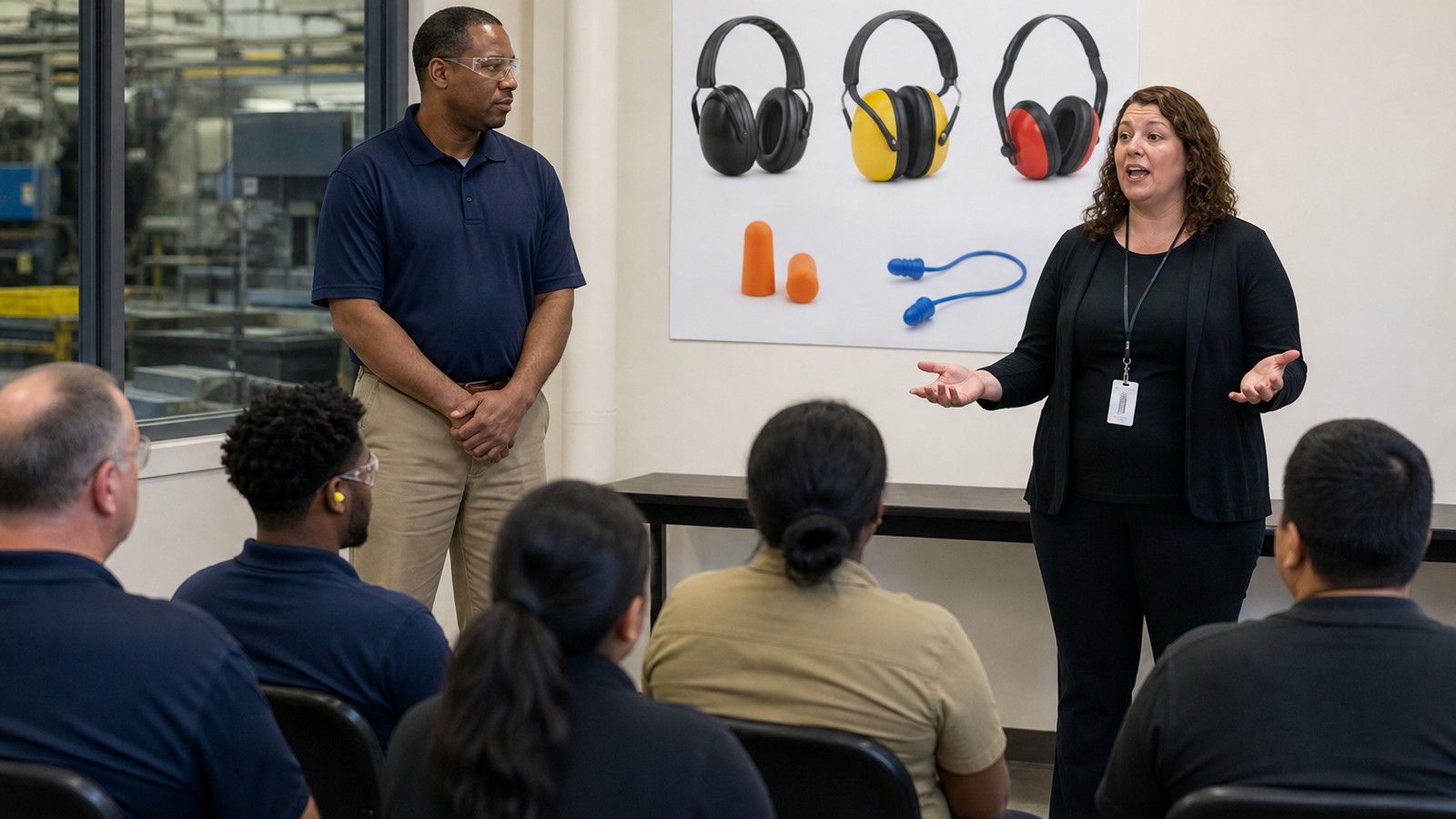
The difference between hearing protector types is technical. Explaining why one earplug or earmuff offers more attenuation than another, and when a worker needs the higher-rated option, requires vocabulary a casual bilingual coworker rarely has on hand.
Noise zone signage and verbal warnings depend on shared understanding in the moment. A worker who cannot read or has not been trained on a facility's hearing-protection-required signage in a language they understand may not realize a zone requires protection until it is too late to matter.
Annual refresher content changes. When a plant updates its hearing protectors or noise-reduction equipment, that updated information has to reach every worker again, in a language they understand, not just the workers who were present for the original rollout.
Building a hearing conservation program that holds up under OSHA review
A hearing conservation program is only as strong as its weakest link — and that link is almost always how training and testing actually reach the floor.
Interpret the full annual training session, not a condensed summary. The effects of noise on hearing, hearing protector selection and fitting, and an explanation of audiometric testing should all be interpreted in full for any employee who is not fully fluent in English, every year the training is repeated.
Staff an interpreter for audiometric testing appointments, not just classroom training. A worker scheduling or undergoing a hearing test benefits from the same language access as a worker sitting in the training room.
Fix core vocabulary once and reuse it. Terms like "decibel," "attenuation," "time-weighted average," and "audiogram" should have one agreed translation that stays consistent across every session and every trainer a worker encounters.
Confirm fitting technique through demonstration, not a nod. Ask a worker to fit their own hearing protector while the interpreter relays feedback in real time — a head nod is not confirmation of understanding.
Interpret posted signage and written materials, too. A worker who followed the spoken training but cannot read a hearing-protection-required sign or a protector's fitting card has not fully closed the gap.
Document the language each training and testing session was conducted in. Recording this alongside noise monitoring and audiometric records gives a plant a defensible paper trail and flags which workers may need additional follow-up.
Hearing conservation interpretation checklist for Tri-State manufacturers
- Identify every worker whose noise exposure reaches the 85-decibel action level and confirm their preferred language before the next training cycle.
- Interpret the full annual session — effects of noise, hearing protector selection and fitting, and audiometric testing — not a condensed version.
- Provide interpreter coverage for audiometric testing appointments, not training sessions alone.
- Fix the exact translation of core terms like decibel, attenuation, time-weighted average, and audiogram, and use it consistently.
- Confirm hearing protector fitting through a supervised demonstration relayed by the interpreter, not a verbal confirmation alone.
- Interpret posted noise-zone signage and hearing protector fitting cards in addition to spoken training.
- Document the language each training and testing session was conducted in alongside monitoring and audiometric records.
- Repeat full interpreted training annually, updated to match any change in hearing protectors or work processes.
This checklist is an operational starting point. Manufacturers should confirm their specific hearing conservation obligations with their own safety and compliance professionals.
Hearing conservation language access for Evansville, Henderson, Louisville, and Jasper manufacturers
Stamping plants, food and beverage manufacturers, and automotive suppliers across the Tri-State region run hearing conservation programs that depend on clear communication — with employees who speak Spanish, Haitian Creole, Marshallese, and other languages alongside English-speaking safety teams. Heartland supports manufacturing facilities with on-site and phone spoken-language interpreting for hearing conservation training, audiometric testing appointments, and annual refreshers, across the languages spoken by workers across Evansville, Henderson, Louisville, Jasper, and Southeast Illinois.
Hearing conservation training sits alongside other OSHA-driven safety programs that depend on precise interpretation. Our guide to electrical safety training interpreters in Indiana covers a closely related compliance obligation, and our overview of lockout/tagout training interpreters in Indiana explains how the same precision applies to machine safety procedures.
Protecting hearing with training workers can actually follow
A hearing conservation program only works as well as the training and testing behind it. Qualified interpretation for noise effects, hearing protector fitting, and audiometric testing — plus a documented language record — gives Tri-State manufacturers a defensible compliance file and gives workers protection they can actually use on the floor.
Need interpreter coverage for hearing conservation training or other OSHA safety programs? Request a quote from Heartland Language and include your site, the languages your workforce speaks most, and whether you need on-site or phone coverage.
Frequently Asked Questions
When does OSHA require hearing conservation training?
Under 29 CFR 1910.95, employers must train each employee whose noise exposure reaches or exceeds an 8-hour time-weighted average of 85 decibels, with that training repeated annually and updated to reflect current protective equipment and work processes.
What has to be covered in hearing conservation training?
The standard requires employees to be informed of the effects of noise on hearing, the purpose, advantages, disadvantages, and attenuation of different hearing protector types along with selection, fitting, use, and care instructions, and the purpose of audiometric testing with an explanation of the test procedure.
Can a bilingual coworker interpret hearing conservation training instead of a professional interpreter?
A bilingual coworker can help informally, but hearing conservation training benefits from a qualified interpreter who can accurately convey technical terms like attenuation, time-weighted average, and audiogram, and who is available for both the classroom session and audiometric testing appointments.
Does hearing conservation training need to be repeated for every employee every year?
Yes. The training program must be repeated annually for each employee included in the hearing conservation program, with content updated whenever protective equipment or work processes change.
About the author
Heartland Language Team
Heartland Language Team shares practical guidance from Heartland Language Services on clear, reliable communication for multilingual workplaces.
Keep reading
Related articles
October 1, 2026
Electrical Safety Training Interpreters Indiana: Arc-Flash Boundary Guide
Arc-flash boundaries and PPE categories are precise numbers, not general caution. This guide shows Tri-State manufacturers how qualified interpreters keep electrical safety training understood by every worker.
Read article →September 25, 2026
Confined Space Entry Interpreters Indiana Manufacturing
A permit-required confined space entry has no room for a missed instruction. This guide shows Tri-State manufacturers how qualified interpreters keep every entry, test, and rescue plan understood.
Read article →October 4, 2026
Diabetes Education Interpreters Indiana: Teaching Chronic Care Across Languages
Diabetes self-management depends on skills patients use alone, without a clinician present. This guide shows how qualified interpreters keep diabetes education understood by every Tri-State patient.
Read article →