
Insights
Confined Space Entry Interpreters Indiana Manufacturing
A permit-required confined space entry has no room for a missed instruction. This guide shows Tri-State manufacturers how qualified interpreters keep every entry, test, and rescue plan understood.
Published September 25, 2026 · By Heartland Language Team
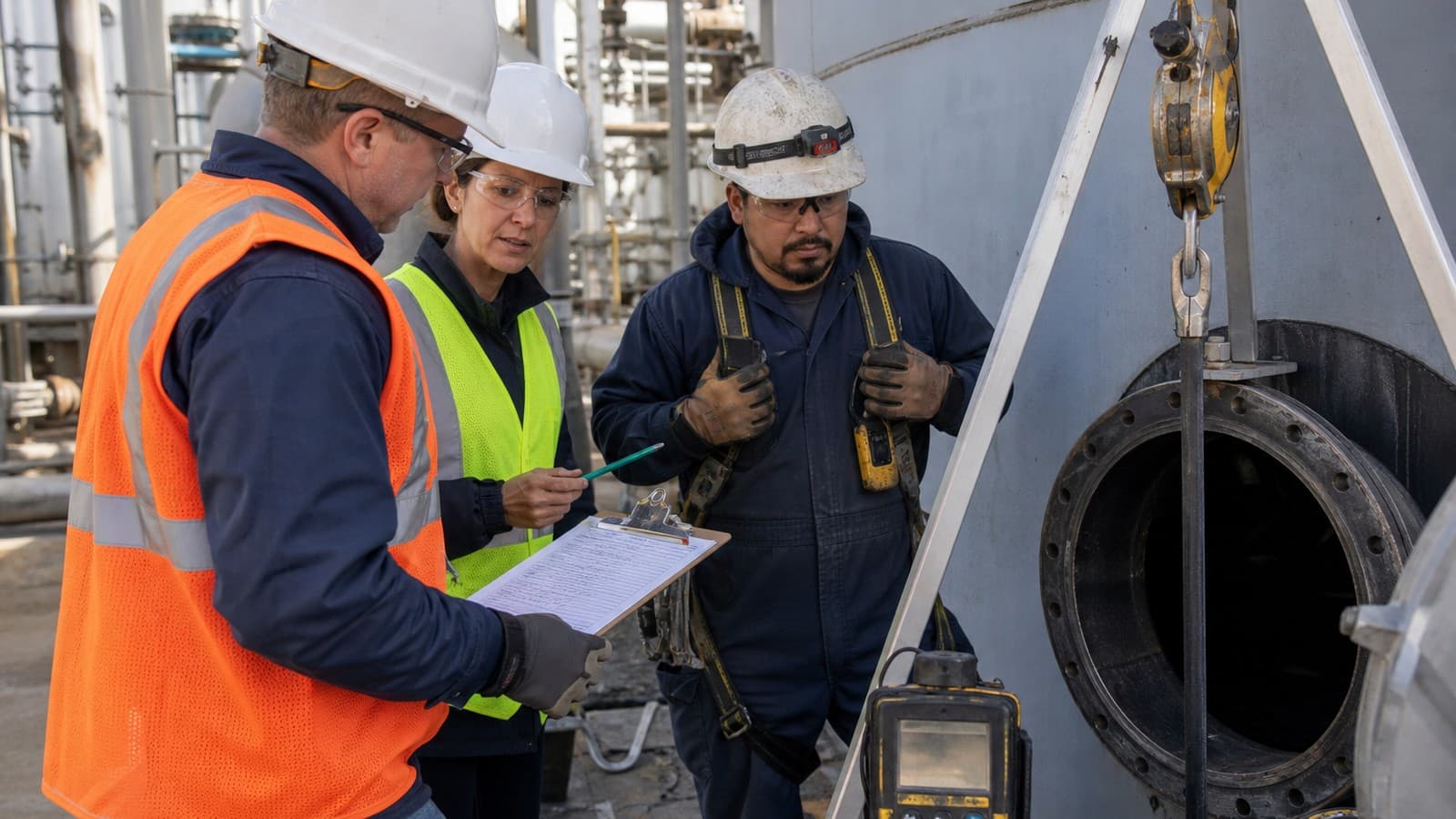
By the Heartland Language Team
A permit-required confined space — a tank, silo, pit, vessel, or process vault — is one of the few places in a manufacturing plant where a misunderstood instruction can kill someone in minutes, not eventually. Confined space entry interpreters Indiana manufacturing plants rely on make sure every entrant, attendant, and entry supervisor understands the same permit, the same air-monitoring readings, and the same rescue plan, in the language they actually think in.
Plants across Evansville and Jasper, Indiana; Henderson and Louisville, Kentucky; and Southeast Illinois run confined space entries every week: tank cleaning, vessel inspection, pit maintenance, and vault work in food, chemical, metal, and plastics manufacturing. Many of those crews include Spanish, Haitian Creole, and Marshallese speakers working alongside English-speaking supervisors and attendants. A permit written in English and a briefing delivered only in English do not protect a worker who cannot fully follow either one.
Quick summary
- A permit-required confined space entry depends on shared, real-time understanding between the entrant, the attendant, and the entry supervisor — not just a signed permit.
- OSHA's confined spaces standard requires atmospheric testing, a written entry permit, a dedicated attendant, and a rescue plan before anyone enters.
- Safety-critical terms — "evacuate," "hot work," "LEL," "standby," "abort" — need to be understood instantly, not translated after the fact.
- A qualified interpreter for the pre-entry briefing is not the same as a bilingual coworker relaying instructions during the entry itself.
- Rescue communication is the part of the program most likely to fail silently if it was never tested in every language on the crew.
Why confined space entry interpreters Indiana manufacturing plants need are a life-safety issue
A permit-required confined space carries hazards that an open work area does not: oxygen deficiency or enrichment, flammable or toxic atmospheres, engulfment in stored material, and physical configurations that can trap a worker. OSHA's confined spaces standard, 29 CFR 1910.146, requires an employer to evaluate the workplace for permit spaces, then control entry through a written permit, atmospheric testing before and during entry, a trained attendant stationed outside, continuous communication between the attendant and entrant, and a rescue plan that does not depend on the attendant entering the space alone. OSHA's confined spaces guidance describes the standard's intent plainly: entry is controlled precisely because the margin for error is so small once someone is inside.
None of those controls work if the entrant does not fully understand the permit conditions, the attendant cannot relay an abort order the entrant will immediately recognize, or the entry supervisor cannot confirm — in a language the crew actually speaks — that atmospheric readings are still acceptable before work resumes after a break.
Where language gaps put confined space crews at risk
The permit conditions never fully translate informally. A permit lists acceptable oxygen and gas ranges, required PPE, and the exact conditions that require evacuation. A verbal, on-the-fly translation from a bilingual coworker during a shift-start rush skips details that matter only if conditions change mid-entry.
Abort signals get misread under pressure. "Evacuate now" needs to land the same way every time, in every language on the crew, whether it is shouted, radioed, or signaled. A worker who hesitates half a second to process an unfamiliar command in a low-oxygen or rising-gas situation has lost time that cannot be recovered.
Atmospheric monitor readings get summarized instead of stated exactly. An attendant who reports "the air's fine" instead of the actual percentages, translated precisely, leaves the entrant with no way to judge the margin for themselves.
Rescue plans are rehearsed in one language only. A non-retrieval rescue plan that has never been walked through with the whole crew, in each crew member's working language, is a plan that exists on paper but has not actually been tested against how the team will communicate under stress.
New or temporary crew members are the most exposed. Contractors and recently hired entrants are less likely to have absorbed plant-specific hazard vocabulary informally, and they are exactly the workers most likely to be assigned routine confined space tasks like tank cleaning.
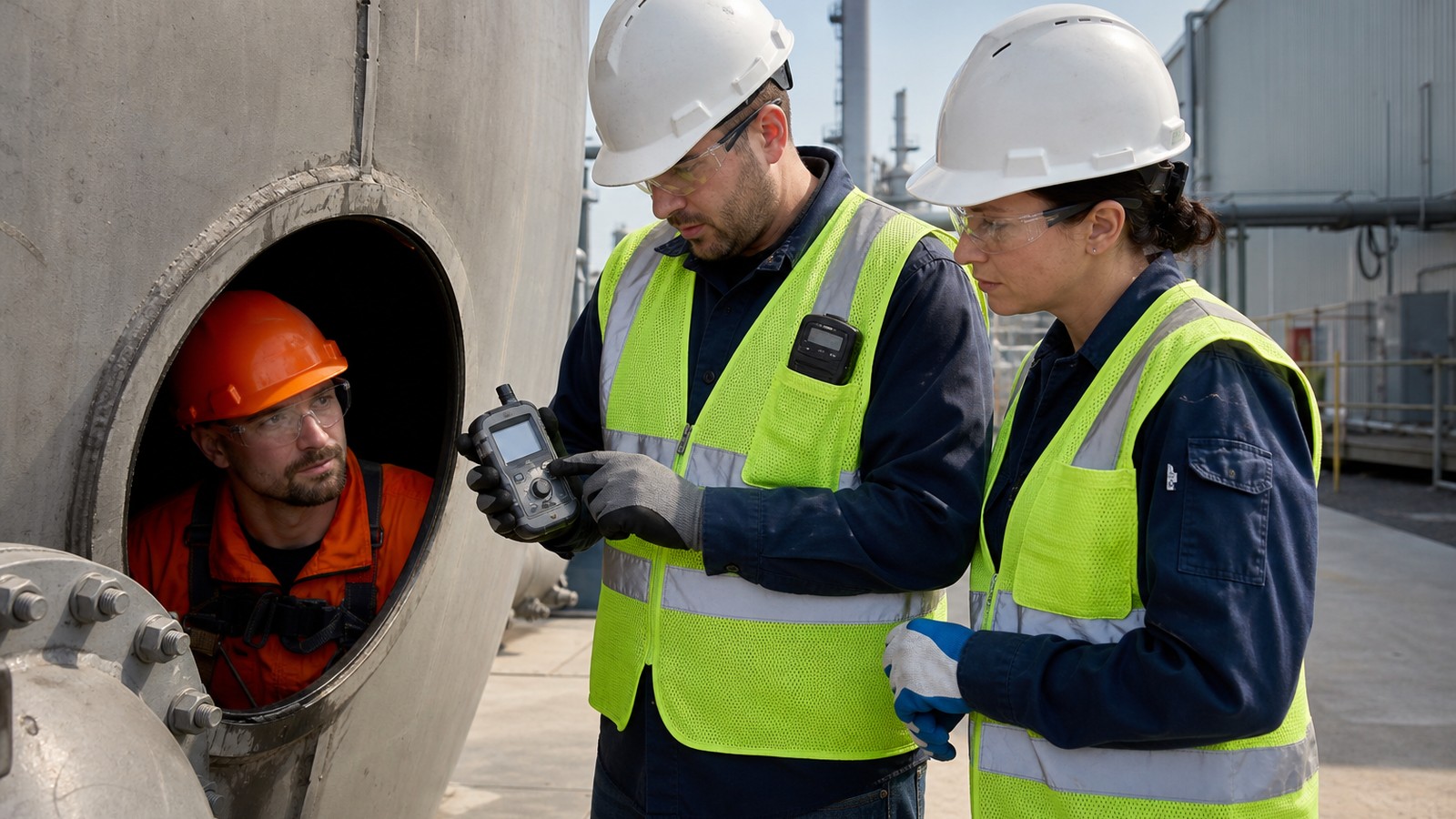
Building a language-inclusive confined space entry program
A strong confined space program treats interpretation as part of the permit system, not an add-on for a single briefing.
Interpret the full pre-entry briefing, not a summary. The entry supervisor should walk every entrant and attendant through the permit, hazards, PPE requirements, and communication plan with a qualified interpreter present, so nothing is condensed or skipped.
Pre-translate the safety-critical vocabulary. "Evacuate," "abort," "standby," "hot work," "LEL," "PPE required," and the plant's specific radio or hand-signal protocol should have a fixed, agreed translation that every crew member has practiced, not one improvised in the moment.
Confirm understanding with teach-back, not a nod. Before the permit is signed, ask each entrant to state back — through the interpreter, in their own words — what the abort signal is and what they will do when they hear it.
Test the rescue plan in every language on the crew. A tabletop or physical rescue drill only proves the plan works if every entrant and attendant has rehearsed it in the language they will actually be thinking in during an emergency.
Keep an interpreter or qualified bilingual resource reachable during the entry. On-site interpreting suits the pre-entry briefing and permit review; a phone or radio-based interpreter line can support real-time questions during longer entries when a dedicated on-site interpreter is not practical for every shift.
Document the language used for the briefing. Recording which language the entrant confirmed understanding in, alongside the signed permit, gives the plant a defensible record and flags where interpreter coverage needs to be scheduled for the next entry.
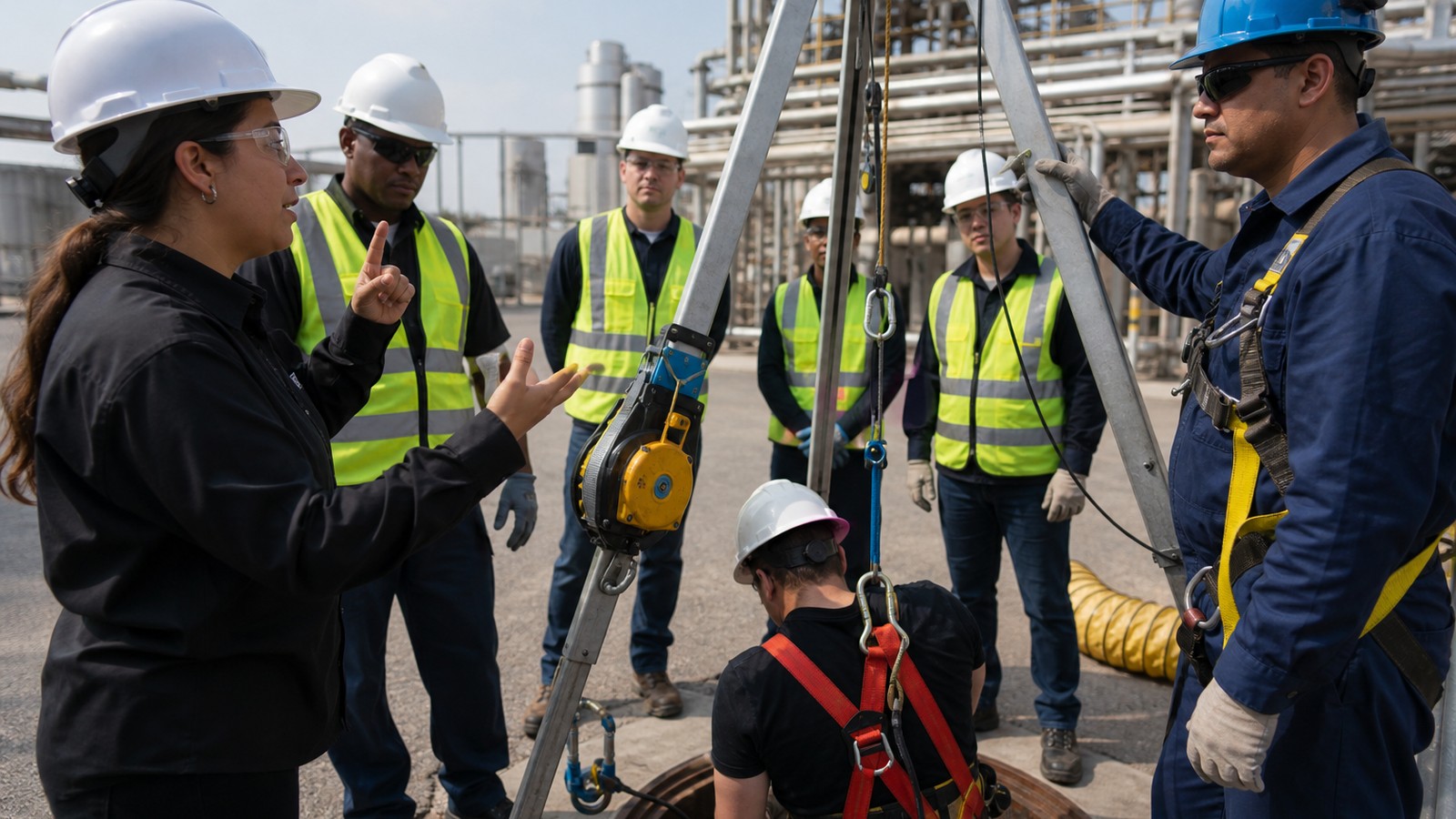
Confined space language-access checklist for Tri-State manufacturers
- Identify every entrant's, attendant's, and entry supervisor's working language before scheduling a permit-required entry.
- Interpret the full permit review and pre-entry briefing — not a summarized version — for any crew member who is not fully fluent in English.
- Fix the exact translation of abort, evacuate, standby, and other safety-critical commands, and drill them with the crew.
- Use teach-back through the interpreter to confirm each entrant understands hazards, PPE, and the abort signal before the permit is signed.
- Rehearse the non-retrieval rescue plan in every language represented on the crew.
- Keep a qualified interpreter reachable — on-site or by phone — for the duration of the entry.
- Document the language each briefing was conducted in alongside the entry permit.
- Review the program after any near-miss, and after any change in crew composition or interpreter vendor.
This checklist is an operational starting point. Manufacturers should confirm their specific OSHA, state, and insurer obligations with their own safety and legal professionals.
Confined space language access for Evansville, Henderson, Louisville, and Jasper manufacturers
Food, chemical, metal, and plastics plants across the Tri-State region schedule confined space entries as routine maintenance, but the hazard is never routine. Heartland supports manufacturing plants with on-site and phone spoken-language interpreting for permit reviews, pre-entry briefings, and rescue drills, across the languages common on Tri-State manufacturing floors.
Confined space entry sits alongside a plant's broader safety-communication program. Our guide to lockout/tagout training interpreters in Indiana covers the related machine energy-control requirement, and our overview of safety data sheet translation for Indiana manufacturers explains how HazCom communication should work for the chemical hazards many confined spaces also involve.
Entries your crew can walk into — and out of — understood
A permit-required confined space entry only stays as controlled as the communication behind it. Qualified interpretation for the permit review, a rehearsed rescue plan in every language on the crew, and documented teach-back give Tri-State manufacturers a defensible program and give every entrant instructions they can act on instantly.
Need interpreter coverage for confined space entries or other high-hazard permit work? Request a quote from Heartland Language and include your site, the languages your crew speaks most, and whether you need on-site or phone coverage during entries.
Frequently Asked Questions
Does OSHA require an interpreter for confined space entry?
OSHA's confined spaces standard, 29 CFR 1910.146, does not name interpretation specifically, but it requires that entrants, attendants, and entry supervisors understand the permit, hazards, and communication procedures before entry. When a crew member is not fully fluent in English, a qualified interpreter is a practical way to meet that understanding requirement and to document it.
Who needs to understand the permit — just the entrant, or the whole crew?
The entrant, the attendant, and the entry supervisor all rely on shared, accurate communication throughout the entry. A language gap with any one of the three — not just the person entering the space — can break down the abort and rescue procedure the whole entry depends on.
Can a bilingual coworker interpret during a confined space entry instead of a professional interpreter?
A bilingual coworker can help day to day, but safety-critical communication during a permit-required entry benefits from a qualified interpreter who is not also performing another safety role, especially for the pre-entry briefing, permit review, and rescue-plan rehearsal, where precision matters more than familiarity.
How often should a confined space rescue plan be tested in multiple languages?
A non-retrieval rescue plan should be rehearsed whenever crew composition changes, after any near-miss, and at a regular interval the plant sets in its written program, with every entrant and attendant — regardless of language — able to demonstrate they understand their role.
About the author
Heartland Language Team
Heartland Language Team shares practical guidance from Heartland Language Services on clear, reliable communication for multilingual workplaces.
Keep reading
Related articles
September 19, 2026
Manufacturing Equipment Training Interpreters Indiana
A new machine only pays off if every operator understood the vendor's commissioning and safety training. This guide helps Tri-State manufacturers get equipment installation and training right in every language on the floor.
Read article →September 16, 2026
Occupational Health Clinic Interpreters Indiana
A pre-employment physical, respirator clearance, or injury visit only counts if the employee actually understood it. This guide helps Tri-State manufacturers get occupational health clinic visits right in every language on the floor.
Read article →September 13, 2026
Forklift Operator Certification Interpreters Indiana
A forklift certification only counts if the operator actually understood it. This guide helps Tri-State manufacturers certify every operator in a language they understand.
Read article →