
Industry expertise · Plastics Manufacturing
Precision communication for a precision industry.
25%
of workplace accidents are caused by language barriers
$176B
annual cost of workplace injuries in the U.S.
$100K+
average cost per preventable language-related incident
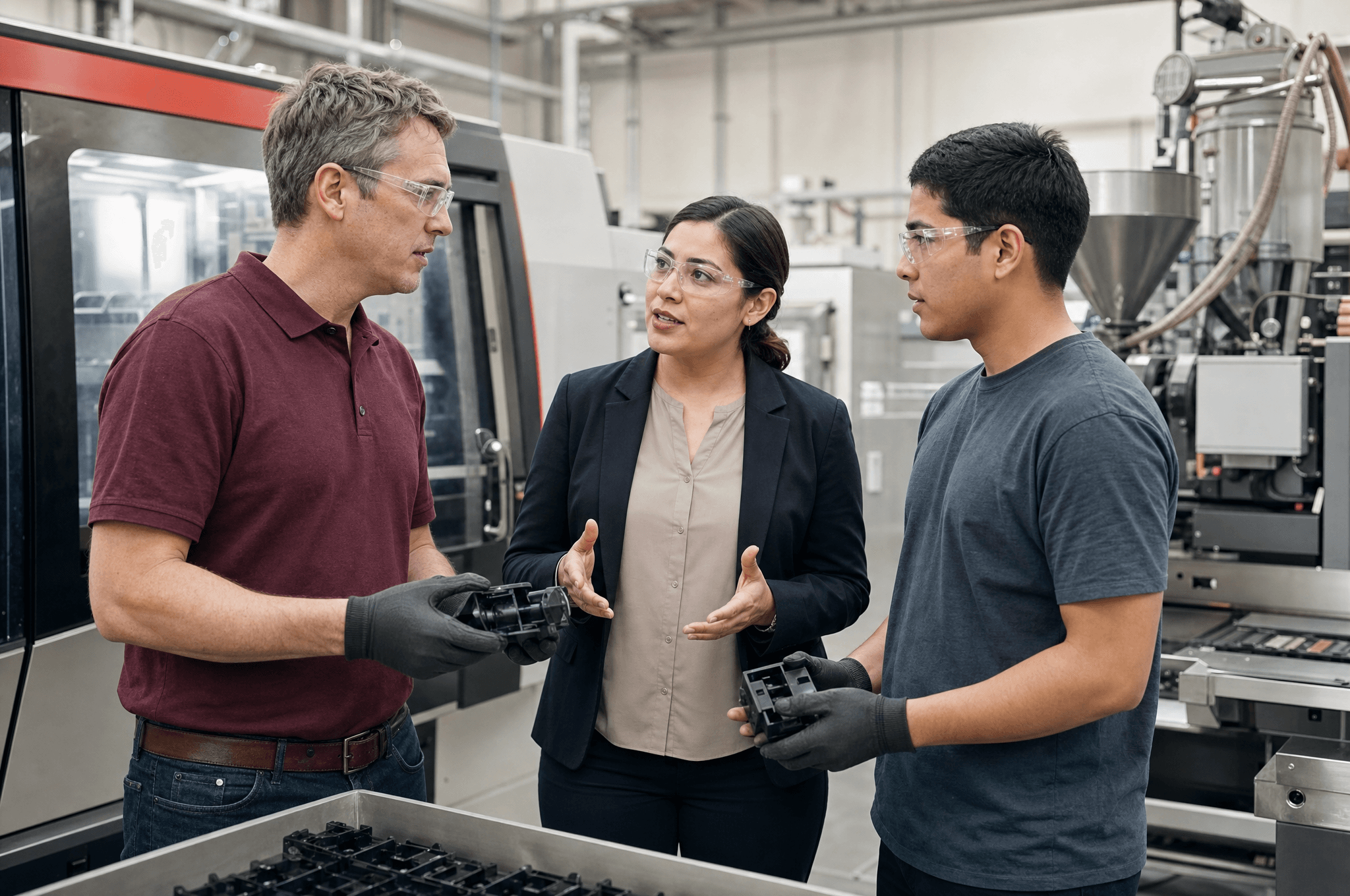
Evansville has long been known as a plastics manufacturing hub — home to major polymer, packaging, and injection molding operations and the suppliers around them. These are fast-moving, tightly-toleranced environments where resin handling, machine setup, and quality specs leave no room for guesswork. As the workforce grows more multilingual, language barriers translate directly into scrap, downtime, and safety exposure.
Industry context
Plastics manufacturing commonly relies on presses, extruders, cutters, conveyors, molds, and maintenance work where machine guarding and clear instruction are central. OSHA’s general requirements for machinery address protecting employees from hazards created by points of operation, rotating parts, and other moving machinery. OSHA interpretation guidance also explains that training must be presented in a manner employees can understand. Practical language access can help employers adapt task instructions, guarding reminders, training materials, and incident-reporting information for multilingual teams. It is a communication aid, not a machine-guarding evaluation, safety program, or legal advice. It does not replace employer-specific assessments, training, or safeguards and cannot by itself establish compliance or guarantee that machinery-related injuries will be avoided.
Where language barriers hit hardest
Machine & thermal hazards
Injection molding presses, extruders, and thermoforming equipment operate at high temperature and pressure. Misunderstood lockout or operating procedures cause severe injuries.
Chemical & resin handling
OSHA HazCom requires workers to understand SDS information for resins, additives, and solvents. Language gaps here are direct compliance violations.
Quality & tolerances
Misread setup sheets, cycle parameters, and QC checklists produce out-of-spec parts, scrap, and customer rejections.
Training & retention
Operators who can't fully access training are slower to onboard, more error-prone, and more likely to leave — driving up turnover costs.
Our language solutions
On-site & on-demand interpreting
- Safety meetings & OSHA training
- Machine setup and changeover briefings
- Shift handoffs & team briefings
- HR & disciplinary meetings
Document translation
- SOPs and work instructions
- SDS for resins, additives, and solvents
- Employee handbooks & HR policies
- Quality documentation and audit materials
Multilingual workforce training
- Plastics industry vocabulary programs
- Bilingual supervisor development
- Safety language programs
- Cross-cultural communication
Why choose Heartland
Built for your environment
Rooted in a plastics town
Heartland is based in Evansville — a city built on polymer and packaging manufacturing. We know the local workforce and the industry's pace.
Industrial-environment interpreters
Vetted, trained, and comfortable on a production floor — with the terminology of molding, extrusion, and quality systems.
Measurable results
Fewer incidents, less scrap, faster onboarding, and better retention — the outcomes our manufacturing clients report.
Compliance note
OSHA's Hazard Communication Standard requires that workers understand chemical hazard information — including the resins, additives, and solvents used across plastics production. Safety training must reach every worker in a language they comprehend. Heartland makes that practical.
Proof from the field
Anchor Industries · Evansville, Indiana
On-site ESL training that became part of onboarding
“Achievement is the word I choose to define our experience with Heartland's ESL program at our company.”
Read the full story →
Frequently asked questions
Do your interpreters know plastics terminology?
Yes — our industrial interpreters are familiar with injection molding, extrusion, thermoforming, and quality system terminology, and we brief them on your specific processes before an assignment.
Can you support round-the-clock shift patterns?
Yes. VRI is available 24/7, and recurring on-site coverage can be planned around 2- and 3-shift patterns, including weekend and night-shift training sessions.
Which languages do Evansville plastics plants need most?
Spanish and Haitian Creole are the most requested in Tri-State plastics facilities, followed by Marshallese and Vietnamese — and we support 350+ languages as your workforce evolves.
Ready to eliminate language barriers?
Contact us for a free consultation about language services for your facility.